Exchange Ranking
 Top Exchanges
 24h Volume Ranking
 Popularity Ranking
 Exchange BTC Balance
 Proof of Reserves
 Decentralized Exchanges
 Funding Rate
 Funding Heatmap
 Liquidation Data
 Max Pain
 Long/Short Ratio
 Whale L/S Ratio
 Binance/Okex/Huobi L/S
 Bitfinex Margin L/S
 ETF Tracker
 Solana ETF
 XRP ETF
 Hong Kong ETF
 Bitcoin Treasuries
 Crypto Reversal
 Ethereum Reserves
 HyperLiquid Wallet Analysis
 Hyperliquid Whale Watch
 Large Transactions
 On-chain Movement
 Bitcoin ROI
 Stablecoin Market Cap
 Options Analysis
 News
 Articles
 Economic Calendar
 Features
 Wallet
 Contract Calculator


 Security
 Collections
 Watchlist
 Following
 ETH
 OG
The undercurrents in the Ethereum market are becoming increasingly intense. While the large investor “BitcoinOG(1011short)” reversed his short position with a stake of 5000 ETH, closing it quickly within 24 hours and making a small profit of over $50,000, on the other side, the company Bitmine is facing a life-or-death crisis—356 million ETH are trapped in unrealized losses, amounting to up to $3 billion. As the price of Ethereum drops below $3,000, this once-thought to be a risky investment has now become a burden on Bitmine’s finances. The flexibility of these large investors, combined with Bitmine’s difficulties, reveals the instability of the current Ethereum market: tight liquidity, fragile emotions—and even minor movements by large positions can trigger new waves of volatility.
I. The Large Investor’s Shift
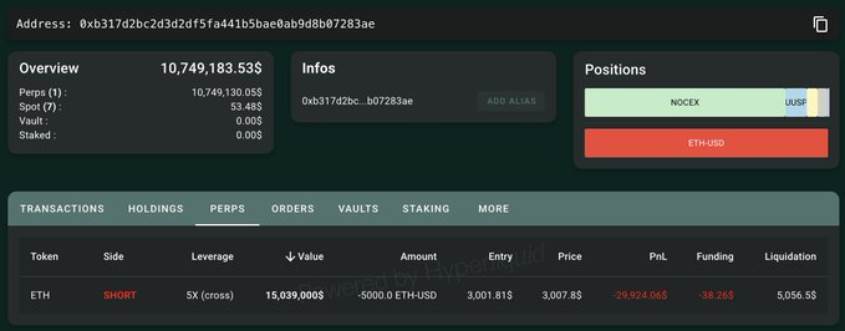
● On November 29th, a large Ethereum investor named “BitcoinOG(1011short)” made a shocking decision to change his strategy. This long-term bullish investor opened a short position with a leverage ratio of 5 times, holding 5000 ETH, with a nominal value of over $15 million. He set a liquidation price of $5056.5 USD.
● However, the dramatic changes in the market didn’t end there. The next day, on November 30th, this large investor suddenly closed this large short position. This transaction resulted in a profit of $54,800, which represents a return rate of only 0.36% compared to its nominal value of $15.04 million.
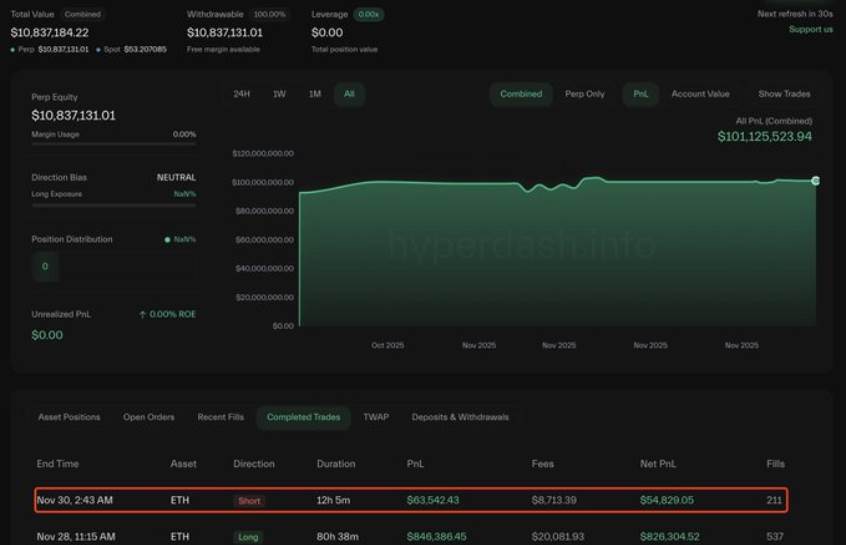
● Analysts noted during their review of this transaction: “The profit from this transaction is extremely small compared to the nominal value, indicating that the decline in Ethereum prices wasn’t as significant as the trader expected. Alternatively, it seems that the position was held for a very short period of time.”
II. Bitmine’s Difficulties
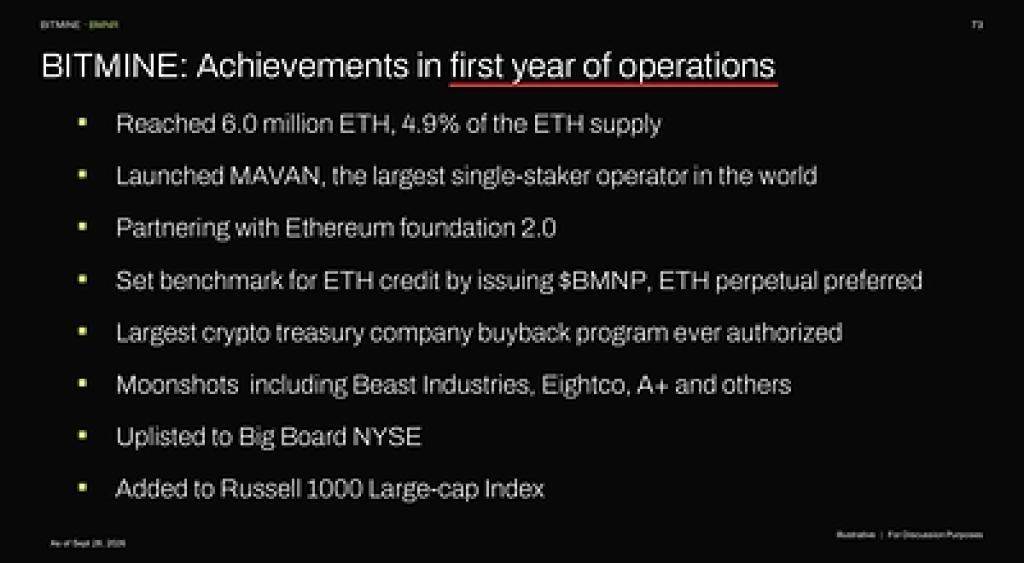
● When the price of Ethereum dropped from over $4,000 to around $3,000, Bitmine’s balance sheet faced significant pressure. The publicly listed company had planned to hold tokens equivalent to 5% of the total supply of Ethereum. So far, it has held 3.56 million ETH, accounting for nearly 3% of the circulating supply.
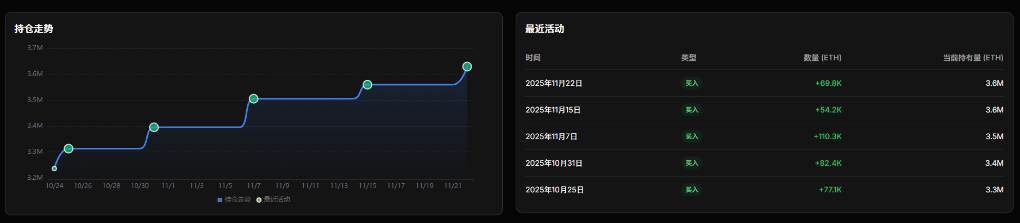
● However, as market conditions worsened, Bitmine’s aggressive strategy began to reveal serious problems. With an average purchase price of $4,009 per share, Bitmine’s book loss has reached nearly $3 billion.
● What’s more concerning is that the company’s cash reserves are only about $607 million, and it has already “invested almost all its cash” in Ethereum acquisitions, leaving it unable to buy more assets at lower prices.
● This has put Bitmine in a situation of “toxic financing”. In one financing event in September 2025, the company was forced to sell 5.22 million shares at $70 per share, along with two options per share.
There’s a saying on Wall Street: Only when the tide recedes do you realize who is really naked. In November 2025, the speed of the tide’s retreat was beyond everyone’s expectations.
III. Market Context
The Ethereum market is experiencing a widespread decline in buying activity. The three main forces that once supported the market—ETFs, government agencies, and on-chain funds—are now completely divided.
● The Digital Assets Treasury company has also entered a phase of differentiation. Currently, the total amount of Ethereum reserves in the treasury industry is 6.2393 million ETH, accounting for 5.15% of the total supply. However, the pace of asset acquisition has significantly slowed down in recent months.
● On the other side of the market, long-term holders (addresses with holdings exceeding 155 days) are selling approximately 45,000 ETH per day, equivalent to about $140 million. This represents the highest level of sales since 2021. Such large-scale selling actions further exacerbate downward pressure on the market.
● At a macro level, the uncertainty surrounding Federal Reserve policies also casts a shadow over the market. Expectations for interest rate cuts in December dropped from 66% to 44%, putting pressure on risk assets.
● On December 1st, the cryptocurrency market experienced a severe downturn. The price of Ethereum fell by 6% to below $2,900. Sean McNulty, head of derivatives trading in the Asia-Pacific region at FalconX, said, “This marks the beginning of a risk-averse trend in December. What’s most concerning is the limited inflows into Bitcoin ETFs and the lack of buyers who take advantage of bargain prices.”
IV. Deep Analysis
Beneath the surface turmoil in the Ethereum market, a deep-seated game of supply control is taking place.
● In 2025, the Ethereum market exhibits two distinct behavioral patterns: on one hand, OG sellers (long-term holders) liquidate their positions, which total more than 100,000 ETH, as prices decline. On the other hand, whales have accumulated an additional 8.01 million ETH since April 2025. On June 12th alone, 871,000 ETH were poured into the market, setting a record for the largest single-day influx of whales that year.
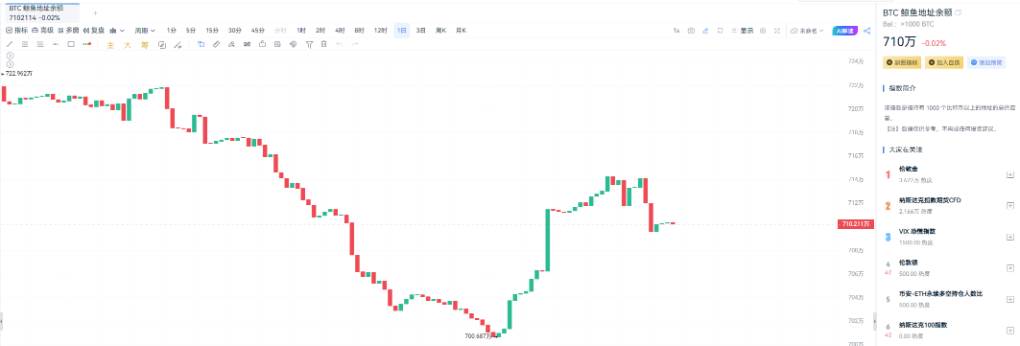
This kind of differentiation has created a situation where supply and demand are in a constant state of tension. This not only brings risks of short-term fluctuations, but also suggests that if institutional buyers can keep Ethereum within the range of $3,000 to $3,400, there may be a turning point.
In this situation, Bitmine’s struggles reflect deeper problems. The company’s stock price has fallen by about 80% since its peak in July, with current market value around $9.2 billion, which is even lower than the $10.6 billion worth of ETH holdings the company has.
The market’s doubts about the company’s value are evident in its mNAV ratio, which has dropped to 0.87. This indicates that market participants are concerned about the company’s net losses and its ability to sustain its operations.
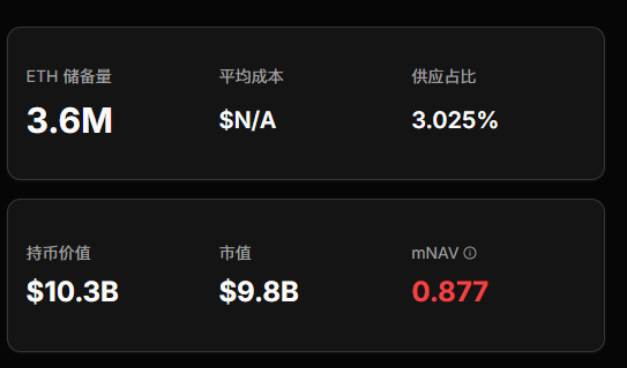
This discount phenomenon is not unique to Bitmine; the entire DAT (Digital Asset Treasury) sector is undergoing structural adjustments. Leading companies can continue to buy into the market due to their financial resources and confidence, while smaller companies face liquidity constraints and debt pressures. The market’s focus is shifting from widespread incremental buying to a few “fighters” who still have capital advantages.
V. Future Outlook
Despite the pessimistic sentiment in the market, there are some potential positive factors that could change the current situation.
The Ethereum Fusaka upgrade, scheduled for December 4th, plans to increase the number of blobs from 9 to 15. This would directly mean that transaction fees on Layer2 will decrease significantly again. Gas fees for mainstream L2 platforms like Arbitrum, Optimism, and Base are expected to drop by 30%-50%, which could stimulate more activity in the Ethereum ecosystem.
● 宏观经济层面同样存在转机。CME FedWatch Tool最新数据显示,12月10日议息会议降息25个基点的概率已飙升至85%,一周前还只有35%。这一概率急剧上升的直接原因是11月PPI数据大幅低于预期,通胀压力继续回落。
● 更令人期待的是,美联储主席人选可能最快在圣诞节前公布,国家经济委员会主任凯文·哈塞特目前大幅领跑。哈塞特是典型的“降息派”+“减税派”,曾多次公开批评鲍威尔加息太狠,主张利率应该大幅低于通胀率。
● 所有这些积极因素并不意味着DAT公司困境的结束。全球领先的指数提供商MSCI已启动咨询,考虑将加密资产在资产负债表中占比超过50%的公司从指数中移除。最终决定将在2026年1月15日公布,这一日期被视为DAT板块的审判日。
市场目光现在聚焦于两个关键日期:12月10日的美联储议息会议,以及2026年1月15日MSCI关于是否将加密资产重仓公司从指数中剔除的最终决定。
这些事件将决定Bitmine等公司的融资能力,也将影响巨鲸们的投资策略。、正如一位市场观察者所言,在这场巨鲸与囤币者的博弈中,真正的考验不在于谁能在牛市中赚得更多,而在于谁能在熊市中活得更久。