Exchange Ranking
 Top Exchanges
 24h Volume Ranking
 Popularity Ranking
 Exchange BTC Balance
 Proof of Reserves
 Decentralized Exchanges
 Funding Rate
 Funding Heatmap
 Liquidation Data
 Max Pain
 Long/Short Ratio
 Whale L/S Ratio
 Binance/Okex/Huobi L/S
 Bitfinex Margin L/S
 ETF Tracker
 Solana ETF
 XRP ETF
 Hong Kong ETF
 Bitcoin Treasuries
 Crypto Reversal
 Ethereum Reserves
 HyperLiquid Wallet Analysis
 Hyperliquid Whale Watch
 Large Transactions
 On-chain Movement
 Bitcoin ROI
 Stablecoin Market Cap
 Options Analysis
 News
News Articles
 Economic Calendar
 Features
 Wallet
 Contract Calculator


 Security
 Collections
 Watchlist
 Following
AI infrastructure faces licensing and grid bottlenecks
According to data quoted by TheStreet, as of September 1, 2026, the S & P 500 index has risen by 11.5% year-to-date, the Nasdaq Composite Index has risen by 12.3%, and the Russell 2000 Index leads the way with a 17.7% increase. Despite a market correction triggered by the war in Iran in March this year and a new round of selling in early September, the index's performance remained strong. This highlights the close correlation between current index performance and market sentiment surrounding the artificial intelligence (AI) infrastructure capital expenditure cycle.
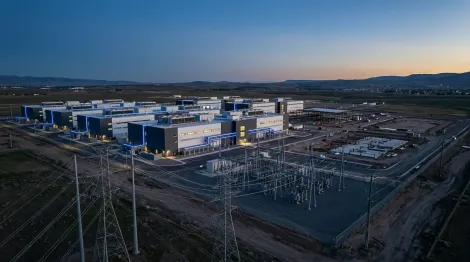
Against this background, Ariana Salvatore, head of U.S. public policy research at Morgan Stanley, told CNBC that investors 'focus has shifted. The question is no longer "whether there is a need for AI computing power", but "whether hyper-scale cloud service providers can obtain licenses, power, and community support quickly enough to turn demand into revenue." According to Reuters, Morgan Stanley expects spending by ultra-large cloud service providers in the United States to reach US$800 billion in 2026 and close to US$1.1 trillion in 2027. The expansion of AI infrastructure construction on this scale means that there is almost no fault tolerance space to withstand long-term execution failures.
AI capital spending resists political pressure
Savatore pointed out that public opposition to data centers has become strong and bipartisan, with politicians from all walks of life responding. She pointed to three specific pressure points that triggered the rebound: rising utility costs, environmental concerns related to water consumption, and quality-of-life disruptions from construction near residential areas.
Crucially, she describes the resistance as local rather than ideologically driven-evident in both Republican and Democratic states. Texas Gov. Greg Abbott and Pennsylvania Gov. Josh Shapiro were cited as examples of increased regulation regardless of party affiliation. Still, Savatore's conclusions are constructive: Morgan Stanley believes the capital spending story is still complete, predicting spending by hyperscale cloud service providers to exceed $1 trillion next year. This view also echoes concerns about whether these expenditures can translate into lasting returns.
Timing delay and geographical dispersion
Savatore distinguishes between "demand destruction" and "demand deferral." Hyperscale cloud service providers are more likely to delay projects in politically sensitive areas and redirect production capacity to states with more energy and water resources and greater public tolerance, rather than simply canceling budgets. Morgan Stanley describes this model as "delayed timing accompanied by geographical dispersion."
There are real physical limitations behind this reorganization. According to PJM Interconnected Grid, data centers can typically be connected to the grid in two to three years, while new power plants can take four to six years to be operational. This misallocation of time permits schedules creates constant pressure, no matter how the political atmosphere changes. A project extension does not eliminate the need for chips, networking, cooling and electrical equipment; it simply pushes those orders back to subsequent quarters.
At present, the evidence at the state level is clearly visible. Texas Gov. Abbott has ordered an audit of data center projects seeking ERCOT (Texas Electric Reliability Commission) grid connections to be reviewed before approval. Utility Dive reports that ERCOT is evaluating a proposed load of 474 gigawatts (GW), more than five times the state's historical peak demand. Pennsylvania has removed AI data centers from its fast-track approval channel and now requires locally approved, developer-funded energy infrastructure and water-saving measures. According to Reuters, New York State has also suspended licensing approvals for facilities 50 megawatts and above due to nearly 12 gigawatts of queuing demand. As licensing frictions force some developers to move to alternative capital structures, financing mechanisms directly linked to GPU-backed infrastructure loans are becoming one of the main capital injections to bypass these bottlenecks.
Execution risk and stock picking strategy
Morgan Stanley's framework distinguishes demand risk (which they believe is largely intact) from execution risk (which they believe is rising). Longer licensing cycles, higher energy costs, and community benefit requirements may compress project returns, and the damage is concentrated mainly on the most leveraged operators rather than evenly distributed across the AI sector.
The company defines its "high exposure" category as companies with profitable platforms, contract backlogs, pricing power, diversified customer bases and strong balance sheets enough to absorb delays. The "low-exposure" category includes highly leveraged developers, speculative utilities, and suppliers whose forecasts assume that all planned campuses will open on time-an assumption that is increasingly challenged with current licensing and power grid realities.
Due to the influence of position concentration, the risk of stock selection is further amplified. According to Yahoo Finance, in the three years to the beginning of 2026, the S & P 500 index rose 76%, while the index excluding AI-related stocks rose only 32%. The breadth of the gap means that any widespread disruption to data center construction will spill over beyond chip makers, especially if it coincides with other geopolitical pressures on AI-related stocks.
Impact of deferred risk on portfolios
Morgan Stanley's message is constructive, but with conditions: Political resistance will not eliminate computing power needs, but will increase the cost and time consuming of transforming hyper-scale cloud service providers 'capital expenditures into operational capabilities. Project postponements can steer equipment sales into subsequent quarters rather than completely stifling demand; geographical dispersion tends to redistribute winners among utilities, developers, and infrastructure providers rather than concentrating losses.
For investors, the practical lesson is to bias exposure weights towards companies with contract backlogs, pricing power, customer diversity and balance sheet strength, while viewing high leverage and assumptions about projects being completed on time as warning signs rather than benchmark situations. Morgan Stanley's comments are not accompanied by any target price or valuation range, and the analysis here does not replace personalized investment advice-it reminds us that the investment logic for AI infrastructure and the timetable for AI infrastructure are no longer the same deal.