Exchange Ranking
 Top Exchanges
 24h Volume Ranking
 Popularity Ranking
 Exchange BTC Balance
 Proof of Reserves
 Decentralized Exchanges
 Funding Rate
 Funding Heatmap
 Liquidation Data
 Max Pain
 Long/Short Ratio
 Whale L/S Ratio
 Binance/Okex/Huobi L/S
 Bitfinex Margin L/S
 ETF Tracker
 Solana ETF
 XRP ETF
 Hong Kong ETF
 Bitcoin Treasuries
 Crypto Reversal
 Ethereum Reserves
 HyperLiquid Wallet Analysis
 Hyperliquid Whale Watch
 Large Transactions
 On-chain Movement
 Bitcoin ROI
 Stablecoin Market Cap
 Options Analysis
 News
News Articles
 Economic Calendar
 Features
 Wallet
 Contract Calculator


 Security
 Collections
 Watchlist
 Following
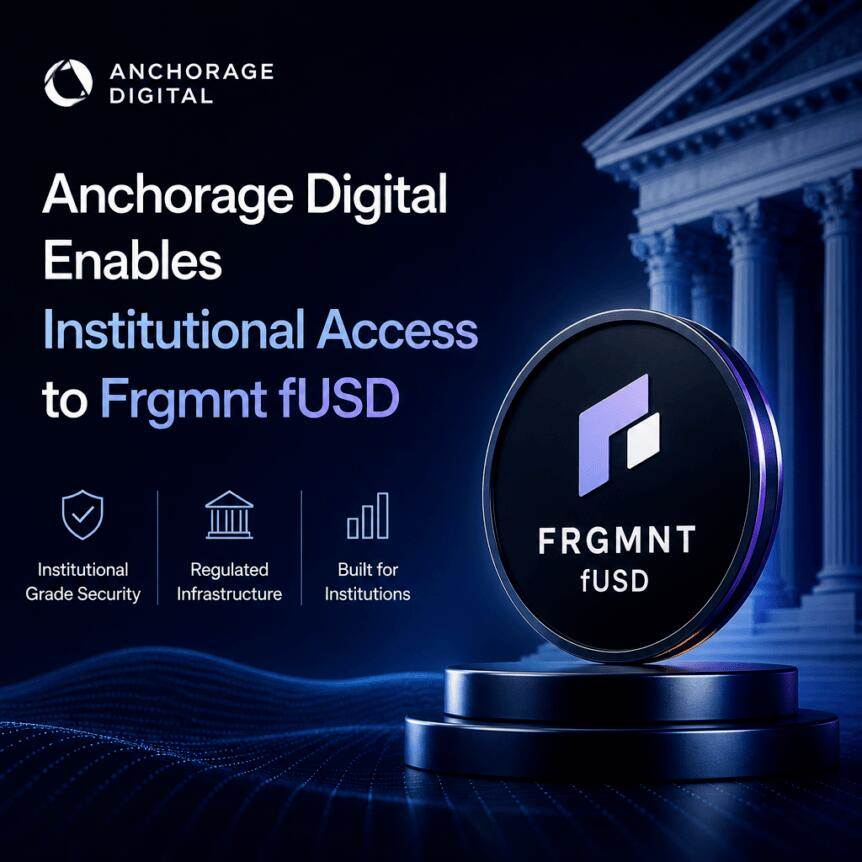
Anchorage Digital has partnered with Frgmnt to provide institutions with hosting services for fUSD and interest-bearing version of sfUSD.
Anchorage Digital has partnered with the stablecoin agreement Frgmnt to expand institutional customers 'access to fUSD and its interest-bearing version of sfUSD through Anchorage's regulated hosting platform. According to an announcement released by Frgmnt on Friday, the new integration aims to allow qualified customers to hold, deposit and redeem fUSD directly on the platform, and pledge or unpledge operations without establishing additional custody infrastructure.
The significance of this cooperation is not only to broaden the scope of stablecoin services provided by Anchorage, but also because Frgmnt's token structure links earnings to proactive lending strategies. For agencies, this move reduces operational friction around custody while maintaining established compliance work processes.
Core Points
- Anchorage Digital will provide institutional customers with escrow access to Frgmnt fUSD (cast/redemption) and sfUSD (pledge/unpledge) through its platform.
- Frgmnt issues fUSD with USDC as collateral on the Base chain and deploys the collateral in the on-chain lending market.
- According to DeFiLlama data, the Frgmnt agreement is currently in a limited and invitation-only testing phase, with a total lock-in value (TVL) of approximately US$100,000.
- Frgmnt said that as of September 4, sfUSD's annual yield (APR) was 13.32%, while noting that yields will fluctuate with changes in underlying lending conditions.
- Frgmnt plans to open public access and increase deposit limits on September 15, which could boost interest among institutions before that date.
Anqiqi-Impact of sharding integration on institutions
Under the framework of this cooperation, institutional customers using Anchorage's hosting infrastructure can manage Frgmnt's stablecoin products directly in Anchorage's environment. The announcement describes support for its core lifecycle operations: holding tokens, minting and redemption fUSD, and acquiring sfUSD by pledging or unpledging fUSD.
From an operational perspective, the main advantage is the avoidance of separate custody arrangements. For regulated companies and large-value allocators, custody is often a limiting factor when adding new tokenized products-especially those involving pledge mechanisms-because each additional channel may introduce new compliance, settlement, and control requirements.
Frgmnt's model also embeds policy-based benefits into the interest-bearing wrapper. The agreement does not treat the pledge as a purely token native reward, but rather links the reward to the performance of the borrowing position deployed by the fUSD collateral.
Operation mechanism of fUSD and sfUSD in the Frgmnt system
Frgmnt is positioned as a stablecoin protocol built on Base. It issues fUSD with USDC as collateral and deploys the collateral in the on-chain lending market. This setting is critical because it explains why sfUSD pledges not only reflect agreement parameters, but also the changing conditions in the lending ecosystem.
The protocol is designed to include a pledge mechanism: users can pledge fUSD to earn sfUSD and earn rewards generated by Frgmnt's underlying strategy. Frgmnt said that as of September 4, sfUSD's annual yield was 13.32%; however, the agreement also emphasized that yields will change as borrowing conditions change.
Frgmnt's current stage of growth is reflected in its access model. DeFiLlama data shows that the total lock-in value of the agreement is about $100,000, and Frgmnt is running a limited and invitation-only beta version. These restrictions suggest that the integration occurred while the agreement was still in the stage of extended distribution and liquidity rather than operating with fully open capabilities.
Timing: Currently an invitation-only beta version, open for public access on September 15
In addition to its partnership with Anchorage, Frgmnt also outlined a timetable for plans to open public access on September 15 and increase the deposit cap. This timeline can be important for institutional adoption, as token access and deposit limits often determine whether large allocators can expand positions.
While Anchorage's integration is immediately applicable to managed workflows, the agreement's invitation-only structure suggests that not all interested institutions can immediately deploy large amounts of capital. Still, having Anchorage support can reduce set-up delays at the beginning of public visits, allowing companies to move faster as deposit capacity expands.
Investors and finance teams may also need to focus on how sfUSD yields transition from a limited beta version to a wider accessibility-especially given that Frgmnt itself points out that annual yields depend on the conditions of the individual lending markets used to support the system.
Anchorage advances towards regulated stablecoins and pledge infrastructure
The latest partnership is in line with a broader model: Anchorage Digital is positioning itself as a regulated "gateway" for institutional stablecoin exposure and pledge related services. The integration of Frgmnt adds another native pledge process based on stablecoins to its existing capabilities.
Anchorage's stablecoin participation is not limited to custody. In January, Tether chose Anchorage Digital Bank to issue USAT, a U.S. -focused stablecoin described as operating under the GENIUS Act. This move puts Anchorage on the issuing side of the stablecoin market, rather than just the custody level.
In addition to issuance, Anchorage is also committed to infrastructure construction for U.S. dollar-related activities. These include a collaboration in May where Grupo Salinas Group in Mexico partnered with Anchorage to support blockchain-based dollar transfers, cross-border settlements and financial activities through its digital assets subsidiary Coinpro. The goal of these cooperating companies seems to be the same: to bring stablecoin functions closer to institutions 'financial and settlement needs within a regulated framework.
In terms of pledge, Anchorage has also expanded its institutional-level pledge products across different chains and reward mechanisms. Early integrations cited in the announcement include a connection with Marinade Finance in April for the Solana pledge strategy, and an expansion in July to include native pledges for TRX.
The underlying theme for market participants is that stablecoins are becoming more than just a "hold and settle" tool. Increasingly, they are packaged as revenue-generating structures-often achieved through on-chain borrowing-and institutions want these functions to be delivered through custody controls they trust.
Readers should focus on two points next: whether Frgmnt's September 15 public visit and limit increase have materially changed TVL growth, and how sfUSD pledge yields will evolve after broader visits begin, given that the agreement clearly relies on underlying lending market conditions.