Exchange Ranking
 Top Exchanges
 24h Volume Ranking
 Popularity Ranking
 Exchange BTC Balance
 Proof of Reserves
 Decentralized Exchanges
 Funding Rate
 Funding Heatmap
 Liquidation Data
 Max Pain
 Long/Short Ratio
 Whale L/S Ratio
 Binance/Okex/Huobi L/S
 Bitfinex Margin L/S
 ETF Tracker
 Solana ETF
 XRP ETF
 Hong Kong ETF
 Bitcoin Treasuries
 Crypto Reversal
 Ethereum Reserves
 HyperLiquid Wallet Analysis
 Hyperliquid Whale Watch
 Large Transactions
 On-chain Movement
 Bitcoin ROI
 Stablecoin Market Cap
 Options Analysis
 News
 Articles
 Economic Calendar
 Features
 Wallet
 Contract Calculator


 Security
 Collections
 Watchlist
 Following
 BTC
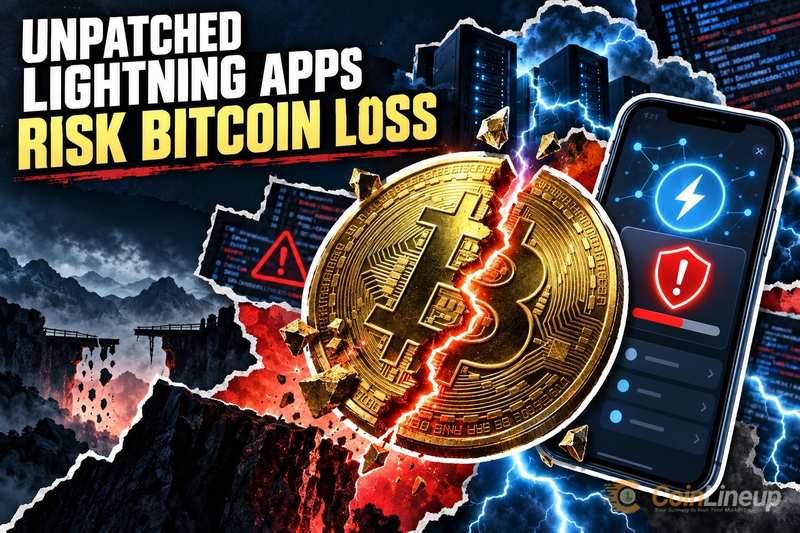
Unpatched Bitcoin Lightning Network apps are at risk of theft of funds
In Bitcoin Lightning Network apps that have not yet been fixed, a malicious channel peer may steal funds simply by reconnecting and sending false information about the channel status. Users of outdated Lightning software built on the Lightning Development Kit (LDK) are at risk, a flaw that affects the widely used open source toolkit that many wallet developers rely on.
Why unpatched Lightning Network apps are at risk of Bitcoin losses
The Bitcoin Lightning Network is a payment system built on top of Bitcoin. It allows both parties to open a shared payment channel to send bitcoins between each other quickly and inexpensively without having to record every transaction on the main Bitcoin blockchain.
Each channel holds a balance, and each party maintains a local record to track the amount of Bitcoin controlled by each party. The vulnerability affects applications that use LDK (Lightning Dev Kit). LDK is a software toolkit widely used to build wallets and services that support the Lightning Network.
In unpatched LDK applications, malicious counterparts may lie about the channel's balance history after reconnecting. Vulnerable applications may accept such false claims and mistakenly update their own records, potentially allowing attackers to claim to have more bitcoins than they actually hold in the channel.
Key Points
- Applications built on the Lightning Development Kit (LDK) but not patched have vulnerabilities that could lead to Bitcoin losses.
- This risk is triggered when a malicious channel peer disconnects and then reconnects and sends false status information.
- Users should update the Lightning web application to the latest security patch version before opening or using the channel.
- This is not a flaw in Bitcoin itself or the core design of the Lightning Network, but a mistake in a specific software implementation. It can be likened to a software vulnerability in a bank's online platform, which has nothing to do with the bank's actual financial rules. Applications built with unupdated LDK are still vulnerable.
- This is not the first time that Lightning Network implementation requires an emergency security patch. Earlier this year, Eclair fixed another Lightning Network flaw that could have caused channel balances to be redirected to miners rather than intended recipients.
How to reconnect a malicious channel peer
In the Lightning Network, both parties must be online and connected to send payments through their shared channel. When one party goes offline and comes back online, the two parties exchange messages to confirm the current status of the channel, and then resume activity.
This reconnect handshake process is where the vulnerability lies. A dishonest peer can send manipulated messages during the reconnection, claiming to favor its own channel status. According to relevant reports, unpatched applications may fail to detect inconsistencies when handling these false news.
This key distinction is important: the defect describes a reported risk rather than a confirmed series of theft incidents. There is currently no publicly recorded evidence that the vulnerability has been actively exploited. However, known and unpatched vulnerabilities mean that any user who has not updated still faces a potential exploit window.
Crypto-wallet security events are not theoretical assumptions. The breach of a single wallet can lead to a complete loss of funds, and vulnerabilities in payment software are one of the most high-profile attack surfaces in the industry.
What Lightning Internet users should take now
If you use a Bitcoin Lightning Internet wallet or app, the most important step is to check if your app has been recently updated. Application developers built on LDK should release patched versions; end users should update through the same channels as they are used for any software update, whether it is an app store or a direct download.
Avoid opening new lightning network channels in unpatched applications or routing payments through existing channels. If you are not sure whether your application has been affected, please check the developer's official release notes or security bulletins directly.
For anyone running their own Lightning network node, check the Rust-Lightning Security Guide to confirm which versions have been patched and follow the upgrade path recommended by the maintainer. Maintaining the same update focus on any application that manages private keys or channel funds is critical, because even a mobile application's chain of vulnerabilities can expose encrypted data and private information on devices that users believe are safe.