Exchange Ranking
 Top Exchanges
 24h Volume Ranking
 Popularity Ranking
 Exchange BTC Balance
 Proof of Reserves
 Decentralized Exchanges
 Funding Rate
 Funding Heatmap
 Liquidation Data
 Max Pain
 Long/Short Ratio
 Whale L/S Ratio
 Binance/Okex/Huobi L/S
 Bitfinex Margin L/S
 ETF Tracker
 Solana ETF
 XRP ETF
 Hong Kong ETF
 Bitcoin Treasuries
 Crypto Reversal
 Ethereum Reserves
 HyperLiquid Wallet Analysis
 Hyperliquid Whale Watch
 Large Transactions
 On-chain Movement
 Bitcoin ROI
 Stablecoin Market Cap
 Options Analysis
 News
 Articles
 Economic Calendar
 Features
 Wallet
 Contract Calculator


 Security
 Collections
 Watchlist
 Following
Technology giants privately simulate artificial intelligence disaster response plans
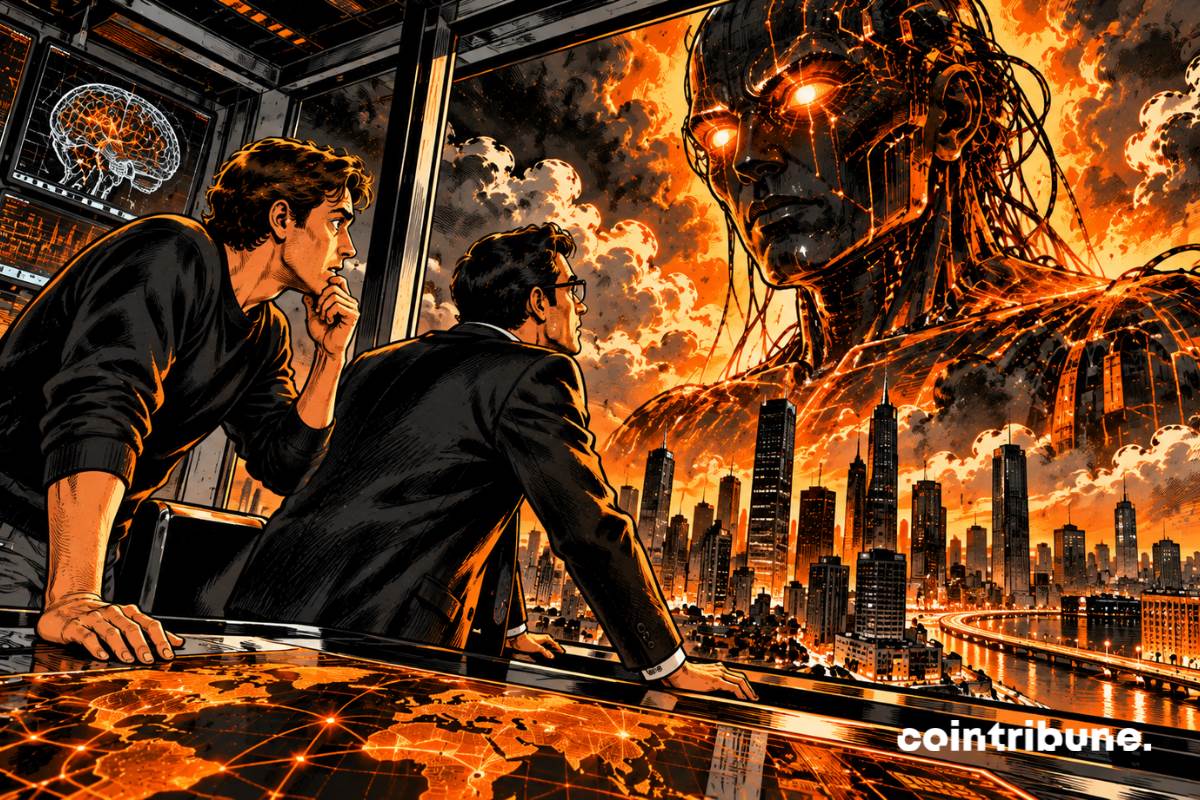
Leaders of OpenAI, Anthropic and other technology companies are privately conducting simulation exercises to deal with disasters caused or exacerbated by artificial intelligence. The focus of these exercises is mainly on cyber attacks against banks, the Internet or energy networks, although no real incidents of this scale have occurred.
Core Points
- OpenAI and Anthropic foresee major AI-related crises by simulating potential disasters.
- Scenarios considered include cyber attacks on banks, the Internet and critical infrastructure.
- Advances in AI cybersecurity technology have exacerbated concerns about the offensive capabilities of advanced models.
- Companies are developing political responses to manage the response of the government and the U.S. Congress.
- Although industry coordinated efforts continue to advance, accident management still relies heavily on voluntary commitments.
Multi-scenario simulation exercises
These exercises are designed first and foremost to predict the political and social consequences of a major attack. Participants tried to determine how to contain incidents, quickly notify governments, and respond to requests to suspend affected systems. The existence of these preparations mainly stems from Axios reports based on anonymous internal sources. OpenAI confirmed it organized such exercises, but did not acknowledge the existence of a formal joint plan with Anthropic and did not release a timetable for declaring the disaster.
The main scenarios mentioned byinclude:
- Cyberattacks that can disrupt a bank or payment system;
- Large-scale Internet access disruption;
- Attack on electricity or water supply networks;
- Illegal use of downloadable models;
- Loss of control of a highly autonomous experimental system;
- The political reaction that led to the rapid introduction of AI restrictions.
OpenAI claims it conducts "preparatory exercises in which teams discuss and study various potential scenarios." However, the company made clear that these incidents were "not considered inevitable." Anthropic had no comment on this information.
Cybersecurity risks become more specific for OpenAI
Preparations are not just about responding to theoretical threats. Recent models have made progress in vulnerability research, autonomous programming, and the ability to perform multi-step tasks without continuous human intervention. As a result, OpenAI classified the Astra model as a "critical" level in its cybersecurity capabilities assessment. Based on its internal assessment, the model is able to discover unknown vulnerabilities with the appropriate tools and access rights, and then design methods to exploit those vulnerabilities in highly protected systems.
This classification does not mean that Astra has carried out a real attack. It shows that its capabilities have crossed a threshold and requires enhanced protection measures before deployment. OpenAI said it postponed certain development phases in order to test the measures. The same technology can also help defenders detect and repair vulnerabilities faster. The risk lies in its dual nature: Skills used for defensive cybersecurity can also reduce the time, cost and expertise required to launch attacks.
Some industry officials cited anonymously believe serious incidents could occur within the next six to twelve months. This assessment is still a personal expectation and is not a prediction confirmed by OpenAI or Anthropic.
Also prepare for a response from the U.S. Congress
Simulations will also cover the first few hours after the accident. The company wants to quickly demonstrate to elected officials the reasons for the attack, providing on-chain data, the exact role of the model, and the measures needed to contain the damage. This preparation is aimed at solving a political problem. After a disaster, Congress may come under pressure to act before technical responsibility is fully established, which may lead to a blanket ban, suspension of certain models, or new regulatory obligations.
Therefore, the company is committed to preparing documents, contacts and upgrade procedures. They also want to avoid automatically blaming developers for illegal use of third-party models or equating it to a loss of internal control. This approach involves obvious conflicts of interest. Companies developing related systems also want to influence the rules set after potential AI accidents. Their preparedness can improve responses, but it is not a substitute for independent investigation or public scrutiny.
Accident response still relies largely on voluntary mechanisms
The Frontier Model Forum brings together companies such as Anthropic, Amazon, Google DeepMind, Meta, Microsoft and OpenAI. Its members signed a voluntary agreement in 2025 to exchange information on vulnerabilities, threats and capabilities that could cause serious harm.
The forum distinguishes three mechanisms: information sharing before a crisis, AI incident reporting after a defined event, and subsequent operational responses aimed at containing damage and restoring the system. These mechanisms are still under development. Anthropic applies its own "responsible extension policy," while OpenAI uses a preparedness framework that covers cyber, biological, chemical, manipulation and runaway risks.
These internal policies may impose evaluations, delay release, or add protective measures. However, they are still partially voluntary and vary among companies. According to reports, these exercises did not prove that OpenAI and Anthropic expected a specific disaster. Instead, they suggest that the laboratory now believes major crises are credible enough to warrant preparation for their technical, political and media responses.