Exchange Ranking
 Top Exchanges
 24h Volume Ranking
 Popularity Ranking
 Exchange BTC Balance
 Proof of Reserves
 Decentralized Exchanges
 Funding Rate
 Funding Heatmap
 Liquidation Data
 Max Pain
 Long/Short Ratio
 Whale L/S Ratio
 Binance/Okex/Huobi L/S
 Bitfinex Margin L/S
 ETF Tracker
 Solana ETF
 XRP ETF
 Hong Kong ETF
 Bitcoin Treasuries
 Crypto Reversal
 Ethereum Reserves
 HyperLiquid Wallet Analysis
 Hyperliquid Whale Watch
 Large Transactions
 On-chain Movement
 Bitcoin ROI
 Stablecoin Market Cap
 Options Analysis
 News
 Articles
 Economic Calendar
 Features
 Wallet
 Contract Calculator


 Security
 Collections
 Watchlist
 Following
 BTC
Bitcoin is under pressure from rising U.S. dollar yields, and analyst Benjamin Cowen is waiting for a crucial turning point for the market. According to Cohen's analysis, the yield on 10-year U.S. Treasury bonds may peak before mid-November, and a possible decline later will provide breathing space for risky assets such as Bitcoin.
Why might the 10-year Treasury yield peak before November?
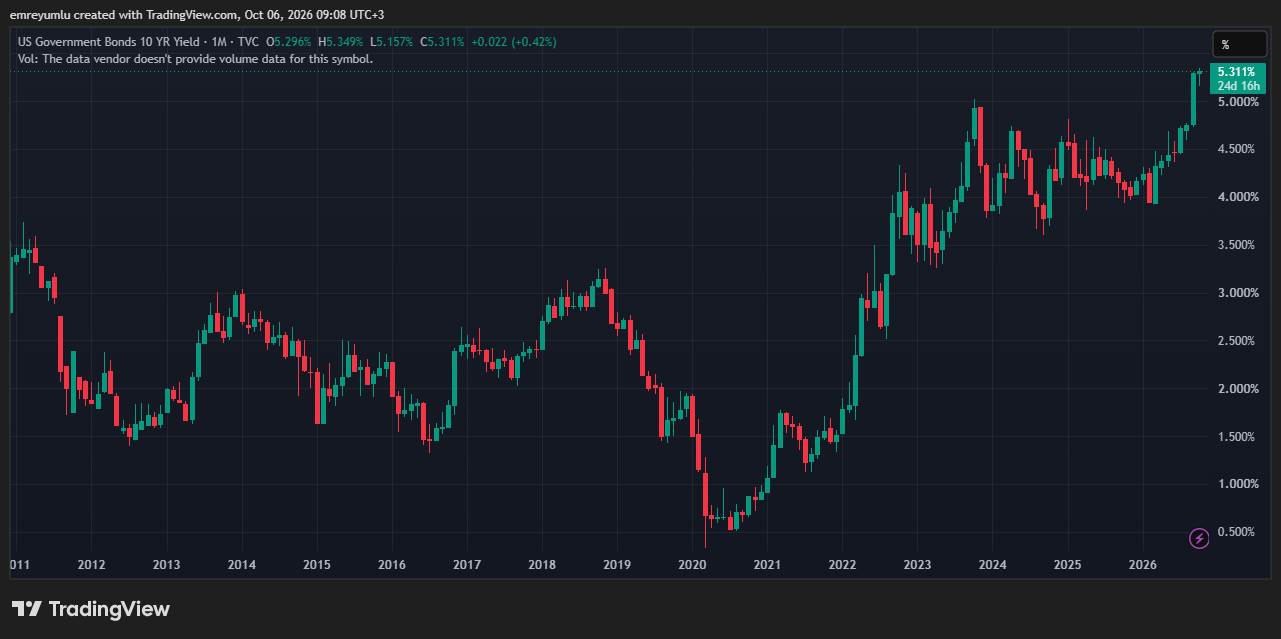
The 10-year bond yield hit 5.342% on October 1, setting a record since early 2002. The development shows just how much pressure is on bond markets after the Federal Reserve raised interest rates in September.
Benjamin Cohen believes that past market cycles have shown similar temporal patterns. Especially during the two U.S. midterm elections in 2018 and 2022, the yield on the 10-year Treasury bond peaked between early October and mid-November. In both periods, yields fell back between mid-November and December. Cohen acknowledged that there is no guarantee that this pattern will be fully repeated in the past, but believes the current situation could open the door to similar scenarios.
Previously, Cohen had regarded 5% as an important target for government bond yields. As yields break through that level, Cohen pointed out that a new peak in the 5.4% to 5.6% range is still possible.
What is the market pricing ahead of the Fed meeting?
According to Cohen's analysis, the peak of market concerns may occur around the Federal Reserve's October 28 meeting. However, it is worth noting that the probability of a rate hike in October plummeted from 64% to 17.7% in a week.
At first glance, a decline in the probability of raising interest rates seems to be beneficial to risky assets. But Cohen believes that behind the push for the rise in government bond yields, there are also bond investors 'concerns that the Federal Reserve's monetary policy is not tight enough.
The Federal Reserve may cite weak personal consumption expenditure (PCE) inflation data and a slowing labor market to delay interest rate hikes. The U.S. economy added only 29,000 jobs in September, a weak data that makes future interest rate decisions particularly important.
How will inflation data affect Bitcoin prices?
According to Cohen's analysis, poor inflation data may trigger the last wave of selling in the bond market. If this follows a fall in two-year Treasury yields, the need for the Fed to raise rates further could weaken.
Analysts expect government bond yields to begin to fall back around mid-November. This time point coincides with the mid-term elections in the United States.
For Bitcoin, this scenario is significant because changes in interest rates and government bond yields will directly affect investors 'risk appetite. The decline in yields may be one of the factors contributing to the short-term easing of the cryptocurrency market.
If bond interest rates fall, will Bitcoin rise?
科恩在评论中并未直接给出比特币的价格目标,而是侧重于债券利率变化对整体风险资产的影响。尽管如此,近期比特币的走势确实与国债收益率密切相关。
上周,比特币在与接近24年高位的国债收益率的博弈中挣扎。随后,随着疲软就业数据的公布,比特币迅速上涨。根据CoinGlass数据,数据公布后一小时内,约有2,750万美元的空头头寸被清算。
然而,潜在的利率宽松并不一定能持续。科恩认为,在未来10到20年的时期内,长期利率总体上将继续上升。因此,短期的国债收益率下降可能无法彻底消除对比特币等不产生固定收益的数字资产的压力。
本内容不构成任何投资建议。市场包含高风险,在做出投资决策之前,请务必进行独立研究。