Exchange Ranking
 Top Exchanges
 24h Volume Ranking
 Popularity Ranking
 Exchange BTC Balance
 Proof of Reserves
 Decentralized Exchanges
 Funding Rate
 Funding Heatmap
 Liquidation Data
 Max Pain
 Long/Short Ratio
 Whale L/S Ratio
 Binance/Okex/Huobi L/S
 Bitfinex Margin L/S
 ETF Tracker
 Solana ETF
 XRP ETF
 Hong Kong ETF
 Bitcoin Treasuries
 Crypto Reversal
 Ethereum Reserves
 HyperLiquid Wallet Analysis
 Hyperliquid Whale Watch
 Large Transactions
 On-chain Movement
 Bitcoin ROI
 Stablecoin Market Cap
 Options Analysis
 News
 Articles
 Economic Calendar
 Features
 Wallet
 Contract Calculator


 Security
 Collections
 Watchlist
 Following
 ETH
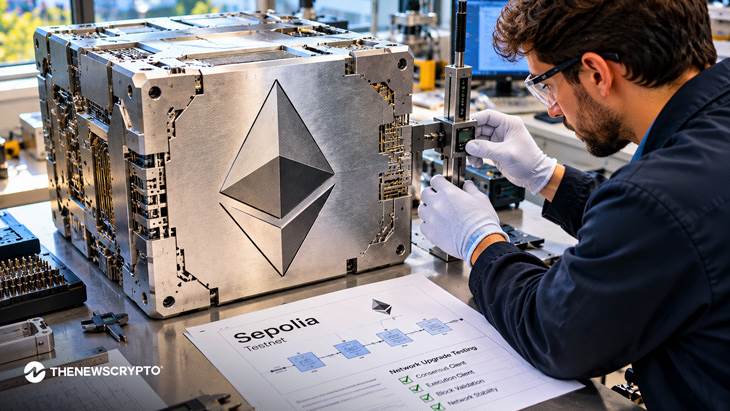
Ethereum will activate the Glamstam upgrade on the Sepolia Test Network to conduct a 200 million Gas Limit Test
Ethereum will activate the "Glamstam" upgrade on the Sepolia Test Network today to conduct a stress test with a 200 million Gas Limit. This upgrade introduces the "Institutional Proponder-Builder Separation"(ePBS) and block-level access lists (BALS) to optimize Ethereum's block production and verification efficiency.
Technical details of Glamsburg upgrade and Prysm update
As the Glamsburg upgrade enters the next testing phase, Ethereum is preparing to test the 200 million Gas cap on the Sepolia Test Network. This latest change stems from the release of Prysm v7.2.1 by Offchain Labs on October 5. This version adds Sepolia's Gas limit scheduling mechanism and sets 200 million as the default Gas limit for validators after the Gloas fork.
The new Prysm release also changes the way data columns are processed, enabling some data column functions by default. Under this change, nodes can propagate individual cells individually rather than entire data columns. In addition, Prysm has added configuration options for the Gloas builder, including builder URL, minimum bid, and builder bid timeout settings.
The 200 million Gas setting is more than three times the previous 60 million Gas configuration of Sepolia. Prysm's latest release notes state that the new schedule will take effect in the 353, 024th era, which matches the Sepolia configuration released for the Gloas fork. Verifiers using Prysm v7.2.1 do not need to manually set the 200 million limit, although operators can still select other limits through proposer settings or the Keymanager API.
Glamstam landed in Sepolia today: Analysis of core changes
Ethereum's Glamstam upgrade is scheduled to be activated on Sepolia on October 6 at 13:53:36 UTC, corresponding to the 353, 024th era and the 11, 296, 768th time slot. The upgrade combines changes at the execution level in Amsterdam with changes at the Gloas consensus level.
Its core changes include institutionalized proposer-builder separation (ePBS) and block-level access lists (BALS). BALS are designed to record the accounts and storage locations visited in a chunk, allowing clients to perform more state reading and transaction verification work in parallel. Glamestead has also adjusted Gas billing rules for state creation, state access, invoked data and access lists.
It should be emphasized that this 200 million Gas test is limited to the Sepolia test network and has not set a new Gas limit for the Ethereum main network. The Ethereum Foundation has not announced an activation date for Hoodi testnet or mainnet.
Analysis of Market Trends and ETH Price Trend
At the same time, according to CoinMarketCap data, ETH is currently trading at approximately US$2,714, with a market value of approximately US$331 billion, and a 24-hour trading volume of more than US$10.2 billion. In the past 24 hours, ETH has fallen by about 0.8%.
Historical data shows that ETH closed at US$2,710.42 on October 5. Previously, ETH reached a recent high of $2,785 on September 23. From a short-term price perspective,$2,700 is a key observation level. Recent market analysis shows resistance in the $2,780 -2,800 range. If it breaks through US$2,800, it will clear the recent resistance area; if it breaks below US$2,650, it may turn attention to the US$2,570 -2,470 area.