Exchange Ranking
 Top Exchanges
 24h Volume Ranking
 Popularity Ranking
 Exchange BTC Balance
 Proof of Reserves
 Decentralized Exchanges
 Funding Rate
 Funding Heatmap
 Liquidation Data
 Max Pain
 Long/Short Ratio
 Whale L/S Ratio
 Binance/Okex/Huobi L/S
 Bitfinex Margin L/S
 ETF Tracker
 Solana ETF
 XRP ETF
 Hong Kong ETF
 Bitcoin Treasuries
 Crypto Reversal
 Ethereum Reserves
 HyperLiquid Wallet Analysis
 Hyperliquid Whale Watch
 Large Transactions
 On-chain Movement
 Bitcoin ROI
 Stablecoin Market Cap
 Options Analysis
 News
 Articles
 Economic Calendar
 Features
 Wallet
 Contract Calculator


 Security
 Collections
 Watchlist
 Following
 BTC
 ETH
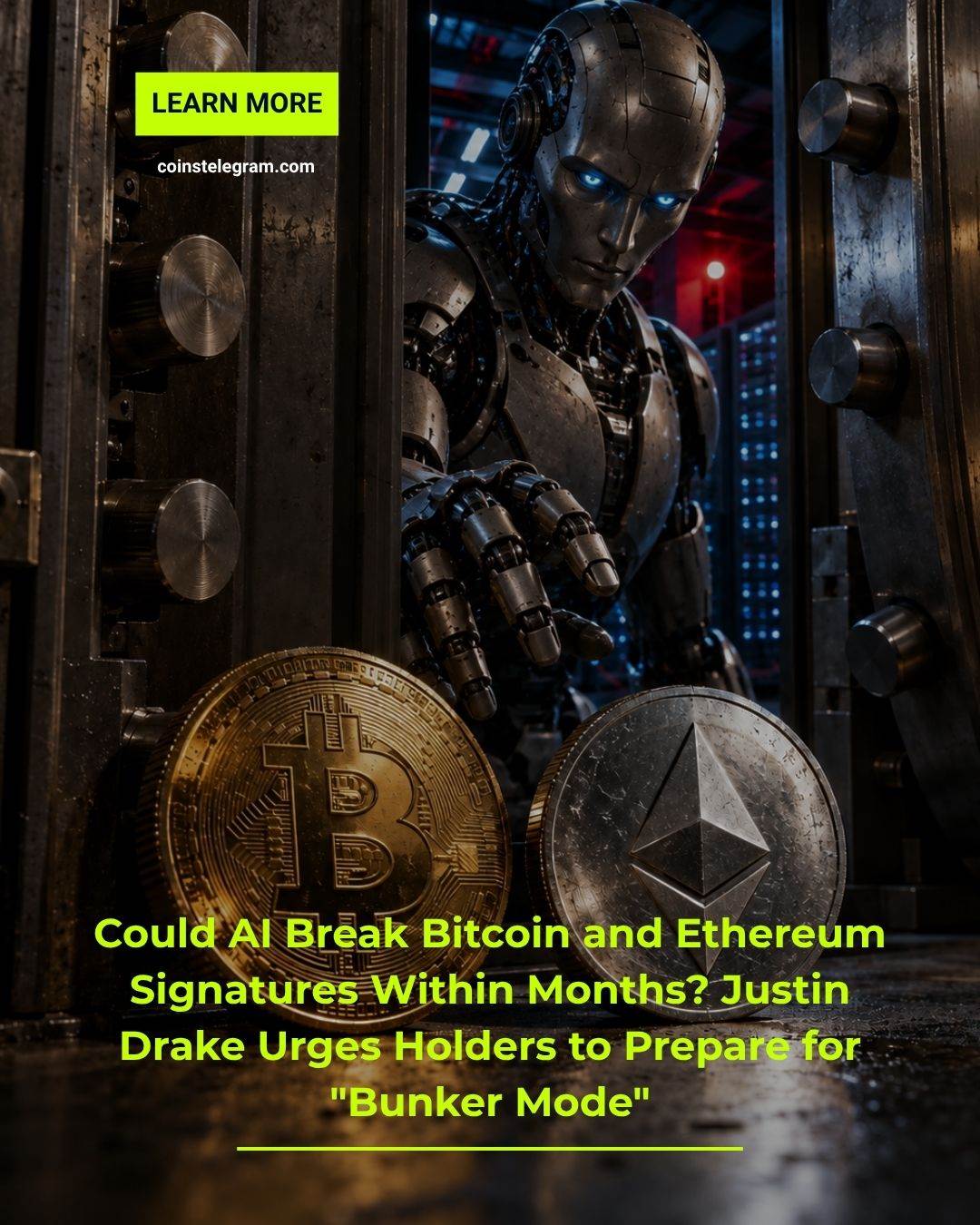
Justin Drake, a researcher at the Ethereum Foundation, warns that AI may crack the signature scheme of Bitcoin and Ethereum wallets faster than quantum computers.
Justin Drake, a researcher at the Ethereum Foundation, issued a warning that artificial intelligence may crack the signature scheme that protects Bitcoin and Ethereum wallets before quantum computers do. In the worst case, this process may only take months. No one has successfully cracked the plan, and Drake said there is no need to panic, but he believes that large holders should start making plans from now on.
Drake's View
On October 7, Drake issued this warning on the X platform. He called on the industry to calmly start preparing for a "bunker mode": the orderly transfer of funds to addresses where transactions have never been signed.
His specific recommendations are as follows:
Holders, especially large and professional holders, should consider moving most of their funds to addresses where transactions have never been signed. When they first sign the transaction, the remaining funds should also be transferred to a new address (which can be generated from the same mnemonic).
He emphasized that the process should not be rushed: "Don't rush to action. While I believe action is necessary, the harm of a hasty relocation may outweigh the benefits. Also, don't panic." He described the step as a simple and preventive measure that "does not require new cryptographic technology or a new wallet."
Analysis of risk technical principles
比特币和以太坊使用一种名为 ECDSA(椭圆曲线数字签名算法)的签名方案来证明交易由私钥所有者授权。当用户发送资金时,钱包会对交易进行签名,而该签名会将用户的公钥暴露给网络。理论上,如果有人能够从公钥逆向推导出私钥,便有可能清空钱包。
德雷克将“被破解”定义为在现有硬件(如大型 GPU 集群)上约一周内恢复私钥的能力。他认为最坏的情况是这种情况将在“Q日”(即量子计算机强大到足以打破当前加密技术的时刻)到来前的“几个月而非几年”内发生。
为何他认为 AI 是触发点
德雷克指出,近期数学领域出现了一系列令人惊讶的事件。他表示,长期持有的假设已被推翻,包括整数乘法的 n log(n) 界限以及 3SUM 猜想。他还引用了五月对埃尔德什单位距离猜想(Erdős unit distance conjecture)的反驳作为“我们的预警信号”。
The latest trigger is OpenAI's release on October 6 of 722 mathematical results generated from internal models. Drake said this clearly showed that "mathematical superintelligence has arrived." He believes that elliptic curves look particularly fragile because they have a rich mathematical structure, and the hash function is designed to minimize this structure. He also pointed out that efficient quantum algorithms can sometimes be a precursor to efficient classical algorithms, so a classical counterpart to Shor's algorithm may exist.
What exactly is the actual evidence?
Need to be precise here. The OpenAI release did not report any attacks on ECDSA or RSA, and neither Drake nor Vitalik Buterin pointed to evidence that ECDSA had actually been cracked. Drake himself noticed that among the 722 results, the proportion of cryptographic breakthroughs was extremely low. His warning was a risk assessment of trends in AI mathematics, rather than a report of cracking incidents that have occurred.
Views of Other Notables
Vitalik Buterin responded that caution should be exercised. He said no one should scramble funds immediately and highlighted the risk of asset loss due to hasty relocation. He agreed that AI-accelerated mathematical research deserves serious attention, pointing out that most plans are based on the assumption that "the elliptic curve is broken, the hash is safe, and the lattice is safe."
He added a complication: The actual safety of lattice-based solutions, including ML-DSA, could be severely impacted by AI mathematical research in the next two years. Like Drake, Buterin is more optimistic about hash-based cryptography. Drake believes that safely exiting "bunker mode" will require "post-AI cryptography." Earlier this year, the Ethereum Foundation established a dedicated quantum-resistant team, and Buterin has also outlined plans to transition the network to quantum-resistant cryptography.
Drake also suggested that major custodians like Binance, Bitbank, Robinhood, Bitfinex and Tether could use the moment to strengthen the security of their cold wallets.
Why cryptocurrency users feel anxious
Fear mainly stems from the following three points:
- Irreversibility: The theft of the private key means that the funds are stolen and the blockchain transaction cannot be revoked.
- Effect of scale: ECDSA protects both Bitcoin and Ethereum accounts. Once cracked, the scope of impact will not be limited to a single project.
- Key exposure: Project Eleven's Bitcoin "Risq List" tracks more than 14 million addresses where public keys have been exposed, which are the most risky in the scenarios described by Drake.
How to protect yourself
According to Drake's instructions:
- Give preference to new addresses: Funds deposited in addresses that have never signed transactions, whose public keys are hidden behind hashes, are not exposed.
- Avoid address reuse: Once an address signs a transaction, the remaining balance should be transferred to a new address. The address can be derived from the same mnemonic.
- Start with large balances: Drake recommends that large and professional holders take the lead.
- Migration with caution: As Drake and Buterin emphasize, mistakes in the hasty transfer process pose a greater risk in the near term than the threat itself.
Future Outlook
Currently, nothing has been cracked. Drake's call was aimed at establishing a calm and orderly plan in case the worst situation forces people to respond hastily. Pay close attention to further statements from the Ethereum Foundation's anti-quantum team, wallet providers and exchanges on how to handle address migration, as well as any real cryptanalysis results, which will immediately change the nature of this debate.