Exchange Ranking
 Top Exchanges
 24h Volume Ranking
 Popularity Ranking
 Exchange BTC Balance
 Proof of Reserves
 Decentralized Exchanges
 Funding Rate
 Funding Heatmap
 Liquidation Data
 Max Pain
 Long/Short Ratio
 Whale L/S Ratio
 Binance/Okex/Huobi L/S
 Bitfinex Margin L/S
 ETF Tracker
 Solana ETF
 XRP ETF
 Hong Kong ETF
 Bitcoin Treasuries
 Crypto Reversal
 Ethereum Reserves
 HyperLiquid Wallet Analysis
 Hyperliquid Whale Watch
 Large Transactions
 On-chain Movement
 Bitcoin ROI
 Stablecoin Market Cap
 Options Analysis
 News
 Articles
 Economic Calendar
 Features
 Wallet
 Contract Calculator


 Security
 Collections
 Watchlist
 Following
 BTC
Since the halving of Bitcoin in 2024, the Bitcoin mining industry has faced significantly tougher operating conditions. The halving is a core mechanism designed into the Bitcoin currency system—it reduces the block reward every four years, thereby maintaining Bitcoin’s long-term scarcity. While this halving has enhanced Bitcoin’s economic resilience, it also results in a sudden significant reduction in miners’ income, putting them under direct pressure. According to TheMinerMag, by 2025, this will lead to “the most challenging profit environment ever seen,” with plummeting income and soaring debt being major challenges. Even miners who have substantial cash reserves and sufficient funds from publicly traded Bitcoin companies find it difficult to remain profitable through traditional mining operations. To cope with these difficulties, many miners are shifting towards other data-intensive industries, aiming to stabilize their income and reduce their dependence on the price of computing power alone. Among these opportunities, artificial intelligence and high-performance computing (HPC) are particularly important. These fields have seen rapid development since the end of 2022, as the demand for computing power continues to rise. Bitcoin miners have a unique advantage in these markets, as their mines are equipped with large-scale power and cooling infrastructure that can be utilized for purposes beyond SHA-256 hashing.
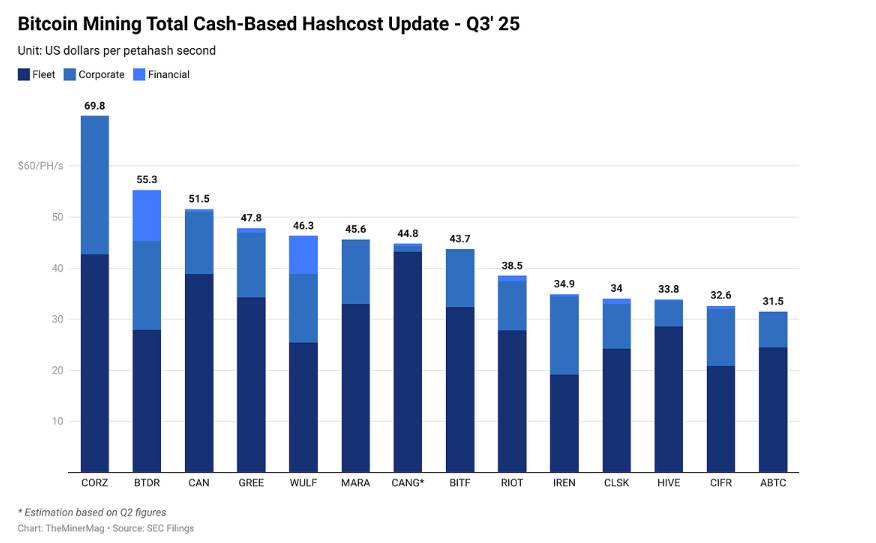
Average cost of Bitcoin mining for 14 publicly traded mining companies in the third quarter of 2025. Source: TheMinerMag
By 2026, Bitcoin will be in its fourth mining cycle. This cycle began after the halving event in April 2024 and is expected to continue until around 2028. With block rewards fixed at 3.125 BTC, competition has become increasingly fierce, which further drives the industry towards efficiency and diversified revenue sources.
Here are three key factors that will influence the development of the Bitcoin mining industry in 2026:
The profitability of the mining industry depends on energy strategies and pricing markets.
Hash rate measures the computational power required to maintain the security of the Bitcoin network, while hash price reflects the benefits derived from this computational power. This distinction remains central to mining economics. However, as block rewards continue to decrease, profitability becomes more dependent on factors beyond scale considerations.
Access to low-cost energy sources and participation in the Bitcoin transaction fee market are crucial for miners to maintain profit margins throughout the cycle.
Bitcoin price continues to play a pivotal role. However, in 2025, there was no sharp increase or decline, unlike what many in the industry expected after the halving event.
Instead, Bitcoin prices rose more steadily, reaching a peak of $126,000 in October. But whether this marks a cyclical high remains uncertain.
然而,价格波动对矿工收入产生了明显影响。TheMinerMag的数据显示,算力价格已从第三季度平均每千万亿哈希每秒(PH/s)约55美元跌至该媒体所称的“结构性低点”——接近35美元PH/s。
雪上加霜的是,比特币挖矿的平均成本在2025年全年稳步上涨,第二季度达到约7万美元,进一步压缩了本已面临算力价格下降的运营商的利润空间。
此次下跌与比特币价格的急剧回调密切相关,比特币价格在11月从高位跌至8万美元以下。如果比特币进入更广泛的下跌行情,矿工面临的压力可能会持续到2026年,这种情况在之前的减半周期中也曾出现过,尽管不能保证会再次发生。
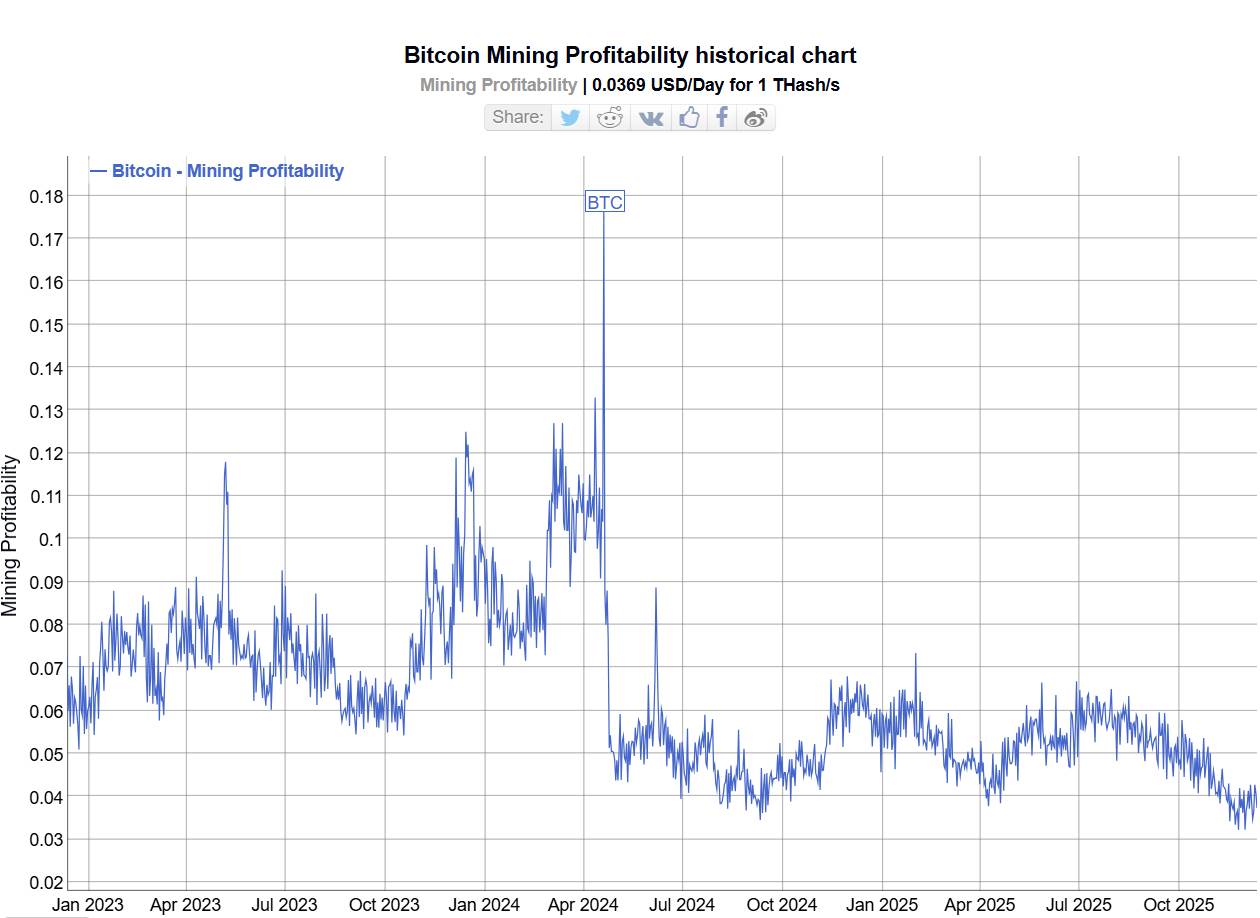
过去三年,以每单位算力所赚取的美元收益衡量的比特币挖矿盈利能力呈下降趋势,反映出减半后收益压缩和挖矿难度增加的情况。来源:BitInfoCharts
人工智能、高性能计算和行业整合正在重塑采矿业格局
上市比特币矿工不再仅仅将自己定位为比特币公司。他们越来越多地将自身业务描述为数字基础设施提供商,这反映出他们更广泛的战略,即在区块奖励之外,将电力、房地产和数据中心能力货币化。
One of the first companies to take this step was HIVE Digital Technologies. In 2022, the company began to shift some of its operations towards high-performance computing, and the following year, it reported revenues related to high-performance computing. At that time, since the industry was still focusing primarily on improving computing power, this strategy seemed particularly significant. Subsequently, more and more mining farms followed suit, converting parts of their infrastructure for use in GPU-based workloads related to artificial intelligence and high-performance computing. These farms include Core Scientific, MARA Holdings, Hut 8, Riot Platforms, TeraWulf, and IREN. The scale and implementation of these efforts vary greatly, but overall, they indicate that the entire mining industry is undergoing broader changes. With profit margins under pressure and increased competition, many miners now view artificial intelligence and computing services as a means to generate stable cash flows, rather than relying solely on block rewards. By 2024, artificial intelligence and high-performance computing had already generated significant revenue for some mining companies. Source: Digital Mining Solutions
It is expected that this trend will continue until 2026. This is based on trends identified by digital asset investment and consulting firm Galaxy in 2024, which noted that there was a growing wave of mergers and acquisitions among mining companies.
Bitcoin mining stocks: Volatility and dilution risks
Public Bitcoin miners play a crucial role in the market. They not only ensure the security of the network but also become one of the largest corporate holders of Bitcoin. Over the past few years, many listed miners have moved beyond their traditional operating models and started to view Bitcoin as a strategic asset for their balance sheets. As reported by Cointelegraph in January, more and more miners are following the example of Michael Saylor from Strategy, adopting more cautious strategies for managing their Bitcoin holdings, keeping a portion of the mined coins for themselves. By the end of the year, these miners had become among the top public holders of Bitcoin. Companies such as MARA Holdings, Riot Platforms, Hut 8, and CleanSpark were among the top ten holders of Bitcoin in terms of total holdings.
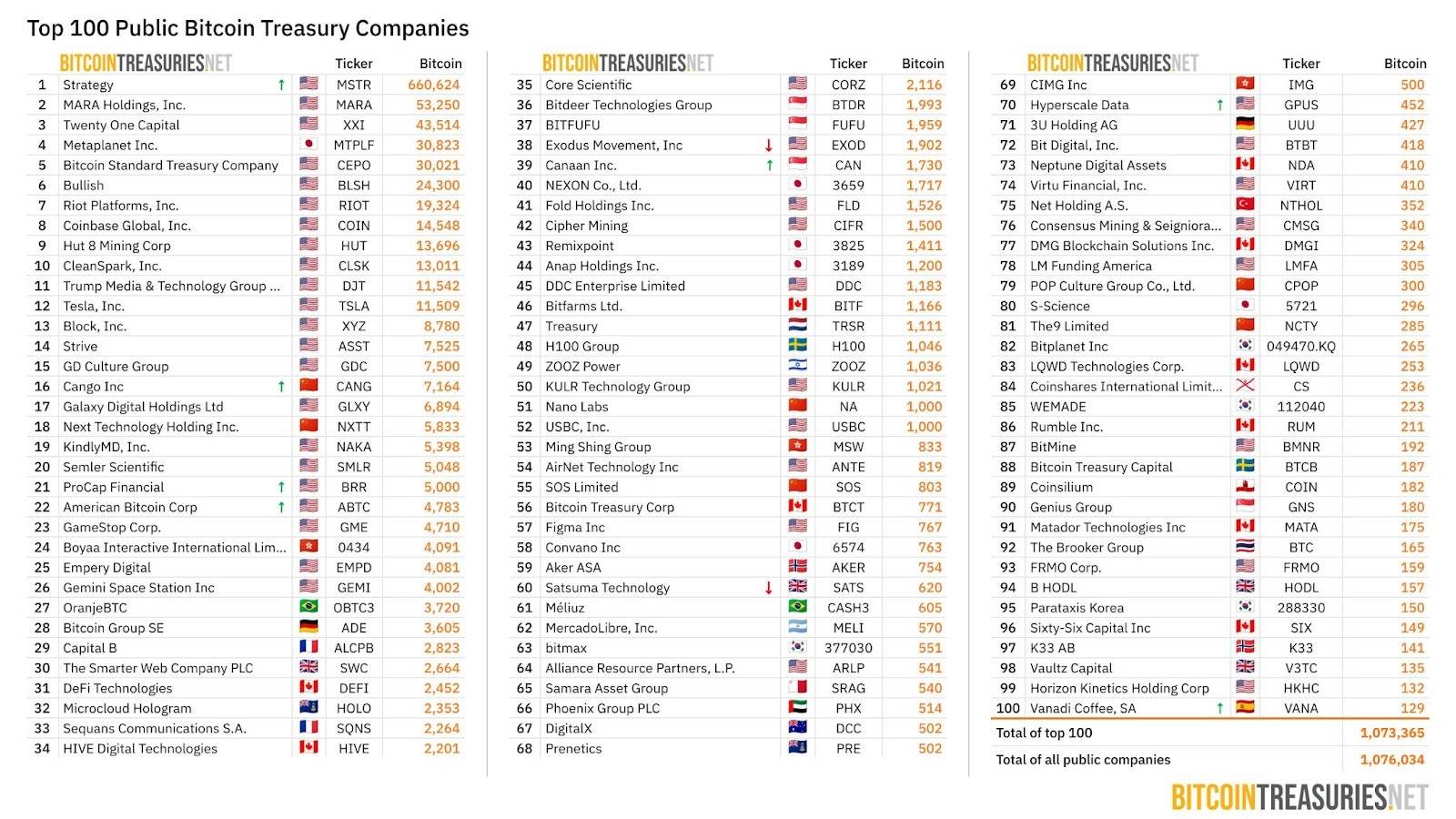
These companies are considered the largest public Bitcoin depository companies. Source: BitcoinTreasuries.NET
However, this risk exposure also increases the risk of volatility. With the fluctuations in Bitcoin prices, miners who hold large amounts of Bitcoin will experience greater changes in their balance sheets, similar to other digital asset management companies that face pressure during market downturns.
Mining stocks also face the risk of continuous dilution of equity. The industry remains capital-intensive, requiring continuous investment in ASIC hardware, expansion of data centers, and debt repayment during economic downturns.
When operating cash flows become tight, mining companies often turn to equity financing to maintain liquidity, including using ATM plans and issuing secondary shares.
Recent financing activities have highlighted this trend. Several mining companies, including TeraWulf and IREN, have utilized bonds and convertible bonds to improve their balance sheets and fund various growth initiatives.
Across the entire industry, only in the third quarter alone, Bitcoin mining companies raised billions of dollars through debt and convertible bond issuance. This continues the trend of increased financing since 2024.
Looking ahead to 2026, dilution risk will likely remain a concern for investors, especially given the ongoing decline in mining margins and the potential for a bear market in Bitcoin prices.
Operators with high break-even costs or aggressive expansion plans may continue to rely on equity capital. In contrast, those with lower break-even costs and stronger balance sheets will be better able to limit shareholder dilution when the market conditions become more favorable.