Exchange Ranking
 Top Exchanges
 24h Volume Ranking
 Popularity Ranking
 Exchange BTC Balance
 Proof of Reserves
 Decentralized Exchanges
 Funding Rate
 Funding Heatmap
 Liquidation Data
 Max Pain
 Long/Short Ratio
 Whale L/S Ratio
 Binance/Okex/Huobi L/S
 Bitfinex Margin L/S
 ETF Tracker
 Solana ETF
 XRP ETF
 Hong Kong ETF
 Bitcoin Treasuries
 Crypto Reversal
 Ethereum Reserves
 HyperLiquid Wallet Analysis
 Hyperliquid Whale Watch
 Large Transactions
 On-chain Movement
 Bitcoin ROI
 Stablecoin Market Cap
 Options Analysis
 News
 Articles
 Economic Calendar
 Features
 Wallet
 Contract Calculator


 Security
 Collections
 Watchlist
 Following
 BTC
Bitwise is about to release its annual “Top Ten Predictions” report for the year 2026. This report is considered by many institutions as an important indicator for predicting the direction of the next crypto cycle. Against the backdrop of continuous changes in Bitcoin ETF inflows, stablecoin volume, and online activity, Bitwise offers more forward-looking insights into market structure, capital flows, and the status of key assets. Although the full content has not been disclosed yet, three key predictions already provide a clear picture of what the crypto market will look like in the next two years.

Prediction 1: Bitcoin will break out of its four-year cycle and reach new highs.
Bitcoin has shown a four-year cycle pattern, with significant increases in the first three years, followed by a significant pullback in the fourth year. Based on this cycle, 2026 seems to be a year of pullback.
We believe this will not happen.
We believe that the factors that have driven this four-year cycle in the past—such as Bitcoin’s halving, interest rate cycles, and the boom/bust patterns driven by cryptocurrency leverage—are now much weaker than in previous cycles.
● Halving: By definition, each halving is half as important as the previous one.
● Interest Rates: Interest rates increased significantly in 2018 and 2022, causing impacts on prices. We expect interest rates to decline in 2026.
● Crisis Escapes: A relative decrease in leverage levels (following the record-breaking liquidations in October 2025) and improved regulations reduce the likelihood of major crises occurring.
More importantly, we believe that as institutions such as Morgan Stanley, Wells Fargo, and Merrill Lynch begin to allocate funds into Bitcoin, the wave of institutional capital flowing into the cryptocurrency market since the approval of the spot Bitcoin ETF in 2024 will accelerate in 2026. At the same time, we expect that as Wall Street firms and fintech companies start to seriously embrace cryptocurrencies, Bitcoin will also benefit from the positive regulatory changes following the elections in 2024.
We believe that these factors combined will drive Bitcoin to reach new record highs, and the four-year cycle will be erased from history.
Prediction two: Bitcoin’s volatility will be lower than that of Nvidia.
If you have worked in the cryptocurrency industry for a long time, you may have heard people say, “I will never invest in something with such high volatility as Bitcoin.” We’ve heard this statement countless times. It’s one of the most common criticisms from those who doubt Bitcoin.
Is Bitcoin’s volatility really higher than that of other assets that investors prefer? Not really.
Throughout 2025, Bitcoin’s volatility will remain lower than that of one of the most popular stocks in the market: Nvidia. Looking further ahead, you’ll notice that Bitcoin’s volatility has been declining over the past decade. This shift reflects a reduction in the fundamental risk associated with Bitcoin as an investment, along with the diversification of investor bases provided by traditional investment tools like ETFs.
We expect this trend to continue into 2026.
Volatility: Bitcoin vs. Nvidia
Annualized volatility over a one-year period
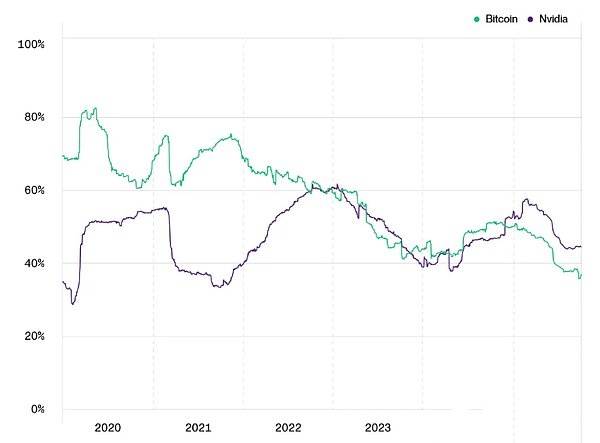
Data source: Bitwise Asset Management; data from Bloomberg. The time range of the data is from December 31, 2019, to December 5, 2025.
Note: After the United States abandoned the gold standard and introduced gold ETFs in 2004, gold also underwent a similar transformation. We discussed these similarities in our recent paper “Long-Term Capital Market Hypotheses for Bitcoin”.
Prediction three: The correlation between Bitcoin and stocks will decrease.
Many people—especially media professionals—claim that Bitcoin is highly correlated with the stock market.
However, data shows otherwise. Using a 90-day rolling correlation metric, the correlation between Bitcoin and the S&P 500 index rarely exceeds 0.50. This threshold is typically used to distinguish between “low” and “moderate” correlations.
Regardless, we believe that the correlation between Bitcoin and stocks will be lower in 2026 compared to 2025. Why? We expect that factors related to regulatory developments and institutional adoption, which are unique to cryptocurrencies, will drive up the price of cryptocurrencies. This is despite the struggles faced by the stock market due to concerns about valuation and short-term economic growth.
Conclusion
Combining these three predictions creates three significant benefits for investors:
● Strong returns
● Reduced volatility
● Decreased correlation
It sounds like a quite attractive investment asset, doesn’t it? I believe that as these events progress, we will see institutional investors invest billions of dollars into this sector.
In conclusion, I think 2026 will be a very promising year.