Exchange Ranking
 Top Exchanges
 24h Volume Ranking
 Popularity Ranking
 Exchange BTC Balance
 Proof of Reserves
 Decentralized Exchanges
 Funding Rate
 Funding Heatmap
 Liquidation Data
 Max Pain
 Long/Short Ratio
 Whale L/S Ratio
 Binance/Okex/Huobi L/S
 Bitfinex Margin L/S
 ETF Tracker
 Solana ETF
 XRP ETF
 Hong Kong ETF
 Bitcoin Treasuries
 Crypto Reversal
 Ethereum Reserves
 HyperLiquid Wallet Analysis
 Hyperliquid Whale Watch
 Large Transactions
 On-chain Movement
 Bitcoin ROI
 Stablecoin Market Cap
 Options Analysis
 News
 Articles
 Economic Calendar
 Features
 Wallet
 Contract Calculator


 Security
 Collections
 Watchlist
 Following
Did you notice? The crypto industry has been quite active lately—in just three months, there have been over 48 new Bitcoin bonds issued. Rachael Lucas, an analyst at BTC Markets, pointed out that this indicates one clear signal: major players are making large-scale investments in Bitcoin, leading to its continuous accumulation. This trend suggests that powerful individuals are quietly positioning themselves for the next market wave.

An analyst stated that the number of listed companies holding Bitcoin increased by 38% between July and September. This indicates that “large corporations are doubling their bets on Bitcoin, rather than withdrawing from it.”
Bitwise, a crypto asset management company, cited data from BitcoinTreasuries.NET in its third-quarter report on corporate adoption of Bitcoin. It was found that 172 companies currently hold Bitcoin, with 48 new companies entering the digital asset finance sector this quarter.
Hunter Horsley, CEO of Bitwise, said in a tweet on Tuesday that these numbers are “absolutely noteworthy,” indicating that “people want to own Bitcoin. Companies are no exception.”
Bitwise’s report also revealed that the total amount of Bitcoin held by all companies has risen to $117 billion, an increase of over 28% compared to the previous quarter. The total amount of Bitcoin held has exceeded 1 million units, accounting for 4.87% of the total supply.
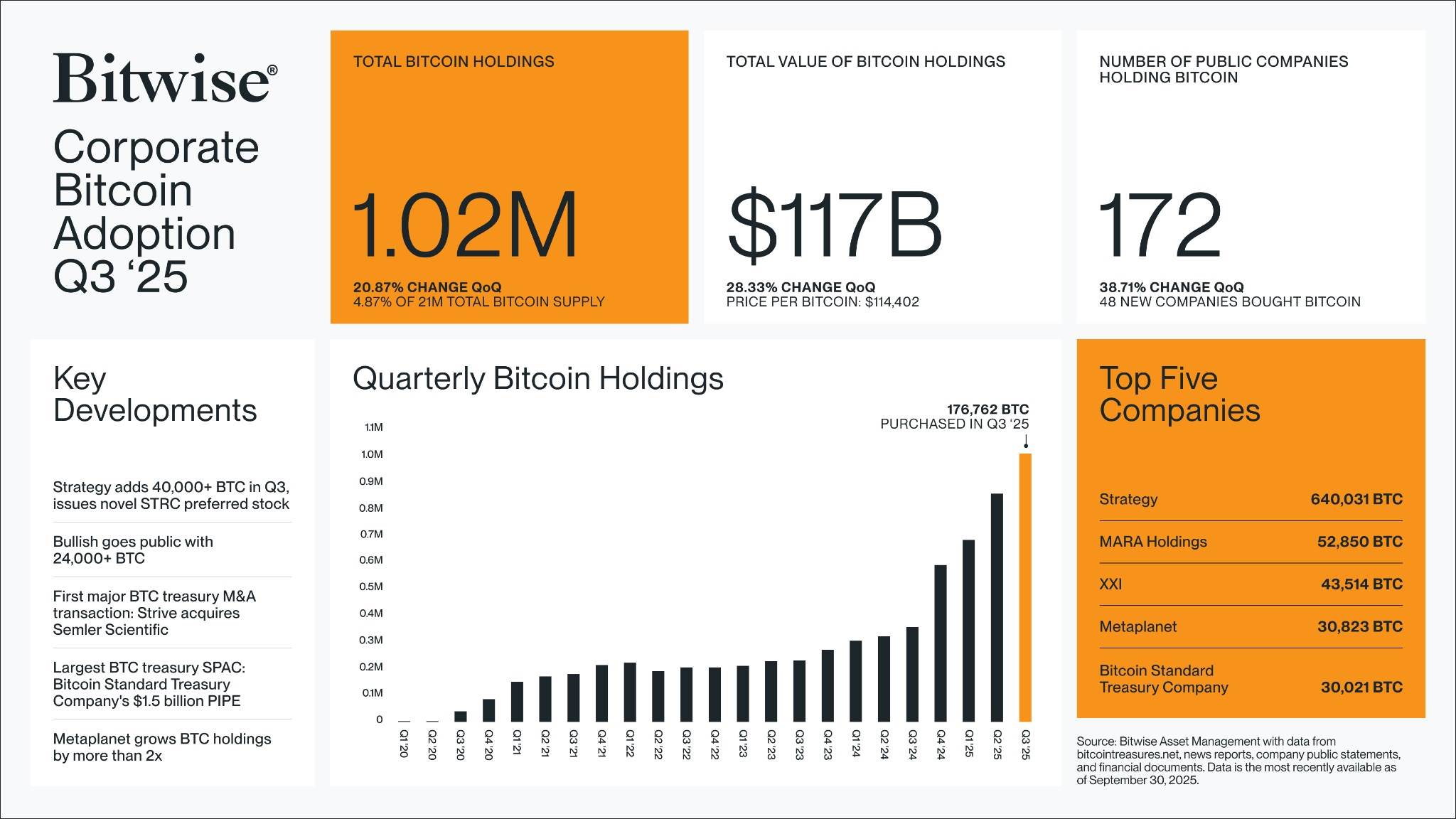
Bitwise’s report shows that corporate adoption of Bitcoin remains stable. Source: Bitwise
Large corporations still want BTC
Rachael Lucas, an analyst at Australian cryptocurrency exchange BTC Markets, said in an interview with Cointelegraph that the increasing number of participants indicates that “major players are doubling their investments rather than withdrawing.” So far, the largest bitcoin fund management company is Strategy, owned by Michael Saylor, who made its last purchase on October 6th, holding 640,250 bitcoins. Meanwhile, cryptocurrency mining company MARA Holdings ranks second, with 53,250 bitcoins under its control. Its holdings increased on Monday. Strategy leads among all companies holding bitcoins. Source: BitcoinTreasuries.NET Lucas added, “As more companies and even sovereign nations get involved, we expect this trend to continue, especially with increased regulatory transparency and the maturation of infrastructure supporting the adoption of cryptocurrencies by institutions.” Lucas believes this is a clear sign that “institutional adoption is deepening,” as these institutions are not just seeking short-term profits, but are making long-term decisions based on digital assets as part of their financial strategies. “This involvement helps make cryptocurrencies a mainstream asset class and lays the foundation for broader financial innovations, from loans supported by bitcoins to new derivatives markets.” As supply continues to be absorbed, when will a bull market arrive?Although the amount of Bitcoin held by individuals continues to increase steadily, its price has been highly volatile recently. Lucas said that companies typically purchase Bitcoin through over-the-counter transactions. This is a “more controlled way of accumulating Bitcoin, which helps to avoid price fluctuations.” However, this also means that such purchases don’t immediately affect the market price of Bitcoin in the physical market.
Nevertheless, she also noted that while institutional investors are buying Bitcoin, other factors can also play a role, leading to “significant corrections.” For example, long-term holders may sell their positions, derivative activities may increase, and macroeconomic factors like the recent tensions between China and the US could also impact prices.
Meanwhile, Edward Carroll, head of marketing at blockchain investment firm MHC Digital Group, told Cointelegraph that although Bitcoin reserves are still in their early stages, “the surge in institutional interest could lead to an imbalance between supply and demand.” This, he said, would create “strong upward pressure on prices in the medium to long term.”
Therefore, Carroll believes that demand for Bitcoin will continue to grow over the next few years. He expects that as institutional demand increases, Bitcoin will become “less dependent on risk and sentiment.”
According to Bitbo, miners currently produce about 900 Bitcoins per day. A report released by financial services company River in September found that by 2025, companies will be purchasing an average of 1755 Bitcoins per day.
Cryptocurrencies are becoming more mature
In addition to corporate purchases of cryptocurrencies, Bitcoin exchange-traded funds (ETFs) are also becoming more popular. Lucas said that this opens the door for more traditional investors to access digital assets through well-known, regulated tools. This represents “a significant shift and an important step towards mainstream adoption.” Last week, US spot Bitcoin ETFs continued their strong performance from the “October Boom,” with weekly inflows reaching $2.71 billion. “
We are witnessing the development of a mature market. Cryptocurrencies are evolving from being a speculative playground into a legitimate asset class with institutional participation.