Exchange Ranking
 Top Exchanges
 24h Volume Ranking
 Popularity Ranking
 Exchange BTC Balance
 Proof of Reserves
 Decentralized Exchanges
 Funding Rate
 Funding Heatmap
 Liquidation Data
 Max Pain
 Long/Short Ratio
 Whale L/S Ratio
 Binance/Okex/Huobi L/S
 Bitfinex Margin L/S
 ETF Tracker
 Solana ETF
 XRP ETF
 Hong Kong ETF
 Bitcoin Treasuries
 Crypto Reversal
 Ethereum Reserves
 HyperLiquid Wallet Analysis
 Hyperliquid Whale Watch
 Large Transactions
 On-chain Movement
 Bitcoin ROI
 Stablecoin Market Cap
 Options Analysis
 News
 Articles
 Economic Calendar
 Features
 Wallet
 Contract Calculator


 Security
 Collections
 Watchlist
 Following
 BTC
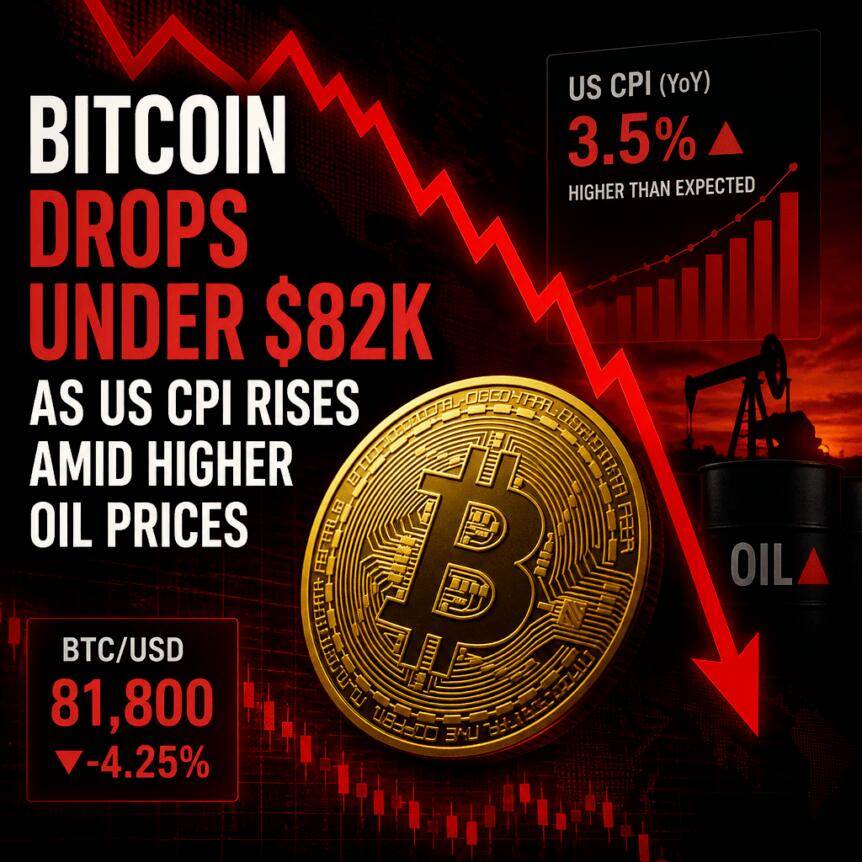
Bitcoin drops below the $82,000 psychological threshold: U.S. inflation data exceeds expectations, macro-pressure dominates the market.
Within hours after the U.S. Bureau of Labor Statistics released September’s Consumer Price Index (CPI) numbers, Bitcoin prices fell below the important psychological level of $82,000. This decline is closely related to higher-than-expected inflation figures and the market’s re-evaluation of interest rate expectations.
According to data from Bitstamp, Bitcoin prices dropped to around $81,926. This drop follows a September CPI growth rate of 3.7%, slightly higher than the market’s average expectation of 3.6%. Fuel costs and other energy-related components were the main factors contributing to this unexpected decline. This report also increased the yield on U.S. government bonds and dragged down gold prices, highlighting that macro-economic factors continue to influence the price movements of cryptocurrencies.
Key points:
- After September’s CPI showed a year-over-year increase of 3.7% (expected to be 3.6%), Bitcoin prices on Bitstamp dropped to around $81,926.
- Fuel and gasoline prices were the main drivers; BLS data shows that gasoline prices increased by 9.1% year-over-year.
- U.S. bond yields soared, and gold prices dropped to around $4,079 per ounce, reflecting broader risk-sensitive macroeconomic reactions.
- The FedWatch tool from CME Group indicates that market sentiment favors a 25-basis-point interest rate hike at the Fed’s meeting in late October.
Inflation tightening puts pressure on Bitcoin.
引用TradingView数据的报道指出,在CPI数据公布后,不仅加密资产,黄金和股指期货也同步走低。根据劳工统计局的数据,9月CPI同比增幅确认达到3.7%,比多数预期高出0.1个百分点。
通胀增长的构成至关重要:受全球供应压力影响的燃料价格上涨——报告中提及这与中东冲突及石油供应紧张有关——显得尤为突出。BLS发布的数据显示,汽油价格同比上涨9.1%,占“所有项目”月度增量的半数以上;而能源指数在8月上涨2.1%的基础上,本月又上升了5.2%。这些来自BLS官方CPI发布的细节对投资者而言意义重大,因为它们表明通胀压力不仅具有“核心性”,而且集中在与全球能源市场紧密相关的投入品上。
核心CPI温和走高,限制了对利率敏感资产的喘息空间
即使抛开能源因素,报告也未提供广泛的降温迹象。核心CPI(剔除能源和食品)同比录得2.6%,同样比市场预期高出0.1个百分点。
Carson Group的Sonu Varghese在接受CNBC采访时指出,投资者本应预料到读数偏高。他提到柴油价格可能带来的后续影响,以及与“人工智能热潮”相关的需求端效应,认为鉴于经济当前的走向,“意外”的说法越来越难以成立。
For cryptocurrency traders, the key insight is that even though headline figures are influenced by energy factors, the strength of the core components reduces the likelihood of the market quickly shifting towards a more accommodative stance from the Federal Reserve, simply due to deflationary pressures.
Changes in Federal Reserve pricing: Higher yields and lower gold prices follow CPI trends.
After the release of CPI data, market interest rate expectations rapidly changed. According to CME Group’s FedWatch tool, most participants now expect the Fed to raise rates by 25 basis points at its meeting on October 28. This probability rose from 22.1% the previous day to 53.7%. Expectations for a second rate hike of 25 basis points were also around 50%.
Theresa Sheehan from Econoday provided additional context. She suggests that, given the weak employment data in September, the FOMC may choose to keep interest rates unchanged at its meeting in late October, while maintaining a rate-hiking trend in December.
In the areas of commodities and interest rates, CPI responses follow a consistent pattern. Gold, which tends to react to real yield and monetary policy expectations, fell to around $4,079 per ounce. U.S. bond yields also increased, with the 10-year yield reaching 5.329%. According to market charts, this is just three basis points away from the highest level in 24 years.
Economist Robin Brooks noted this trend in a blog post. He believes that CPI results are “something the global bond markets least need,” especially after signs indicated that bond selling might be slowing down.
The next steps for Bitcoin: determining the range and the next catalyst for inflation
. Although overall market sentiment is defensive, Bitcoin’s technical movements remain within a specific range. Analysts suggest that BTC continues to trade around the key range of $82,500 to $83,400. Analysts are waiting to see whether this range will be sustained as a support level, or if it may collapse.
This is crucial, as if the usual resistance levels are broken, macro-driven selling could quickly intensify. On the other hand, if this range is maintained while yields remain stable, traders may shift their focus away from purely long-term interest rate expectations and towards the capital flows associated with crypto assets. In that case, BTC is likely to regain momentum.
Looking ahead, the next important data point in the inflation context is the Producer Price Index (PPI), which will be released on Friday. Since the CPI has already influenced the Fed’s pricing expectations, traders will be keen to see whether the PPI confirms another round of inflationary pressures, or—more importantly—whether it indicates a potential reduction in input costs, which could then affect retail prices.
The main uncertainty currently lies in whether these CPI fluctuations are merely temporary re-pricing related to energy prices, or whether they represent a more lasting inflationary trend that could sustain high yields. Regardless, it seems that Bitcoin is reacting as a macro asset. Therefore, monitoring interest rate expectations and the next inflation data release may be just as important as keeping an eye on order book dynamics.