Exchange Ranking
 Top Exchanges
 24h Volume Ranking
 Popularity Ranking
 Exchange BTC Balance
 Proof of Reserves
 Decentralized Exchanges
 Funding Rate
 Funding Heatmap
 Liquidation Data
 Max Pain
 Long/Short Ratio
 Whale L/S Ratio
 Binance/Okex/Huobi L/S
 Bitfinex Margin L/S
 ETF Tracker
 Solana ETF
 XRP ETF
 Hong Kong ETF
 Bitcoin Treasuries
 Crypto Reversal
 Ethereum Reserves
 HyperLiquid Wallet Analysis
 Hyperliquid Whale Watch
 Large Transactions
 On-chain Movement
 Bitcoin ROI
 Stablecoin Market Cap
 Options Analysis
 News
 Articles
 Economic Calendar
 Features
 Wallet
 Contract Calculator


 Security
 Collections
 Watchlist
 Following
 BTC
In a volatile market, Bitcoin exhibits a unique “island effect,” with its correlation with traditional assets such as gold and stocks being virtually zero. This makes Bitcoin an ideal refuge in investment portfolios, while also revealing a hidden wealth secret. With continued inflows of institutional funds, faster approvals for crypto ETFs, and the growing maturity of the derivatives market, Bitcoin is gradually shifting from a speculative tool to a significant force in the global financial ecosystem.

Key points
● The correlation between Bitcoin and stocks and gold has recently dropped to near zero, indicating that Bitcoin is moving towards a phase of decoupling from traditional assets. This phenomenon often occurs during significant market catalysts or shocks.
● Although Bitcoin has a low correlation with interest rates, changes in monetary policy can still affect its performance. During the monetary tightening period from 2022 to 2023, there was a strong negative correlation between Bitcoin and interest rate increases.
● Despite being referred to as “digital gold,” historically, Bitcoin has shown a higher beta coefficient and greater sensitivity to upward movements, especially when macroeconomic conditions are favorable.
● Since 2021, Bitcoin’s volatility has steadily decreased. Currently, its volatility pattern is more similar to that of technology stocks, indicating that its risk characteristics are becoming more stable.
Introduction
比特币正在与更广泛的市场脱钩吗?比特币最近相对于黄金和股票的出色表现,再次引发了这一话题的讨论。在比特币 16 年的历史中,被赋予了许多标签,从 「数字黄金」 到 「价值储存手段」,再到 「风险偏好资产」。但它真的具备这些特点吗?比特币作为一种投资资产,是否与众不同,还是仅仅是市场上现有风险资产的一种杠杆化表现形式呢?
在本期的《Coin Metrics 网络状况报告》中,我们将探究比特币在不同市场环境下的表现,重点分析它与股票、黄金等传统资产之间相关性较低时期背后的催化因素和条件。我们还将研究货币政策制度的转变如何影响比特币的表现,评估它对更广泛市场的敏感度,并结合其他主要资产来分析它的波动率特征。
不同利率制度下的比特币
美联储是金融市场中最具影响力的力量之一,因为它能影响利率。联邦基金利率的变化,无论是在货币紧缩还是宽松的情况下,都会直接影响货币供应量、市场流动性以及投资者的风险偏好。在过去十年里,我们经历了从零利率时代,到新冠疫情期间前所未有的货币宽松政策,再到 2022 年为应对不断上升的通货膨胀而进行的激进加息。
为了解比特币对货币政策变化的敏感度,我们将其历史划分为五个关键的利率制度阶段。这些阶段考虑了利率的走向和水平,范围从宽松型(联邦基金利率低于 2%)到紧缩型(联邦基金利率高于 2%)。由于利率变化并不频繁,我们将比特币的月度回报率与联邦基金利率的月度变化进行比较。
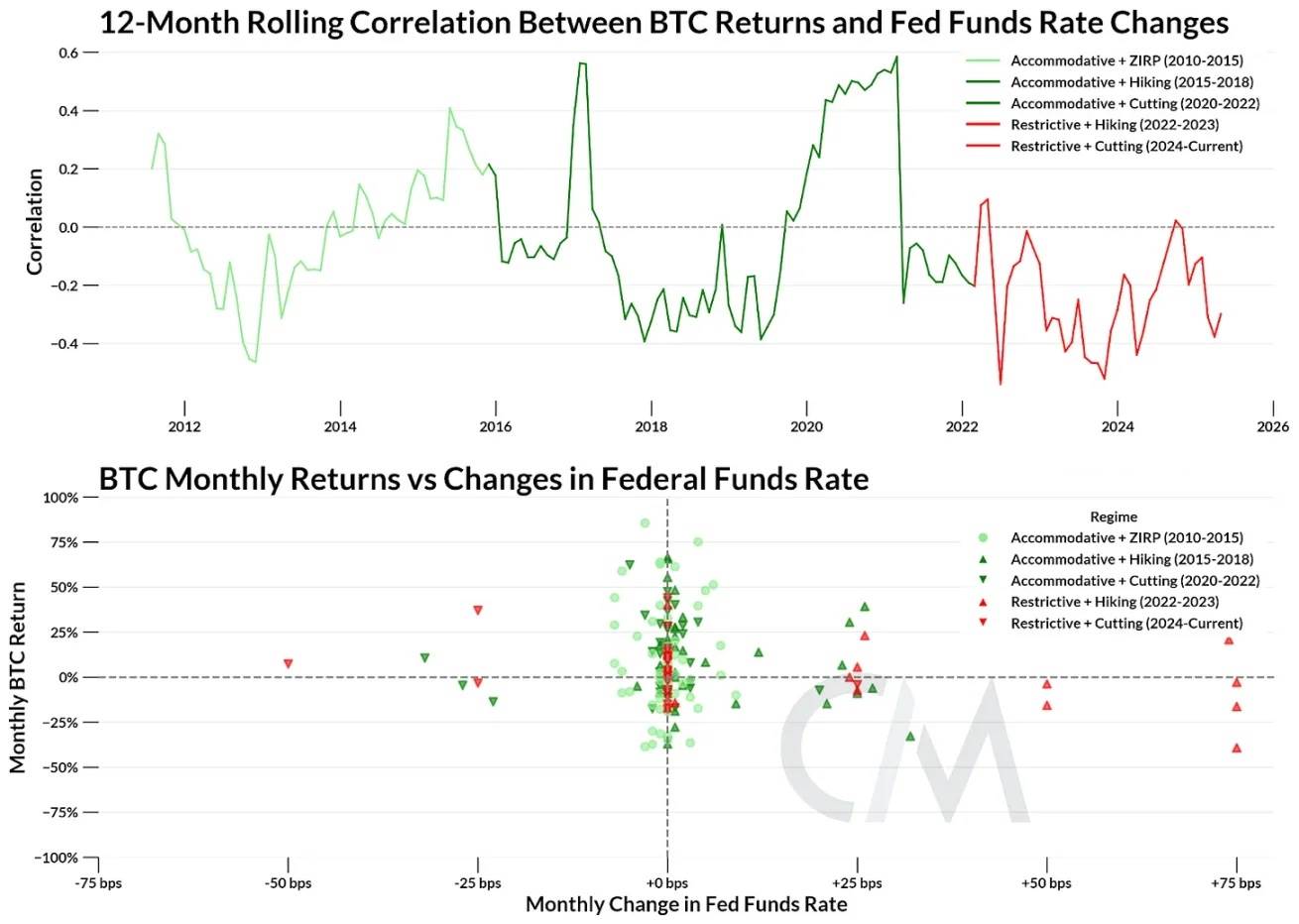
数据来源:Coin Metrics 和纽约联邦储备银行
虽然比特币与利率变化的相关性总体较低,且集中在中间水平附近,但在政策制度发生转变时,仍出现了一些明显的模式:
● 宽松政策 + 零利率(2010 年 - 2015 年):在 2008 年金融危机后的零利率政策推动下,比特币实现了最高的回报率。比特币与利率的相关性大致呈中性,这与比特币的早期增长阶段相吻合。
● 宽松政策 + 加息(2015 年 - 2018 年):随着美联储开始将利率提高至接近 2%,比特币的回报率出现了上下波动。虽然在 2017 年相关性有所飙升,但总体上仍保持在较低水平,这表明比特币与宏观政策存在一定的脱节。
● 宽松政策 + 降息(2018 年 - 2022 年):In response to the COVID-19 pandemic, there were rapid reductions in interest rates and fiscal stimulus measures during this period. This led to two years of near-zero interest rates. Bitcoin’s returns varied significantly, but generally tended to be positive. During this time, the correlation between Bitcoin prices and interest rates fluctuated greatly, ranging from below -0.3 in 2019 to +0.59 in 2021, before returning to a near-neutral level.
● Tightening policies + Interest rate increases (2022–2023): To address soaring inflation, the Federal Reserve implemented one of the fastest interest rate hikes, pushing the federal funds rate above 5%. Under these conditions, there was a strong negative correlation between Bitcoin prices and interest rate changes. Due to risk aversion, Bitcoin performance was weak, especially under the impact of events in the crypto industry, such as the collapse of FTX in November 2022.
● Tightening policies + Interest rate cuts (2023–present): After three rounds of high-interest rate cuts, Bitcoin’s performance shifted from neutral to slightly positive. Several catalysts also played a role during this period, such as the U.S. presidential elections and trade wars. These factors continued to influence Bitcoin’s performance. The correlation remains negative, but it seems to be approaching zero. This indicates that Bitcoin is in a transitional phase as macroeconomic conditions begin to stabilize.
While interest rates determine the market context, comparing Bitcoin’s performance with that of stocks and gold can provide a better understanding of its relative performance compared to major asset classes.
The relationship between Bitcoin’s returns and those of gold and stocks
Correlation
要判断一种资产是否与另一种资产脱钩,最直接的方法是查看回报率之间的相关性。下面是比特币与标准普尔 500 指数和黄金之间 90 天回报率相关性的图表。
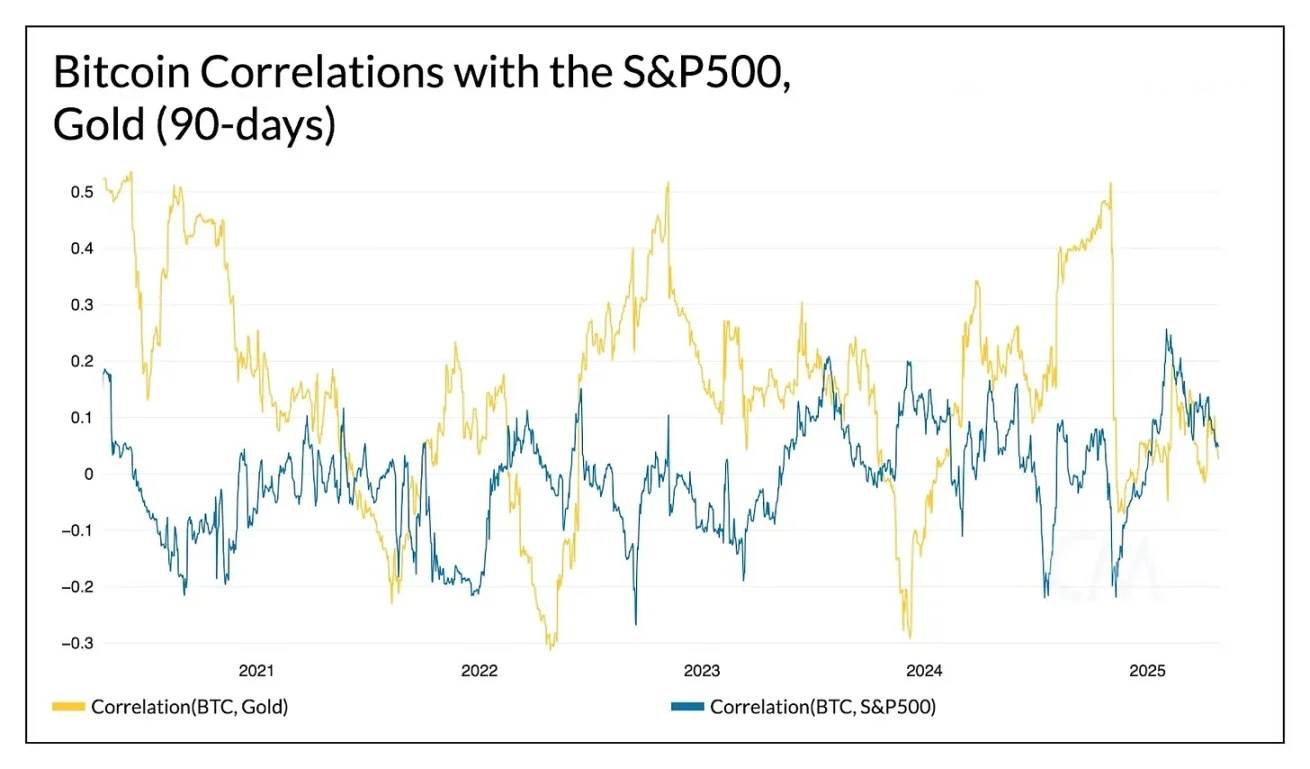
数据来源:Coin Metrics
确实,我们看到比特币与黄金和股票的相关性在历史上都处于较低水平。通常情况下,比特币的回报率会在与黄金或股票的相关性之间波动,与黄金的相关性一般更高。值得注意的是,随着市场情绪升温,比特币与标准普尔 500 指数的相关性在 2025 年有所上升。但从 2025 年 2 月左右开始,比特币与黄金和股票的相关性都趋向于零,这表明比特币正处于一个与黄金和股票 「脱钩」 的独特阶段。自 2021 年末上一个周期的高峰期以来,这种情况还未曾出现过。
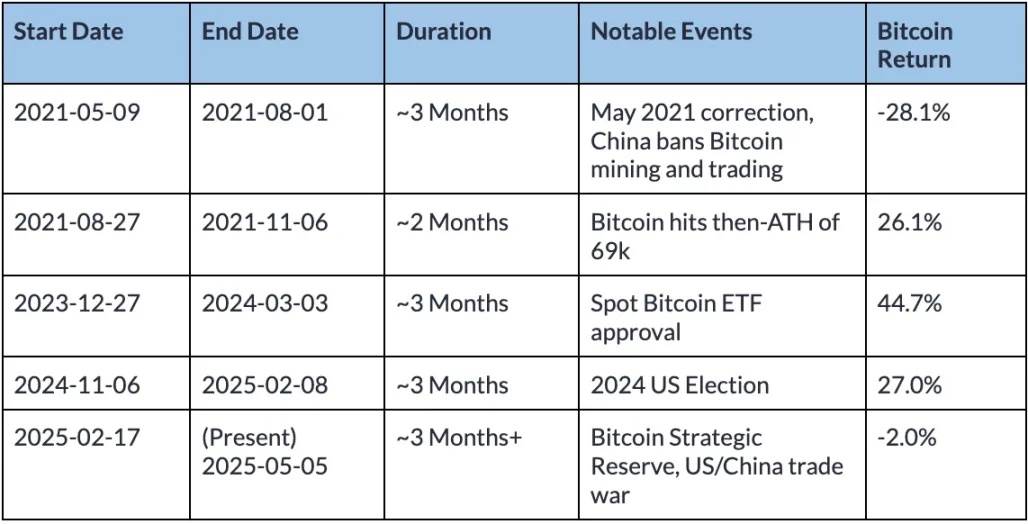
当相关性如此之低时,通常会发生什么呢?我们整理了比特币与标准普尔 500 指数和黄金的滚动 90 天相关性低于显著阈值(约 0.15)的时间段,并标注了当时最值得关注的事件。
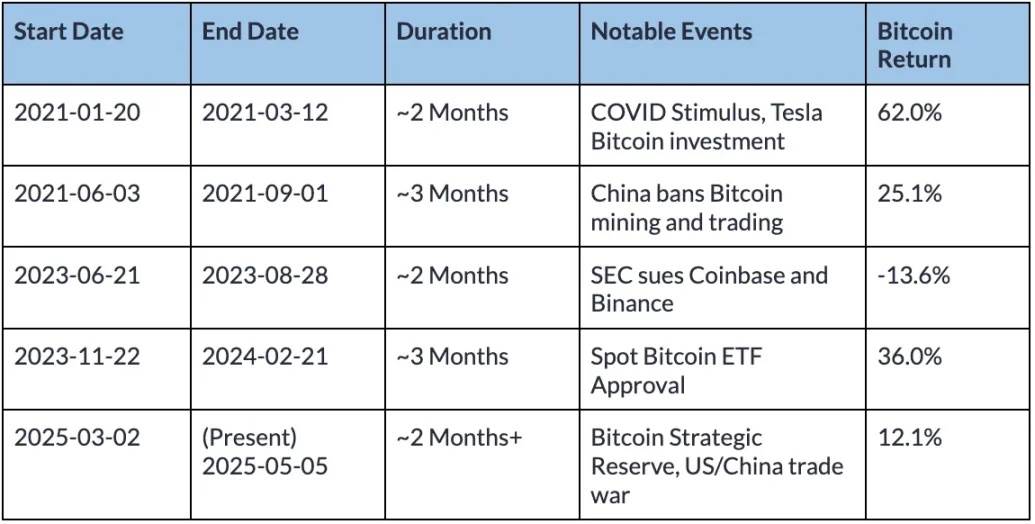
比特币与标准普尔 500 指数的低相关性时期
比特币与黄金的低相关性时期
As expected, the separation of Bitcoin from other assets occurred during periods of significant shocks in the cryptocurrency market. Examples include China's ban on Bitcoin and the approval of Bitcoin spot ETFs. Historically, periods of low correlation usually last around 2 to 3 months, but this depends on the threshold you use for measuring correlation. During these periods, there was indeed a moderate positive return rate. However, since each period has its unique characteristics, it's important to consider these differences before making any conclusions about Bitcoin's recent performance. Nevertheless, for those who wish to incorporate Bitcoin into their risk-diversified portfolios, its low correlation with other assets is a desirable trait. In addition to correlation, the market beta coefficient is another useful indicator of the relationship between an asset's return rate and the market's return rate. The market beta coefficient quantifies the extent to which an asset's return rate changes in response to market fluctuations. It’s calculated by subtracting the sensitivity of the asset’s return rate to the risk-free rate relative to a certain benchmark. Correlation measures the direction and strength of the linear relationship between an asset and the benchmark return rate, while the market beta coefficient measures the direction and magnitude of an asset's sensitivity to market volatility.例如,人们常说比特币相对于股票市场的交易具有 「高 beta 系数」。具体来说,如果一种资产(如比特币)的市场 beta 系数为 1.5,那么当市场基准资产(标准普尔 500 指数)变动 1% 时,预计该资产的回报率将变动 1.5%。负 beta 系数意味着当基准资产的回报率为正时,该资产的回报率为负。
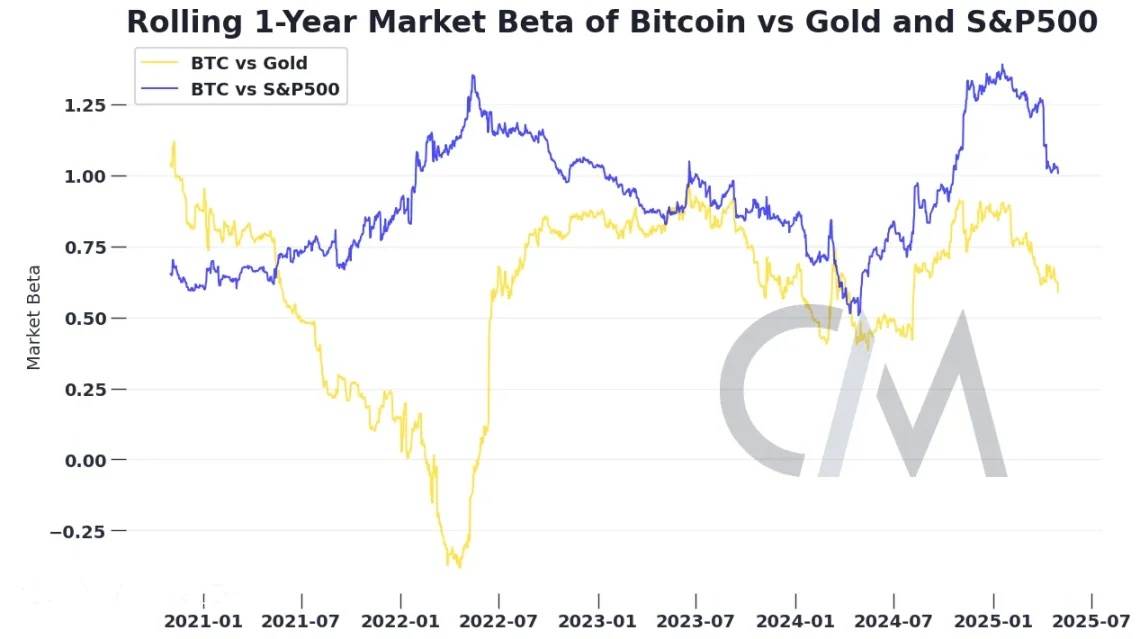
在 2024 年的大部分时间里,比特币相对于标准普尔 500 指数的 beta 系数远高于 1,这意味着它对股票市场的波动高度敏感。在乐观的、风险偏好较高的市场环境中,持有一定比例比特币的投资者相比于仅持有标准普尔 500 指数的投资者,获得了更高的回报。尽管比特币常被贴上 「数字黄金」 的标签,但其相对于实物黄金的低 beta 系数表明,同时持有这两种资产可以对冲各自资产的下行风险。
随着我们进入 2025 年,比特币相对于标准普尔 500 指数和黄金的 beta 系数开始下降。尽管对比特币对这些资产的依赖程度正在降低,比特币仍然对市场风险敏感,其回报率也仍然与市场回报率相关。比特币可能正在成为一种独特的资产类别,但它的交易方式在很大程度上仍类似于风险偏好资产,目前还没有强有力的证据表明它已经成为一种 「避险资产」。
高波动时期的比特币表现
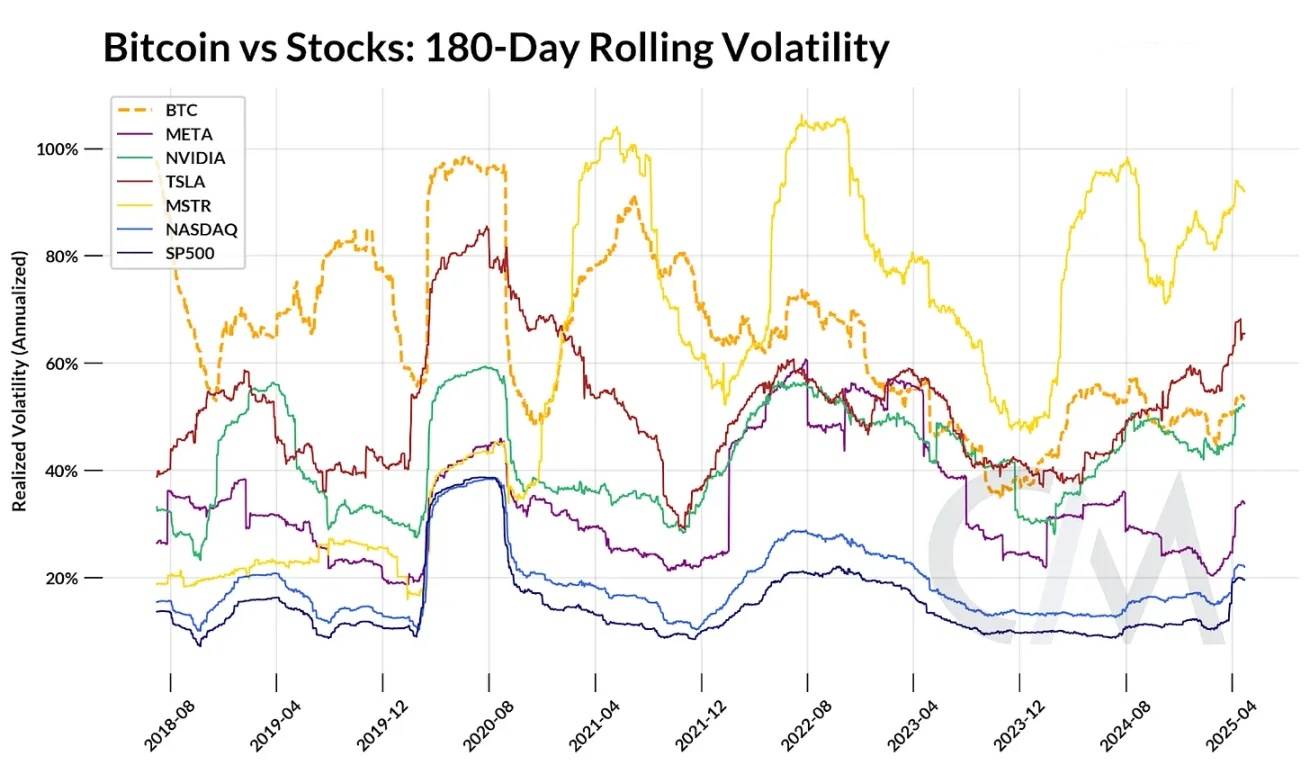
已实现波动率为理解比特币的风险特征提供了另一个维度,它衡量了比特币价格在一段时间内的波动幅度。波动率常被认为是比特币的核心特征之一,既是风险的驱动因素,也是回报的来源。下面的图表对比了比特币的 180 天滚动已实现波动率与纳斯达克指数、标准普尔 500 指数以及一些科技股等主要指数的波动率。
数据来源:Coin Metrics 和谷歌财经
随着时间的推移,比特币的波动率呈下降趋势。在比特币早期阶段,受价格大幅上涨和回调周期的驱动,其已实现波动率经常超过 80%-100%。在新冠疫情期间,比特币的波动率与股票波动率一同上升,并且在 2021 年和 2022 年的一些时期,受 Luna 和 FTX 倒闭等加密货币领域特有的冲击影响,其波动率也独立上升。
然而,自 2021 年以来,比特币的 180 天已实现波动率逐渐下降,最近即使在市场波动率较高的情况下,也稳定在 50%-60% 左右。这使其波动率与许多广受欢迎的科技股相当,低于 MicroStrategy(MSTR)和特斯拉(TSLA),而与英伟达(NVIDIA)的波动率非常接近。尽管比特币仍然容易受到短期市场波动的影响,但与过去的周期相比,其相对稳定性可能反映了它作为一种资产的成熟度。
结论
比特币是否已经与市场其他部分脱钩了呢?这取决于你如何衡量。比特币并非完全不受现实世界的影响。它仍然受制于影响所有资产的市场力量:利率、特定的市场事件,以及其他金融资产的回报率。最近,我们看到比特币的回报率与市场其他部分的相关性消失了,但这是一个暂时的趋势,还是长期市场变化的一部分,仍有待观察。