Exchange Ranking
 Top Exchanges
 24h Volume Ranking
 Popularity Ranking
 Exchange BTC Balance
 Proof of Reserves
 Decentralized Exchanges
 Funding Rate
 Funding Heatmap
 Liquidation Data
 Max Pain
 Long/Short Ratio
 Whale L/S Ratio
 Binance/Okex/Huobi L/S
 Bitfinex Margin L/S
 ETF Tracker
 Solana ETF
 XRP ETF
 Hong Kong ETF
 Bitcoin Treasuries
 Crypto Reversal
 Ethereum Reserves
 HyperLiquid Wallet Analysis
 Hyperliquid Whale Watch
 Large Transactions
 On-chain Movement
 Bitcoin ROI
 Stablecoin Market Cap
 Options Analysis
 News
 Articles
 Economic Calendar
 Features
 Wallet
 Contract Calculator


 Security
 Collections
 Watchlist
 Following
 HYPER
In the crypto community, Hyperliquid has become a popular topic for arbitrage opportunities recently. Some people have shared their practical experiences, from scratch to reaching an amount of up to $5 million. They’ve shown how one can utilize the platform’s liquidity and market mechanisms to create their own “arbitrage machine”. This process involves not only quickly capturing price fluctuations, but also precise risk management and strategic optimization. Under the dual conditions of a bull market and increased volatility, such arbitrage strategies have attracted many technical traders. It’s also made more people realize that in the DeFi world, knowing how to use rules and liquidity can lead to greater profits compared to simply buying and selling tokens. However, it’s important to be aware of potential risks.
Let’s take time back to March 2025. At that time, the crypto market looked dismal, with severe impacts due to tariff conflicts. We started to think about where the next potential opportunities might lie.
Since 40% of Hyperliquid hadn’t been distributed to the community yet, we thought this could be an opportunity. In February, we had already tested some market-making strategies on Unit, the asset tokenization layer built specifically for Hyperliquid. But those attempts were relatively small-scale and not very serious.
At that time, HyperEVM just launched some decentralized exchanges. My brother said, “Why not try arbitrageing between HyperEVM and Hyperliquid? Even if we lose money, we can still get some rewards from Hyperliquid’s third season.”
We decided to give it a try. There were indeed opportunities for arbitrage, but we weren’t sure if we could really compete with others.
Why would there be opportunities for arbitrage on HyperEVM?
HyperEVM 的区块时长是 2 秒。这意味着 HYPE 的价格每 2 秒才更新一次,而在这 2 秒之间,HYPE 的价格可能会波动。
因此,HyperEVM 上的 HYPE 经常会相对 Hyperliquid 出现“低估”或“高估”。
初期尝试与结果
我们先是构建了一个初版的 Bot 程序,相当基础款。
每当 HyperEVM 上 AMM DEX 池和 Hyperliquid 现货之间出现价格差,我们就在 HyperEVM 发起交易,并在 Hyperliquid 上进行对冲。
举个例子,如果 HYPE 在 Hyperliquid 上价格上涨,那它在 HyperEVM 上就是被低估的。此时的交易逻辑为 —— 在 HyperEVM 上用 USDT0 买入“便宜的” HYPE ➡️ 卖出 HYPE 换取 USDC ➡️ 在 Hyperliquid 上将 USDC 再换回 USDT0。
头几天,我们在 Hyperliquid 上的日交易量达到 20–30 万美元,且没有亏损,甚至还能到赚几百美元的小利润。
起初,我们只在利润高于0.15%(扣除 DEX 与 Hyperliquid 手续费后) 时执行套利。两周后,我们开始看到更大潜力,因为利润已有上升趋势。
我们识别出了另外两家竞争者,他们也在做相同的事情,但规模不大。我们决定“干掉”他们。
四月,Hyperliquid 推出了质押HYPE 以返还手续费的功能。这对我们来说是一个完美的更新,因为我们的资金规模更大,可以借此机会有效利用这一优势。
我们质押了10 万枚 HYPE,获得了 30% 的交易手续费返还,并将利润阈值从 0.15% 下调至 0.05%。我们希望最大限度地压制竞争对手,让他们就此放弃,这样我们就能独享蛋糕。我们的目标是两周内实现超过 5 亿美元的交易量,以提升在 Hyperliquid 上的手续费等级。
随着交易量的上升,利润也随之上升。最终我们达到了超过 5 亿美元的交易量,竞争对手被彻底击溃。
我仍记得那天 —— 两家竞争对手被迫关停了他们的 Bot 程序,而我和我的兄弟正从巴黎飞往迪拜,疯狂地看着我们的机器人在“印钞” —— 当天的利润高达 12 万美元。
过了狂刷交易量的阶段后,尽管此时我们的竞争对手在手续费方面较我们已有明显劣势,但他们仍不肯放弃,这迫使我们进入了0.04% 利润空间的超窄区间,这基本就是我们和他们之间的手续费差距。我们的交易量依然强劲,单日利润稳定在 2 万至 5 万美元之间。
扩展瓶颈
随着我们的规模逐步扩大,我们开始遇到瓶颈。
HyperEVM 每个区块的 gas 上限为 200 万,而一次套利交易需要约 13 万 gas,所以每个区块最多只能容纳 7–8 笔套利交易。
随着 HyperEVM 上越来越多的池和 DEX 启动,这个数量远远不够,部分交易会卡住,导致交易队列积压与资金头寸失衡。
为此我们采取了一系列措施:
● 使用 100+ 钱包,每个钱包独立发送套利交易,避免单钱包排队;
● 每个区块最多执行 8 次套利;
● Gas 动态控制:当 HyperEVM 的 gas 飙升时,会提高最低的投资回报率(ROI)要求,避免高 gwei 时段白白发送交易;
● 速率限制:若过去 12 秒内发送交易次数过多,在发送新交易前会提高利润要求。
优化策略
在利润持续上涨,交易量持续远超竞争者 5–10 倍的同时,我们也在病态地痴迷于优化。
这不是我们第一次经历这种事了 —— 今天你可能边喝啤酒边印钞,明天某个未知实体就能让你一夜之间被打回原形。
在 Hyperliquid 上成为挂单方
六月,我兄弟提出一个他思考了几周的想法:“如果我们不再作为吃单方(Taker)下单,而是作为挂单方(Maker)发起套利,会怎样?”
这样做有两个主要好处:
● 一是可以捕捉 HYPE 的针尖波动(wick candles),这将带来更多套利机会;
● 二是可以为每笔交易节省0.0245% 的手续费,从而提高净利润。
但与此同时,这也是一个非常有挑战的举措,因为如果我们在 Hyperliquid 上先发起挂单,就无法确保能在 HyperEVM 上完成对应的对冲 —— 可能有人比我们更快。
之前,我们的套利逻辑是:先在 HyperEVM 发起交易 —— 若交易失败,则在 Hyperliquid 不动;若交易成功,再在 Hyperliquid 执行对冲。但作为挂单方,我们必须先在 Hyperliquid 等待成交,而不确定能否及时在 HyperEVM 上成交。这会造成账面头寸失衡(unbalancing),进而可能带来亏损。
起初,每次测试都会出现±1 万枚 HYPE 的头寸偏差。我们甚至很难理解为什么会这样,因为有时 20 秒内发出 100 笔交易,却没有任何数据分析工具。情况一片混乱。
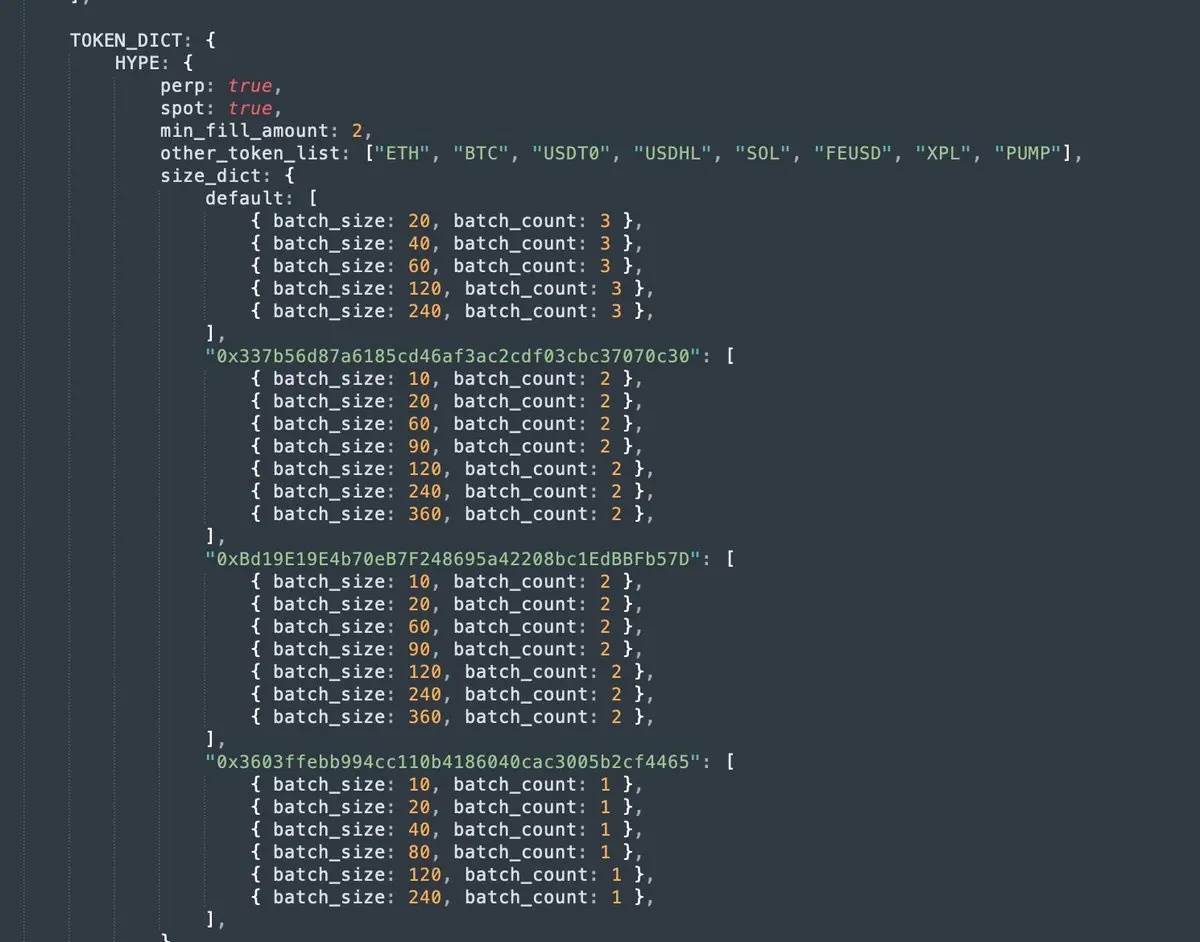
为了解决这个问题并能安全执行挂单套利,我们引入了一系列新概念,并将它们转化为代码模块与参数:
● 利润区间(Profit Range):定义何时挂单、何时保留、何时撤单并替换;
● 可参与的 AMM 池(例如 HyperSwap 上的 HYPE/USDT0 0.05% 费率池,Project X上的 HYPE/UBTC 0.3% 费率池);
● 每个池的下单规模与订单数量。
吃单交易的参数如下图所示。
经过几天的微调,我们终于避免了大部分的失衡情况,且一旦出现失衡,我们会立即使用时间加权平均价格来尽快平仓以限制风险。这彻底改变了游戏规则,竞争对手仍然只是吃单方,而我们正在碾压他们,交易量达到了他们的 20 倍。
跳过在Hyperliquid上的 USDT/USDC 交易
我们遇到的下一个挑战是 USDT0 的特有情况。USDC 是 Hyperliquid 上排名第一的稳定币,而 USDT0 是 HyperEVM 上排名第一的稳定币。HyperEVM 上交易量和套利机会最好的资金池是 HYPE-USDT0 池。但由于我们需要在 HyperEVM 上使用 USDT0,在 Hyperliquid 上使用 USDC,我们不得不在 Hyperliquid 上执行 2 笔交易来在这两种资产之间进行再平衡。
举个例子,当 HYPE 价格上涨时:
● Hyperliquid 上的挂单成交 ➡️ 卖出 HYPE 换取 USDC(0% 手续费);
● 在 HyperEVM 上用 USDT0 买入 HYPE;
● 在 Hyperliquid 上卖出 USDC,买入 USDT0(t吃单费率 0.0245%);
问题在第三步:
● 我们需要支付吃单手续费(利润更低,竞争力下降);
● The USDT0/USDC market on Hyperliquid is not yet mature. There are high slippage rates, and pricing is inaccurate.
Therefore, we have decided to skip this step as much as possible. To achieve this, we have developed new parameters and logic:
● USDC threshold: Only when the USDC balance exceeds 1.2 million, will transactions from USDT0 to USDC be skipped.
● USDT0 threshold: Only when the USDT0 balance exceeds 300,000, will transactions from USDC to USDT0 be skipped.
● Real-time price data source: We call the Cowswap API every minute to obtain real-time prices for USDT0/USDC, rather than relying on Hyperliquid’s order book.
We have introduced perpetual contracts for arbitrage opportunities.
Let me clarify first: We have never used leverage or perpetual contracts in the cryptocurrency industry, except once in 2018 on BitMex—and that wasn’t very successful. So at first, we didn’t really understand this concept.
But later, we noticed that the trading volume of HYPE perpetual contracts is much higher than that of spot transactions, and the transaction fees are slightly lower (0.0245% for spot transactions, while perpetual contracts only cost 0.019%). We thought we could try using perpetual contracts to optimize our strategies. No competitors have used perpetual contracts yet, so we essentially have exclusive access to this market.
During testing, we found that using perpetual contracts not only allows us to capture more arbitrage opportunities, but also generates additional income from funding costs. When the price of HYPE perpetual contracts is higher or lower than spot prices, we can further exploit arbitrage opportunities. This is something that competitors haven’t done at all.
Therefore, we have designed a new set of system parameters:
● Limit: The maximum number of short/sell positions allowed, to prevent liquidation or depletion of USDC/HYPE balance;
● Premium/Discount: Real-time monitoring of the deviation between perpetual prices and spot prices;
● Maximum Premium/Maximum Discount: Stop taking positions when the premium becomes too high, and switch to trading on the spot market;
● Progressive ROI: The larger the position size, the higher the required profit margin, to avoid taking too deep of positions;
● ROI formula: Dynamic adjustment based on perpetual premium/discount and position size.
Below is the parameter interface for configuring HYPE short positions.
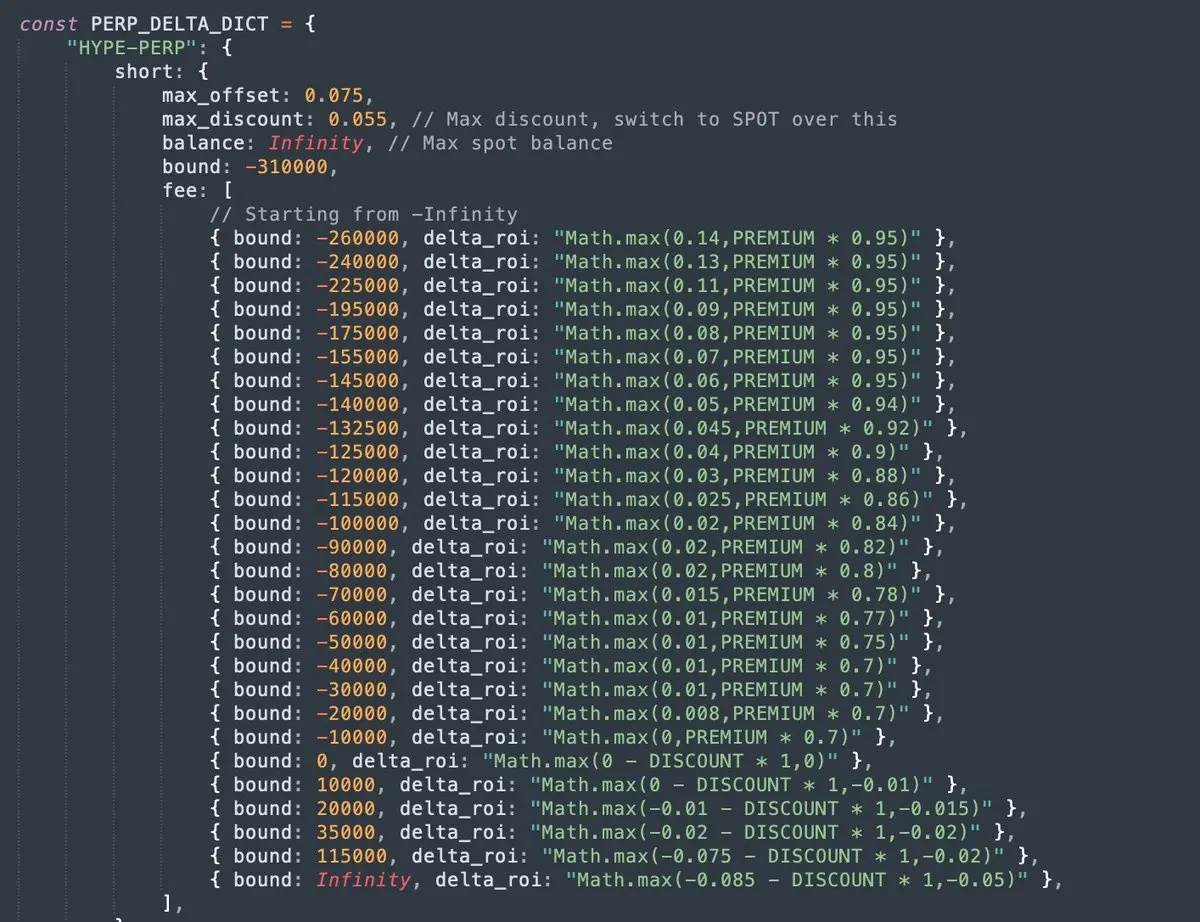
It turns out that introducing perpetual contracts was one of our most significant improvements. It generated approximately $600,000 in revenue solely from funding costs, and also provided more opportunities for arbitrage based on premium/discount differences.
Division of labor and collaboration
Many people ask us how we divide our work and collaborate with each other.
In the eyes of others, I’m often seen as the “talker” who just posts nonsense on social media, while my brother is the quiet programmer. But reality is much more complex than that. Our way of working is similar to how Blur mined coins back in the past.
When developing such Bot programs, you never know when the next bug or market changes will occur. Every day, we work to solve problems, optimize algorithms, and refine our approaches. Any changes are only implemented after being thoroughly discussed and agreed upon.
He is responsible for coding, and he also created the control panel, allowing me to manage the parameters. I can’t write code at all (really, I can’t even begin), but I know how to configure strategies to get the best results in the market. My brother, on the other hand, can write code, but he doesn’t know how to configure strategies.
We also have very different personalities: my brother likes to make frequent updates and experiment quickly (I think that’s too aggressive); I’m more conservative, preferring to wait until there’s a real chance of making money before taking action (he thinks that’s too lazy).
Our typical conversation pattern goes like this:
Me (actually, I’m quite critical): “This program seems strange… What did you change?”
He: “Nothing much… Maybe something small.”
For both of us, one of the strange aspects of building Bot programs without proper company processes is that after 250 updates, you might find yourself creating something that you no longer fully understand or can control. Sometimes, it’s difficult to grasp all the effects that new updates will have.
Conclusion
Over the past 8 months, we’ve spent almost all our time working on this program.
Especially since June, those monster-level market makers from Wintermute joined the competition, bringing with them massive amounts of liquidity and entire quantitative teams. I still remember our 5-day trip to Bodrum from Istanbul in July—we were supposed to go on vacation, but we spent all five days debugging programs in hotel rooms.
In the end, our results were as follows:
● Profit: $5 million;
● Total trading volume on Hyperliquid: $12.5 billion;
● Gas fees paid on HyperEVM: $1.2 million (accounting for 20% of the total costs on that chain);
● Total development time: 2,000 hours or more;
● Market share: 5% of the unit trading volume;
Now, we have decided to take a break and let the robots rest. We’re looking forward to the next opportunity—HyperliquidSeason 3 and UnitSeason 1.