Exchange Ranking
 Top Exchanges
 24h Volume Ranking
 Popularity Ranking
 Exchange BTC Balance
 Proof of Reserves
 Decentralized Exchanges
 Funding Rate
 Funding Heatmap
 Liquidation Data
 Max Pain
 Long/Short Ratio
 Whale L/S Ratio
 Binance/Okex/Huobi L/S
 Bitfinex Margin L/S
 ETF Tracker
 Solana ETF
 XRP ETF
 Hong Kong ETF
 Bitcoin Treasuries
 Crypto Reversal
 Ethereum Reserves
 HyperLiquid Wallet Analysis
 Hyperliquid Whale Watch
 Large Transactions
 On-chain Movement
 Bitcoin ROI
 Stablecoin Market Cap
 Options Analysis
 News
 Articles
 Economic Calendar
 Features
 Wallet
 Contract Calculator


 Security
 Collections
 Watchlist
 Following
 ETH
The world’s largest asset management company, BlackRock, has made another move—transferring $135 million in Ethereum to Coinbase. This action once again stirred the market, which was already tense before. Over the past week, the frequent portfolio adjustments by major players on the blockchain have become a hot topic of discussion. The actions of this “giant” institution have attracted particular attention.
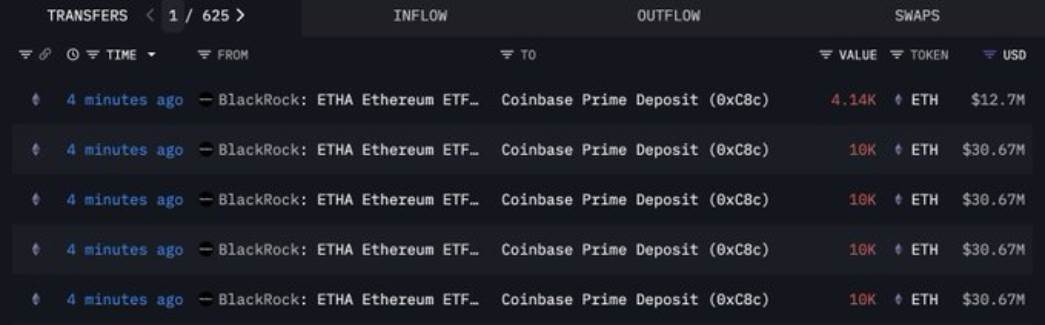
According to blockchain data, on December 3rd, BlackRock deposited 44,140 ETH into Coinbase Prime, causing a sudden surge in market prices. It’s worth noting that this isn’t the first time such a large transfer has occurred. In November this year, during a time of market turmoil and tight liquidity, BlackRock transferred significant amounts of crypto assets to the exchange twice: once exceeding $290 million, and once exceeding $640 million.
Such large transfers at critical moments are often seen by traders as potential “downtrend signals,” and they can lead to significant price fluctuations. Now, with this third transfer, the intentions of this major institution once again become a focus of market analysis.

I. Key Points of the Incident
● This transfer is quite straightforward. According to various blockchain monitoring platforms, BlackRock deposited 44,140 Ethereum into Coinbase Prime on December 3rd.
● At the time of the transaction, the value of these assets was approximately $135 million. The transfer was captured by blockchain surveillance and quickly spread among the crypto community and financial media.
II. Market Interpretation
● The initial reaction of the market to such large-scale transfers is often concern. Traditional logic suggests that transferring large amounts of cryptocurrency from private wallets to exchanges is typically done in preparation for selling or trading, which can lead to direct selling pressure on the market.
● Especially when the transfer is made by financial giants like BlackRock, their actions are seen as indicators of institutional sentiment. Many traders begin to pay close attention to changes in the depth of market orders and the spread between buy and sell prices, in order to anticipate potential price fluctuations.
● However, a more thorough analysis reveals another possibility. Evgeny Gaevoy, the founder of market maker Wintermute, pointed out that such transfers are actually “a highly delayed indicator.”
III. The Underlying Mechanism
● The widespread panic in the market may stem from a lack of understanding of the operating mechanisms of ETFs. These on-chain transfers by BlackRock actually involve the settlement phase of its spot Bitcoin ETF (IBIT) and Ethereum ETF (ETHA) programs.
● When there is a net outflow of funds from an ETF, market makers will purchase shares from the ETF sellers and submit redemption requests to BlackRock, converting those ETF shares into actual Bitcoin or Ethereum. This process usually takes one day to complete.
● The key point is that the real selling pressure doesn’t occur when the on-chain transfers become visible, but rather when market makers sell in the external markets in order to hedge risks. This means that when retail investors see large-scale transfers on the chain, the related selling pressure might have already been absorbed by the market one day earlier.
IV. Pattern Analysis
Looking at recent data, it can be seen that there is a pattern to the large-scale cryptocurrency transfers from BlackRock to Coinbase.
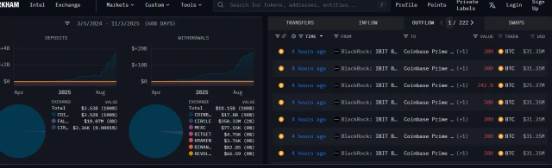
● These transfers occur frequently and on a large scale, with significant amounts being transferred almost every week. Over the past month, BlackRock has carried out four significant asset transfers, each involving hundreds of millions of dollars.
● Both ETH and BTC have been transferred in large quantities, but ETH accounts for a larger proportion. Multiple records show that the number of ETH transfers is quite substantial, reaching tens of thousands of units at times, while BTC also maintains stable high-volume flows.
● The behavior appears to be characterized by “mass-based + cyclical patterns.” The transfer intervals are typically around 7 to 10 days, and the amounts are relatively concentrated. This suggests that these transfers are likely part of a regular asset management process, rather than temporary events involving a single entity. These transactions have a significant impact on market sentiment, but they do not result in consistent negative trends.
Although large transfers to exchanges are often seen as potential selling pressure, the recent incidents did not directly correspond to obvious sell-offs. Instead, they seem to be part of routine asset transfers related to ETFs or custody positions.
Below are the main transfer records over the past month:
● December 3rd: 44,140 ETH transferred, approximately $135 million.
● November 24th: 2,822 BTC + 36,283 ETH transferred, totaling approximately $345 million.
● November 17th: Another large transfer of BTC and ETH, with a total value of approximately $646 million.
● November 4th: $172.48 BTC + 22,681 ETH were transferred, totaling approximately $293 million.
V. Market Perspectives
● In response to the frequent large-scale transfers by BlackRock, analysts in the crypto market have divided into different factions. Some traders believe that these transfers are strong bearish signals, indicating that institutions may be reducing their holdings or preparing to sell their assets.
● However, other analysts believe that these transfers signify the growing maturity of the crypto market and its acceptance by traditional financial systems. The involvement of institutions like BlackRock brings unprecedented liquidity and legitimacy to the market. They argue that the long-term participation of institutional investors will transform cryptocurrencies from marginal speculative assets into mainstream asset classes.
● CryptoQuant, a platform for analyzing the crypto market, notes that since 2023, the number of retail investors holding small amounts of Bitcoin has decreased, while the influence of institutional investors has increased.
● This shift is closely related to changes in US regulatory environments. The approval of spot Bitcoin ETFs has allowed institutional investors to invest in crypto assets without directly interacting with exchanges.
VI. Investment Perspectives
● For ordinary investors, understanding the large-scale transactions conducted by institutions like BlackRock requires looking beyond surface-level phenomena. As market analysts point out, it’s best to analyze these transaction data in conjunction with daily ETF fund inflows and outflows.
● When witnessing large-scale transfers on the blockchain, investors should first examine the capital flow patterns of the relevant ETFs during the previous trading day, rather than immediately interpreting these transactions as additional bearish signals.
This approach helps investors avoid unnecessary panic and enables them to better understand the real dynamics of the market. In today’s increasingly institutionalized cryptocurrency market, understanding the intersections between the operational logic of traditional finance and the characteristics of the cryptocurrency market becomes crucial for making investment decisions.
While the actions of financial giants on the blockchain are certainly noteworthy, seasoned investors have already begun to break through these appearances and uncover the true pulse of the market.
As Bitcoin fell by 4.5% during this period, hitting below $104,000, Ethereum also declined by 5.5%, with its trading price falling below $3,390. The market is naturally processing this information in its own way.
Larry Fink, the CEO of BlackRock, recently admitted that his previous stance against Bitcoin was incorrect, stating that the company is “actively embracing Bitcoin.” This giant firm, which manages assets worth $10 trillion, clearly continues to develop its crypto-related initiatives.