Exchange Ranking
 Top Exchanges
 24h Volume Ranking
 Popularity Ranking
 Exchange BTC Balance
 Proof of Reserves
 Decentralized Exchanges
 Funding Rate
 Funding Heatmap
 Liquidation Data
 Max Pain
 Long/Short Ratio
 Whale L/S Ratio
 Binance/Okex/Huobi L/S
 Bitfinex Margin L/S
 ETF Tracker
 Solana ETF
 XRP ETF
 Hong Kong ETF
 Bitcoin Treasuries
 Crypto Reversal
 Ethereum Reserves
 HyperLiquid Wallet Analysis
 Hyperliquid Whale Watch
 Large Transactions
 On-chain Movement
 Bitcoin ROI
 Stablecoin Market Cap
 Options Analysis
 News
 Articles
 Economic Calendar
 Features
 Wallet
 Contract Calculator


 Security
 Collections
 Watchlist
 Following
 ETH
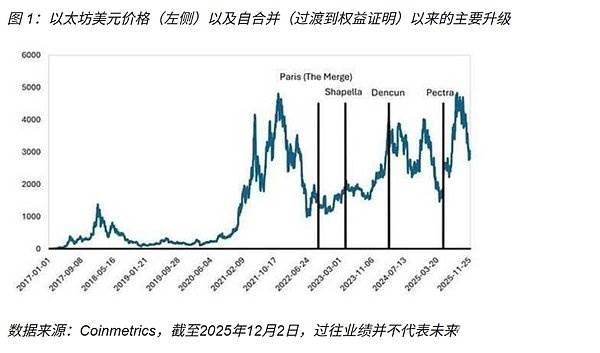
Today, Ethereum underwent a major upgrade called “Fusaka”. Everyone’s attention was focused on this moment. With the block height of 13,164,544 being successfully triggered, this upgrade was officially implemented, adding another crucial step to Ethereum’s scalability efforts. Following Dencun and Pectra, Fusaka will further enhance data processing capabilities and optimize protocol efficiency, thereby reducing the transaction costs on Layer2. This also helps Ethereum to become more stable in its role as a global settlement layer. Kenny Lee, head of Goldman Sachs’ crypto division, said that Fusaka marks a new stage in Ethereum’s scalability strategy. The goal is to make Ethereum both globally influential and affordable for users. For developers, users, and the entire ecosystem, this upgrade could be the starting point for another period of prosperity.
The most important change brought about by this upgrade is the introduction of “PeerDAS” technology. This technology aims to increase the data capacity of the Layer2 network by an impressive 8 times, thereby improving transaction throughput and significantly reducing transaction fees for Layer2 users.
In addition, the Fusaka upgrade includes the introduction of a “BPO” fork mechanism, which makes future network capacity adjustments more flexible. It also improves the performance of the Layer1 mainnet through features like storage expiration and block control. These changes together represent a structural leap forward for Ethereum in terms of scalability, sustainability, and usability.
From Dencun to Fusaka: Focus on expansion and infrastructure optimization
The upgrade of Fusaka actually involves the simultaneous activation of both the consensus layer “Fulu” and the execution layer “Osaka” upgrades. According to the final plan confirmed by the Ethereum Foundation, the improvements included in this upgrade mainly focus on three areas:
● Improving efficiency at Layer-1: This includes improvements such as storage expiration mechanisms (EIP-7642) and transaction gas limits (EIP-7825), aimed at maintaining high operational efficiency of nodes as the network usage increases.
● Expanding data capacity at Layer-2: The core of this effort is PeerDAS (EIP-7594), supplemented by updates to Blob parameters (EIP-7892) and optimization of Blob fees (EIP-7918).
● Improving user experience and developer tools: This includes measures like deterministic proposer functionality (EIP-7917) and support for secp256r1 curves in precompiled scripts (EIP-7951), all of which help enhance wallet functionality and application development.
These three areas align perfectly with the strategic priorities established by the Ethereum Foundation in April 2025: expanding the main Ethereum network, expanding Blobs, and improving user experience. This article will focus specifically on how these measures can enhance data capacity at Layer-2 and optimize fee mechanisms.
Our core mission: a Layer-2-centric approach to expansion
To understand why Ethereum focuses on expansion through Layer-2, it’s necessary to look back at its design philosophy.
在“区块链三难困境”(即去中心化、安全性和可扩展性三者无法兼得)中,以太坊的设计早期优先保障了其基础层(Layer-1)的去中心化和安全性。这导致随着去中心化应用需求的增长,Layer-1出现了交易费用高昂和确认时间缓慢的瓶颈。
为解决此问题,以太坊采纳了“以Rollup为中心”的路线图。该策略将绝大部分交易处理任务转移到Layer-2网络上,Layer-2在链下执行交易,然后将压缩后的数据发布回以太坊Layer-1进行最终结算和保障安全。
这种模块化方法使以太坊在不牺牲其核心去中心化原则的前提下,实现了可扩展性。然而,这也引出了新的“数据可用性”问题——即如何向全网证明已发布的压缩数据是有效的,而又无需每个节点都下载全部数据。
PeerDAS:实现数据容量8倍增长的关键
Fusaka升级中最具影响力的功能PeerDAS,正是为了解决上述数据可用性问题而生。
在Fusaka之前,尽管Dencun升级引入了“Blobs”作为一种经济高效的Layer-2数据存储方式,但每个以太坊全节点仍需下载完整的Blob数据,这限制了网络的带宽和吞吐量上限。
PeerDAS has fundamentally changed this model. After the upgrade, the network divides blob data into smaller pieces and distributes them across different nodes. Each node only needs to download and verify a small portion of the total data (approximately 1/8), thereby ensuring the availability and integrity of the entire dataset through encryption methods. This mechanism significantly reduces the resource requirements of individual nodes, resulting in an theoretical increase in data capacity of approximately 8 times. PeerDAS lays the foundation for future blob expansions and is a key driver behind the reduction of Layer-2 transaction costs.
BPO fork: allows for more flexible increases in the maximum amount of blobs available
As Layer-2 transaction activity continues to grow (as shown in Figure 2), the demand for blob space also increases.
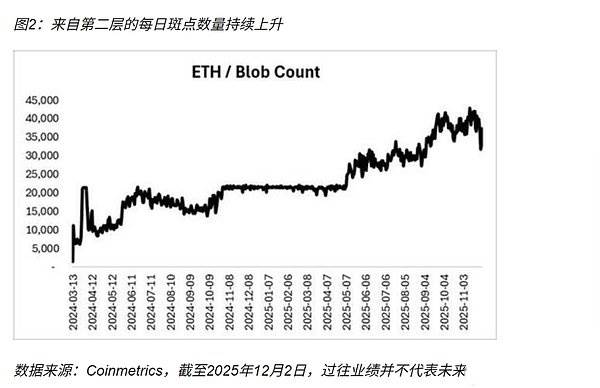
According to Coinmetrics data, the number of blobs per day is on the rise. However, under the current system, increasing the number of blobs per block requires a complex “hard fork” process. Such major upgrades are difficult to coordinate and occur rarely.
To address this bottleneck, Fusaka introduced the “Blob-only parameter BPO fork” mechanism. This is a lightweight fork that is used solely to update parameters related to blobs, such as the maximum number of blobs per block. Due to its limited scope and manageable impact, the development team can implement such upgrades more frequently and securely, allowing the network to gradually increase its data capacity without waiting for major upgrades that include additional features. According to the Ethereum Foundation, the BPO fork will be programmed to double the number of blobs over several weeks, until it reaches its maximum value.
Stable fee market: introducing a mechanism for setting a minimum price for blobs
Dencun升级后,Layer-2向以太坊发布数据面临两种独立的费用:执行Gas和Blob Gas。当Blob需求低时,其费用可能降至接近零,但Layer-2仍需支付可能相当可观的执行Gas。这种“价格信号失灵”会导致定价效率低下和市场不稳定。
为解决此问题,Fusaka通过EIP-7918引入了Blob的“底价”机制。该底价并非固定值,而是与执行Gas费用动态挂钩。
当市场驱动的Blob费用低于此底价时,费用调整算法将阻止其进一步下降。此举旨在确保Blob费用始终能反映其经济价值,使费用市场对网络拥堵保持敏感,并为Layer-2提供一个更稳定、更可预测的定价环境。
市场影响与潜在风险
Fusaka升级预计将对市场产生深远影响。PeerDAS和BPO分叉带来的数据容量提升,有望进一步降低Layer-2的运营成本。同时,EIP-7918的底价机制则确保了Blob空间不会被不合理地廉价使用,维持了网络的经济可持续性。这可能会加剧Layer-2网络之间的竞争,竞争焦点或将从交易成本转向用户体验、生态合作和流动性深度。
不过,此次升级也伴随着一些风险与考量:
● 执行风险:任何重大硬分叉都存在客户端协调失败或出现漏洞的风险,可能导致网络暂时不稳定。
● The impact of network fees is limited: The main benefit of upgrading to lies in Layer-2. Gas fees on the Ethereum mainnet are unlikely to decrease immediately in the short term.
● Hardware requirements: Although PeerDAS improves efficiency, the increased bandwidth requirements for validators may continue to increase over time.
● Adaptation time for the ecosystem: Developers working in Layer-2 and dApps will need time to fully leverage the advantages of this new architecture.