Exchange Ranking
 Top Exchanges
 24h Volume Ranking
 Popularity Ranking
 Exchange BTC Balance
 Proof of Reserves
 Decentralized Exchanges
 Funding Rate
 Funding Heatmap
 Liquidation Data
 Max Pain
 Long/Short Ratio
 Whale L/S Ratio
 Binance/Okex/Huobi L/S
 Bitfinex Margin L/S
 ETF Tracker
 Solana ETF
 XRP ETF
 Hong Kong ETF
 Bitcoin Treasuries
 Crypto Reversal
 Ethereum Reserves
 HyperLiquid Wallet Analysis
 Hyperliquid Whale Watch
 Large Transactions
 On-chain Movement
 Bitcoin ROI
 Stablecoin Market Cap
 Options Analysis
 News
 Articles
 Economic Calendar
 Features
 Wallet
 Contract Calculator


 Security
 Collections
 Watchlist
 Following
 BTC
Bitcoin and U.S. bond yields deviate: the new normal in the ETF era
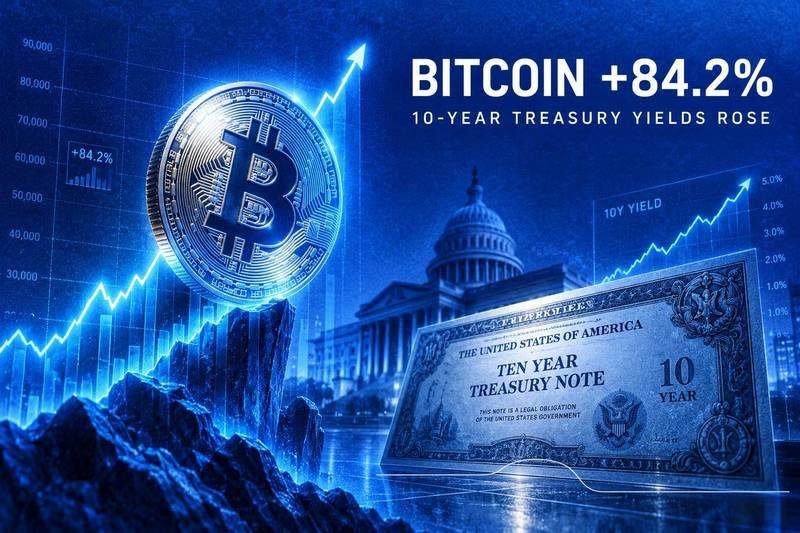
According to CryptoSlate data, Bitcoin prices rose 84.2% between January 10, 2024 and October 5, 2026. At the same time, the U.S. 10-year Treasury yield rose 127 basis points over the same period. This phenomenon challenges the traditional view that rising risk-free yields will inevitably suppress Bitcoin prices, although analysts point out that the relationship between the two is very weak.
Comparison of Bitcoin's increase and the rise in 10-year Treasury yields
CryptoSlate reported that Bitcoin achieved a return of 84.2% during the comparison window period covering the approval of the U.S. spot Bitcoin ETF. This structural shift in institutional access is the core reason why analysts believe that the current "yield pressure theory" is difficult to apply to Bitcoin as it did before ETF-driven demand became a market force.
During this period, according to the official daily curve data of the U.S. Department of the Treasury, the coupon yield on U.S. 10-year Treasury bonds increased from 4.04% on January 10, 2024 to 5.31% on October 5, 2026, an increase of 1.27 percentage points. This means a 1.27 percentage point increase in the return investors receive from this risk-free government tool.
This comparison is descriptive only, not causal. Although Bitcoin and 10-year yields moved in the same direction during this window, this does not mean that yields drove Bitcoin prices, nor does it mean that Bitcoin prospered due to rising yields. Other factors including ETF inflows, halving cycle dynamics and broader risk appetite also played a role during the same period.
For Southeast Asian investors on exchanges such as Indodax, Tokocrypto and Coins.ph, the practical lesson is that rising U.S. yields alone has not prevented Bitcoin from achieving significant returns in local currency.
Implications of CryptoSlate's "weak data" discovery
CryptoSlate called the 5.3% U.S. bond yield level an "obstacle" for Bitcoin, while also pointing out that Bitcoin's post-ETF approval performance record complicates the threat. The media concluded that the statistical relationship between the 10-year yield and the Bitcoin price was weak. Since the original text cannot be independently obtained, the 84.2% return rate and complete methodology in this report are attributed to CryptoSlate and have not been independently audited.
Analyst comments at the time supported the "weak relationship" feature. Kyle Rodda, senior market analyst at Capital.com, said crude oil driven yield pressures have limited non-interest-bearing assets and halted Bitcoin's gains. This view, reported by Decrypt in late September 2026, describes a short-term headwind rather than a structural negative correlation. Bitcoin was trading at about $84,000 at the time, a weekly decline of about 2%, while the peak 10-year yield was close to 5.274%.
B2PRIME analyst Alex Tsepaev provided a complementary view: "When U.S. Treasury yields are above 4.5% and the market prices future Fed rate cuts, some of the money will naturally flow to cash and bonds." He pointed out in an interview with Decrypt. This dynamic can be seen in ETF money flow data in early 2026: During the surge in Treasury yields, institutional investors cut their exposure to Bitcoin, even though retail demand kept prices generally stable. The Federal Reserve vote in September and yields close to 5% illustrate how quickly market sentiment on expectations of a Fed rate cut has changed during the cycle.
Distinguishing between correlation and causality is crucial because policy decisions in ASEAN markets (from Bank of Indonesia to the Central Bank of the Philippines) are partially calibrated against U.S. interest rate movements. The significantly weak relationship between Bitcoin and U.S. yields means that regional crypto asset allocations cannot simply be modeled as a mirror image of Fed policies, a point that deserves careful weighing by Southeast Asian fund managers and regulators. The U.S. Treasury's $5.187 billion bond repurchase program in early 2026 highlighted the intensity of the Treasury's aggressive management of the yield curve, adding more noise to any simple yield comparison to Bitcoin.
Key Points
Bitcoin's current price is around US$83,257, down 2.4% in the past 24 hours, and the Fear and Greed Index reads 64, classified as "greed". This puts it within the range measured by the 84.2% increase cited by CryptoSlate, but the increase itself remains to be independently verified and is currently attributed to only a single source.
Looking back at Bitcoin's resilience above $78,000 amid early hawkish Fed expectations, a consistent pattern emerges: Bitcoin after the ETF era is more resilient to yield pressures than the pre-2024 era suggests.
Three points of evidence are summarized as follows:
- First, according to CryptoSlate data, Bitcoin rose 84.2% between January 10, 2024 and October 5, 2026; this data is not independently reproduced in this report.
- Secondly, according to official data from the U.S. Treasury Department, the yield on the 10-year Treasury bond rose by 1.27 percentage points over the same date range.
- Third, CryptoSlate found a weak statistical link between the two movements , which means that a rise in yields does not reliably predict the direction of Bitcoin, and an 84.2% increase does not mean that yields are irrelevant to short-term price movements over the window.