Exchange Ranking
 Top Exchanges
 24h Volume Ranking
 Popularity Ranking
 Exchange BTC Balance
 Proof of Reserves
 Decentralized Exchanges
 Funding Rate
 Funding Heatmap
 Liquidation Data
 Max Pain
 Long/Short Ratio
 Whale L/S Ratio
 Binance/Okex/Huobi L/S
 Bitfinex Margin L/S
 ETF Tracker
 Solana ETF
 XRP ETF
 Hong Kong ETF
 Bitcoin Treasuries
 Crypto Reversal
 Ethereum Reserves
 HyperLiquid Wallet Analysis
 Hyperliquid Whale Watch
 Large Transactions
 On-chain Movement
 Bitcoin ROI
 Stablecoin Market Cap
 Options Analysis
 News
News Articles
 Economic Calendar
 Features
 Wallet
 Contract Calculator


 Security
 Collections
 Watchlist
 Following
 BTC
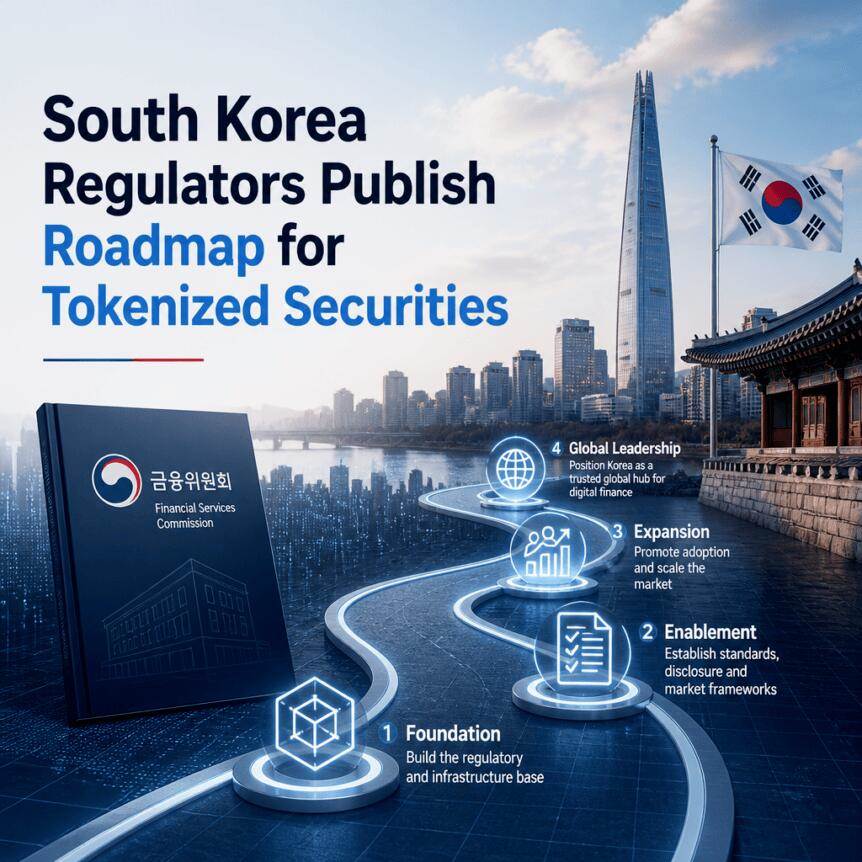
BTC The Financial Commission of Korea releases a roadmap for tokenized securities
The Financial Commission of Korea (FSC) has outlined a three-phase plan to establish the legal and technical foundation for issuing tokenized securities covering assets such as stocks, bonds and funds. The roadmap aims to integrate tokenization into South Korea's existing capital market framework, rather than treating it as an independent, unregulated activity.
In a press release issued on Friday, the Finance Commission said that with the amendment to the Electronic Stock and Bond Registration Act taking effect on February 4, 2027, tokenized securities will receive formal legal recognition and be considered a digital form of securities. This implementation timetable is closely related to the promotion of the broader revised Capital Market Law and Electronic Securities Law.
Core Points
- Legal status establishment: On February 4, 2027, the amendment to the Electronic Stock and Bond Registration Law will take effect on tokenized securities.
- Phase 1 (starting with accreditation): covers institutional money market funds, bonds, unlisted stocks and share investment securities.
- Phase 2: Expand scope to extend tokenization to all publicly issued securities.
- Phase 3: For on-chain settlement, promote on-chain payments linked to stablecoins.
- Infrastructure construction: The Financial Commission will work with the Korea Securities Depository (KSD) to establish the necessary tokenization infrastructure.
Content of the 2027 Financial Commission reform
The Financial Commission's roadmap relies on a legal shift: Under South Korea's e-registration framework, tokenized securities will be considered a digital version of traditional securities. According to the Financial Commission, this change is expected to take effect on February 4, 2027 after the relevant statutory updates take effect.
Once this shift is achieved, tokenization tools will no longer be just "securities with additional technology layers." Instead, they will be recognized within the legal system that governs stock and bond registrations-an important distinction for issuers, investors and intermediaries who need clear rights, governance and compliance.
For market participants, legal recognition is often a prerequisite for large-scale offerings and broader participation. Without such recognition, tokenized products often face uncertainty in terms of transferability, custody, and enforcement of investor protection. The Finance Commission's plan aims to bridge these gaps by integrating tokenized securities into the capital market system.
Phase 1: Recognition of limited products
During the first phase, the Finance Commission stated that tokenized securities will be legally recognized in multiple categories, including institutional money market funds, bonds, unlisted stocks and decision-based investment securities. This sequencing is important because it starts in areas where regulators can more directly define operational boundaries, while infrastructure and oversight processes are still being established.
The Finance Commission also linked the roadmap to the planned implementation of two legislative components: the revised Capital Markets Act and the Electronic Securities Act, which together constitute what the Finance Commission calls the country's first tokenized securities framework. Early in the process, the Financial Commission said it was preparing detailed rules for tokenized securities, aiming to include tokenized securities in South Korea's capital market framework by 2027.
The practical question for phase 1 participants is how to handle tokenization end-to-end-including issuance, registration, transfer and custody-especially for instruments such as shared-based investment securities whose ownership units may differ from traditional models.
Phases 2 and 3: Expand offerings and test new payment channels
Phase 2 of the Finance Commission roadmap plans to extend tokenization to all publicly issued securities . This is a significant improvement because it means that under the same umbrella rule, tokenized products can be used more widely by both retail and institutional investors.
However, the Finance Committee did not specify a specific disclosure date for the transition to the second phase in its press release. Instead, it said it would determine the time after subsidiary regulations were submitted and improved.
The third phase introduces additional technical ambitions: On-chain payments linked to stablecoins 。In other words, the Financial Commission aims not only to tokenize the asset layer (securities issuance and ownership records), but also to modernize parts of the settlement process. The stablecoins mentioned here as links to on-chain payment settlements reflect regulators 'efforts to coordinate tokenized securities workflows with digital payment mechanisms.
Still, major implementation details-such as which stablecoin frameworks, if any, will be considered, how payment flows will be controlled, and what kind of supervision will apply-were not specified in the announcement. Market observers may focus on the amendments to subsidiary rules that the Financial Committee plans to propose after consulting relevant stakeholders.
Regulatory coordination and follow-up matters for investors
The Financial Commission said it will work with China Korea Securities Custody (KSD) to develop the necessary tokenized infrastructure before the launch of the roadmap. This coordination is a practical signal: if the core market pipeline-especially the registration and transfer process-cannot reliably handle tokenization formats, tokenized securities cannot be scaled.
After announcing the roadmap, the Finance Committee also said it plans to propose amendments to relevant subsidiary regulations by the end of September, and then decide on the timetable for the second and third phases. For investors and platform builders, this period of regulatory and technical rulemaking may be the most important window into understanding how compliance works in practice.
In addition, it is necessary to place the roadmap in the context of South Korea's broader regulatory movement around tokenized assets. It was previously reported that the Financial Commission said it would issue detailed rules for tokenized securities in 2027 to include tokenized securities in the capital market framework. In addition, in April this year, the Ministry of Economy and Finance of South Korea announced a pilot project involving tokenized deposits to implement government operating expenditures, with a comprehensive promotion target set for the fourth quarter of 2026.
Overall, these developments suggest that regulators are viewing tokenization as a structural modernization of finance-starting with legal recognition, then expanding product coverage, and finally testing settlement innovations that may connect on-chain activities to regulated payment processes.
At present, the key points of observation are the subsidiary regulation revisions at the end of September, the exact operating requirements for tokenization infrastructure developed jointly with KSD, and how the third phase handles on-chain payments linked to stablecoins while retaining investor protection and settlement finality.