Exchange Ranking
 Top Exchanges
 24h Volume Ranking
 Popularity Ranking
 Exchange BTC Balance
 Proof of Reserves
 Decentralized Exchanges
 Funding Rate
 Funding Heatmap
 Liquidation Data
 Max Pain
 Long/Short Ratio
 Whale L/S Ratio
 Binance/Okex/Huobi L/S
 Bitfinex Margin L/S
 ETF Tracker
 Solana ETF
 XRP ETF
 Hong Kong ETF
 Bitcoin Treasuries
 Crypto Reversal
 Ethereum Reserves
 HyperLiquid Wallet Analysis
 Hyperliquid Whale Watch
 Large Transactions
 On-chain Movement
 Bitcoin ROI
 Stablecoin Market Cap
 Options Analysis
 News
News Articles
 Economic Calendar
 Features
 Wallet
 Contract Calculator


 Security
 Collections
 Watchlist
 Following
Polish Parliament fails to overturn President's veto of crypto regulation bill
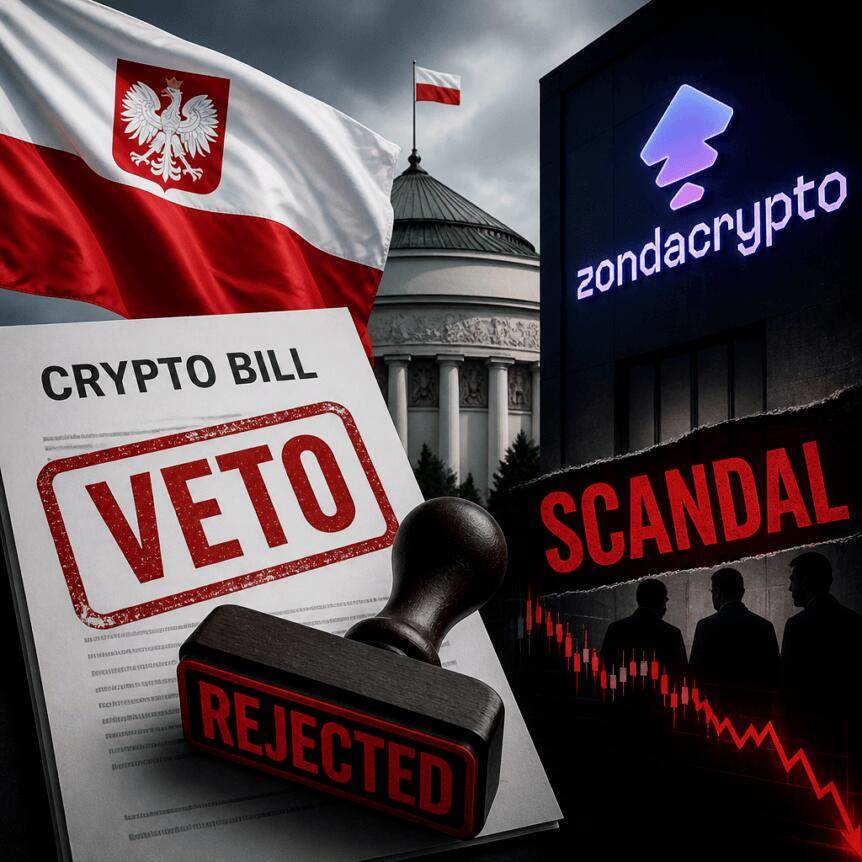
Polish lawmakers have again failed to reach the super majority needed to overturn President Karol Nawrocki's veto of a bill aimed at strengthening the regulation of crypto assets. On Friday, the House of Representatives tried to override the veto with a vote of 241 to 198, but with three abstentions, the final vote was 25 votes short of the 266 votes needed to pass it. This marks another failure in Poland's efforts to establish a national framework compliant with the EU's Cryptographic Asset Markets Regulation (MiCA).
This re-vote comes against the backdrop of Poland being mired in the aftermath of the Zondacrypto scandal. The scope of the case has widened further as bankruptcy proceedings unfold against the Zondacrypto Estonia operator and Prime Minister Donald Tusk cited testimony alleging improper attempts to influence politicians.
Core Points
- The House's attempt to override the veto failed by 25 votes, failing to reach the 266-vote threshold, and President Nawotsky's veto remains valid.
- The bill originally planned to give crypto market regulatory responsibilities to the Polish Financial Supervisory Authority (KNF) to align with MiCA regulations that have been implemented across the EU.
- Although MiCA has come into effect in the EU, KNF stated that Poland still lacks a designated authority responsible for regulating crypto assets.
- At the same time, prosecutors are investigating suspected fraud and money-laundering related to Zondacrypto, which previously estimated losses of no less than PLN 350 million.
- According to an announcement issued in August, Zondacrypto's operator BB Trade Estonia has been declared bankrupt by the Estonia court.
The veto once again hinders the legislative process
Friday's parliamentary vote was the latest attempt after Navotsky vetoed relevant legislation three times. The president previously believed the rules would cause excessive regulation of the industry. He expressed support for regulating crypto assets, but believed the bill's approach was too radical, including concerns about compliance costs and authorities 'ability to block websites.
In the House vote, members voted 241 to 198 to override the veto, with three others abstaining. Because it did not meet the three-fifths majority requirement stipulated in the Constitution, the bill could not be moved forward despite receiving parliamentary majority support.
For market participants, repeated vetoes highlight a core uncertainty: While MiCA forms the legal basis at the EU level, domestic legislation is still needed to determine who will actually regulate crypto activities and enforce the rules. The lack of this clarity may lead to companies continuing to face regulatory ambiguity in terms of license applications, regulatory procedures and enforcement coordination.
Poland still has no designated regulatory authority under the MiCA framework
The core of the controversy is how to implement MiCA in Poland. The defeated legislation aims to establish a national framework for Poland to apply MiCA, which includes placing crypto market regulation under the Polish Financial Supervisory Authority (KNF).
The KNF noted in a statement on Friday that although MiCA has been applied across the European Union, Poland still lacks a designated authority responsible for overseeing the crypto asset market. This statement is significant because the effectiveness of MiCA for businesses depends not only on EU-level rules, but also on national enforcement structures and supervisory responsibilities.
Navotsky's stance contrasts with the urgency emphasized by regulators and government stakeholders. Although the president is not entirely opposed to crypto regulation, his reasons for veto have repeatedly pointed out that the proposed Polish framework could impose excessive burdens or grant him powers that he deems too powerful.
Investors and crypto companies concerned about Poland should pay attention to how to handle this regulatory vacuum in the absence of an operating national system. The longer Poland remains vacant as a designated supervisory authority, the greater the likelihood that compliance and enforcement decisions will be delayed or fragmented compared to other EU member states that have implemented supervisory arrangements.
Zondacrypto investigation expands, operator moves towards bankruptcy
Friday's parliamentary vote came against the backdrop of deepening criminal investigations related to failed crypto exchange Zondacrypto. Prime Minister Donald Tusk has disclosed excerpts of what he called key witness testimony on allegations involving payments to politicians linked to Poland's former government and attempts to exert influence.
Tusk said witnesses alleged the existence of a payment arrangement of 2 million zlotys (about US$550,000) linked to a foundation linked to former Justice Minister Zbigniew Ziobro. In another testimony cited by Tusk, witnesses accused an unnamed person of promising a presidential pardon if the witness was convicted.
Polish prosecutors are investigating suspected fraud and money laundering related to Zondacrypto. In a previous investigation, prosecutors merged the Zondacrypto case with the investigation into the 2022 disappearance of BitBay founder Sylwester Suszek, which later changed its name to Zondacrypto.
Prosecutors estimated in April that losses related to Zondacrypto were no less than 350 million zlotys (approximately US$95 million). Such data is likely to continue to put pressure on policymakers to strengthen oversight and enforcement mechanisms, especially with regard to exchange and custody related risks.
Parallel to the criminal investigation, BB Trade Estonia, the exchange's operator, has been pushed into formal bankruptcy proceedings. According to an announcement, an Estonia court declared the company bankrupt in August, and the first creditor meeting is scheduled for September 17.
For users and creditors, bankruptcy may shift the focus from tracking violations to asset recovery and claim verification. For regulators and lawmakers, the Zondacrypto incident adds to the sense of urgency to establish clear oversight structures-especially if oversight bodies are expected to need to monitor compliance risks that are allegedly exploited by failed entities.
The significance of regulatory battles transcends national borders
Poland's standoff is more than just a domestic political game. It highlights broader tensions in the EU's post-MiCA transition: even though the rule system is defined at the EU level, member states still control the pace and structure of implementation through domestic legislation and supervisory authorizations.
Given that KNF has previously stated that it lacks a designated authority responsible for overseeing crypto assets, the impact is substantial. Companies aiming to comply with MiCA may find it difficult to clarify responsibilities when the role of supervisors is uncertain; regulators may also face the challenge of coordinating enforcement without clear institutional leadership.
The Zondacrypto case has also raised the political attention of crypto regulation. As criminal investigations expand and bankruptcy proceedings advance, policymakers may face increasing pressure to align regulatory authority, investigative capabilities and compliance requirements, especially for platforms that are at the center of investor funding and custody arrangements.
Readers should focus next on whether lawmakers will attempt another vote to override the veto, or whether governments and regulators will seek alternative paths to allocate oversight responsibilities. The key uncertainty remains as to who will ultimately oversee Poland's crypto assets as MiCA obligations are transformed from EU law to day-to-day enforcement.