Exchange Ranking
 Top Exchanges
 24h Volume Ranking
 Popularity Ranking
 Exchange BTC Balance
 Proof of Reserves
 Decentralized Exchanges
 Funding Rate
 Funding Heatmap
 Liquidation Data
 Max Pain
 Long/Short Ratio
 Whale L/S Ratio
 Binance/Okex/Huobi L/S
 Bitfinex Margin L/S
 ETF Tracker
 Solana ETF
 XRP ETF
 Hong Kong ETF
 Bitcoin Treasuries
 Crypto Reversal
 Ethereum Reserves
 HyperLiquid Wallet Analysis
 Hyperliquid Whale Watch
 Large Transactions
 On-chain Movement
 Bitcoin ROI
 Stablecoin Market Cap
 Options Analysis
 News
News Articles
 Economic Calendar
 Features
 Wallet
 Contract Calculator


 Security
 Collections
 Watchlist
 Following
 BTC
BTC Bitcoin's sharp correction is gradually narrowing
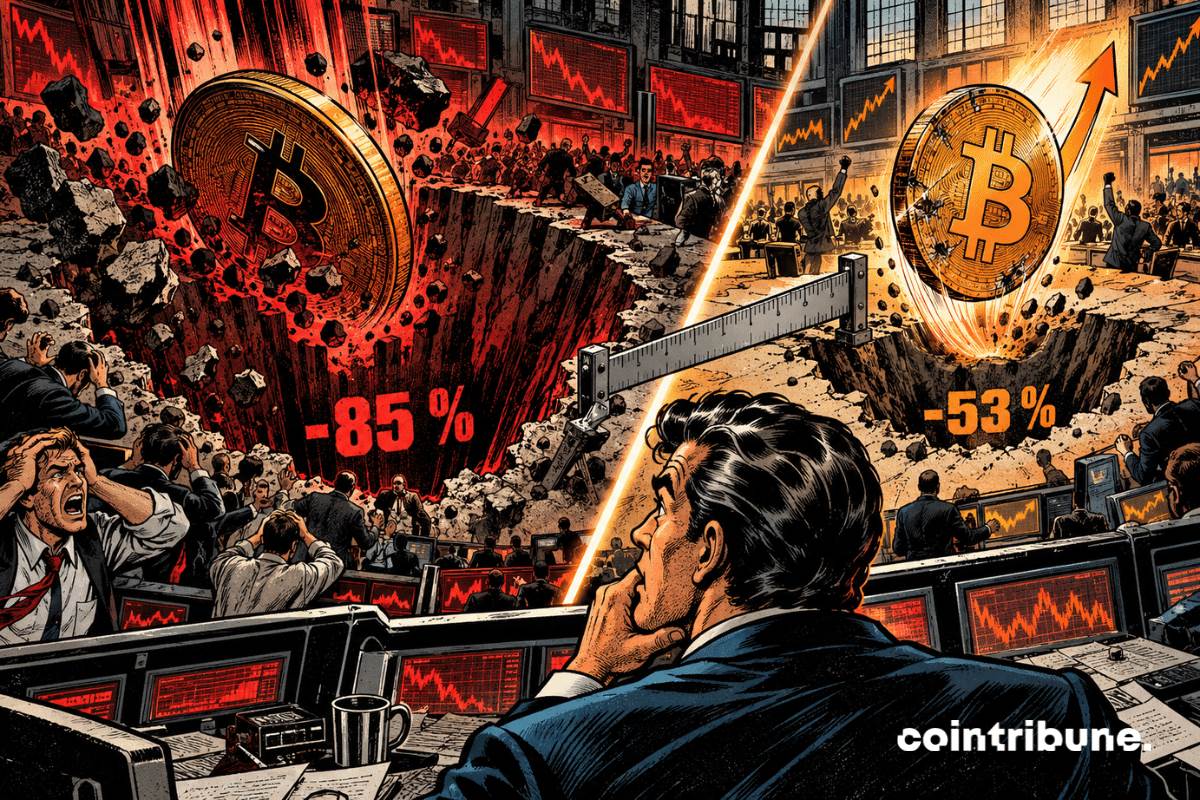
Bitcoin's main correction is gradually decreasing. In the early cycle, the decline was about 85%, followed by 84%, 77%, and in the current cycle, this figure has dropped to nearly 53%. Data compiled by Galaxy Research shows that although the bottom of the 2025-2026 cycle has not yet been finally confirmed, this gradual compression trend is still clearly visible.
Summary of Core Points
- Bitcoin's significant retracement has narrowed from approximately 85% to 53%.
- The rebound between lows and highs also dropped significantly.
- The four-year cycle pattern is still visible, but the amplitude of fluctuations is tightening.
- Bitcoin is absorbing an increasingly shallow correction.
Evolution of deep pullbacks
Looking back on history, this trend shows a clear sequence. In 2014, Bitcoin fell by about 85% from its peak. With the launch of futures contracts in 2017 and the intervention of Wall Street Capital, the next decline still reached 84%. In the 2020-2021 market, the entry of new institutional investors such as MicroStrategy and Tesla changed the market structure, and Bitcoin's subsequent correction was about 77%.
Currently, the correction in this cycle temporarily stops at-53%. As early as February, it was pointed out that despite different market structures, the signals on the chain are still consistent with the four-year cycle. From-85% to-53%, the gap reached 32 percentage points. Proportionally, the current depth of the pullback is nearly 38% less than in the first major cycle.
This change is not caused by a single event. The launch of physical bitcoin ETFs, the inclusion of BTC in corporate treasury reserve strategies, and the expansion of the investor base have all added buyer power to the market that was lacking in earlier cycles. That doesn't stop the decline entirely, but at least it stops it at a higher level.
Bull rallies also shrink
When we look at the bullish phase, we can see its corresponding side. Data shows that between cyclical lows and subsequent highs, Bitcoin has increased by approximately 580 times, 130 times, 22 times, and then 8 times. This decline was extremely significant, with the multiple between the first and fourth rounds shrinking by more than 72 times.
As a result, the decline in Bitcoin is no longer drastic, and the bull market rally that has occurred so far is less extreme. This evolution is consistent with recent discussions about market maturity. Michael Saylor believes that with the influx of institutional capital and ETFs, the impact of the traditional four-year cycle is waning.
However, this phenomenon is difficult to attribute accurately. ETFs can indeed sell some of the pressure through stable demand buffers, but they alone cannot explain why the amplitude has decreased. The halving mechanism is not as mechanical as Bitcoin's early days. Although each halving will still reduce the issuance of new BTC, this new supply accounts for a very small proportion of the current huge market. The new scarcity available for absorption is reduced, while the capital already on the market has increased significantly.
Four-year cycle has not disappeared yet
The compression of fluctuations is not enough to bury this historic cycle. Galaxy Research points out that the previous sequence continues to follow a tight timeline: bottom, half, peak, and then a new round of pullbacks. The three previously completed cycles all bottomed out about 12 to 13 months after peaking.
The current cycle has not yet been completed. This is why the figure of-53% has important limitations. If Bitcoin hits a new low, the depth of this correction will deepen in a mechanical sense. Therefore, this percentage should be regarded as a snapshot of the current market stage rather than a final conclusion.
At the same time, the sense of existence of institutions remains real. On September 2, after experiencing a strong round of capital outflows in the United States, the Bitcoin ETF still attracted US$101.15 million in capital inflows. As a result, the market in 2026 does not look like the early cycle in terms of amplitude, but still retains certain rhythm characteristics. The correction shrank from 85% to 53%, and the rebound shrank. To determine whether this compression has become a structural trend, we must first clarify the true bottom of the current cycle.