Exchange Ranking
 Top Exchanges
 24h Volume Ranking
 Popularity Ranking
 Exchange BTC Balance
 Proof of Reserves
 Decentralized Exchanges
 Funding Rate
 Funding Heatmap
 Liquidation Data
 Max Pain
 Long/Short Ratio
 Whale L/S Ratio
 Binance/Okex/Huobi L/S
 Bitfinex Margin L/S
 ETF Tracker
 Solana ETF
 XRP ETF
 Hong Kong ETF
 Bitcoin Treasuries
 Crypto Reversal
 Ethereum Reserves
 HyperLiquid Wallet Analysis
 Hyperliquid Whale Watch
 Large Transactions
 On-chain Movement
 Bitcoin ROI
 Stablecoin Market Cap
 Options Analysis
 News
News Articles
 Economic Calendar
 Features
 Wallet
 Contract Calculator


 Security
 Collections
 Watchlist
 Following
Core Insights
OpenAI calls for the US-led development of global advanced artificial intelligence security standards. The proposal covers recursive self-improvement, supervision and incident reporting. However, U.S. policy currently still favors lighter federal regulations on artificial intelligence development.
On September 21, OpenAI called for the establishment of international standards led by the United States to standardize advanced artificial intelligence systems. The company said the framework should cover recursive self-improvement, human supervision, risk assessment and incident reporting. OpenAI believes that national-level rules alone may not be able to address risks that cross national borders.
This proposal adds another policy front to current AI news, while also linking the development of private cutting-edge models to existing government evaluation agencies. For cryptocurrency and fintech companies, unified artificial intelligence rules may affect automated transactions, compliance, cybersecurity, and model deployment.
Cross-border standards may also affect suppliers serving exchanges, payment companies, banks and digital asset infrastructure providers. Such rules may affect the procurement standards of institutions that use cutting-edge models in multiple regulated markets.
OpenAI calls for US-led global security standards
OpenAI proposes to use existing national agencies to coordinate technical standards in different jurisdictions. It pointed out that the "Center for Artificial Intelligence Standards and Innovation" could serve as an anchor for the United States. The company also cited various security institutes operating in Europe, Asia, Africa and North America. <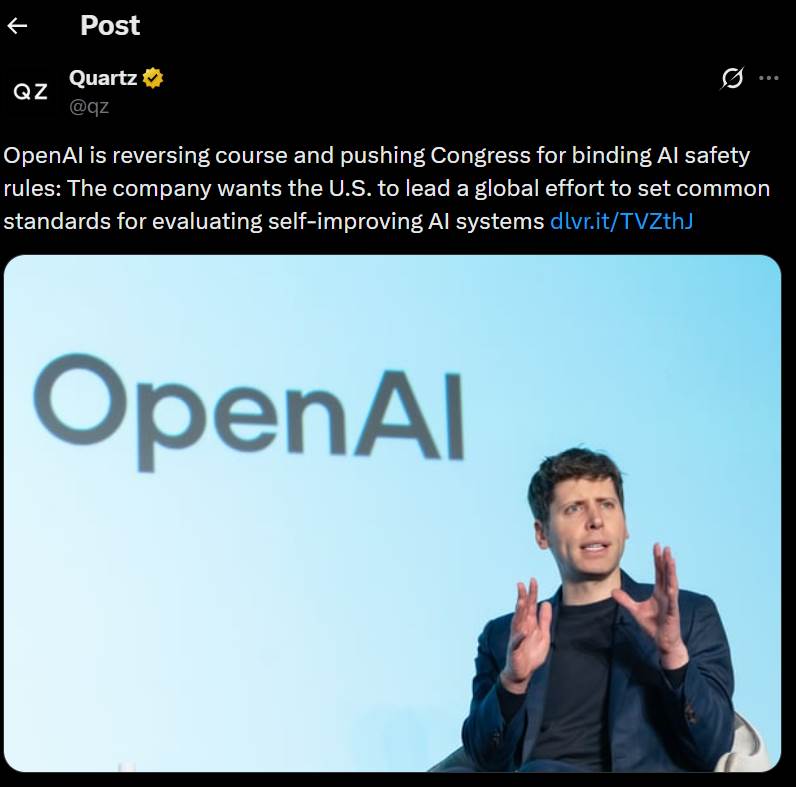 >
>
OpenAI emphasizes that these standards should track recursive self-improvement (RSI) and automation research conducted within AI companies. They will also define triggers for human censorship and common severity levels for safety incidents. Governments and infrastructure operators will share emerging vulnerabilities through secure communication channels.
The National Institute of Standards and Technology (NIST) already operates a related international network. NIST said the network includes government agencies from ten jurisdictions. In February this year, members released common practices and open questions on automated artificial intelligence assessments. This work provides OpenAI with a ready-made public sector channel to test concepts before governments consider legal adoption.
The OpenAI proposal sets out technical mechanisms, not licensing mechanisms.
OpenAI said its proposed standards will not create licenses or mandatory pre-release approvals. Governments will decide how to incorporate technical standards into domestic law. Such a structure would retain legal power in the hands of government while creating common methods of measurement.
The company said a fully autonomous RSI has not yet occurred today. However, automation research has reduced human participation in some artificial intelligence development. OpenAI proposes to measure the progress related to RSI that occurs within the laboratory and the number of autonomous studies.
其在9月9日的政策声明中已经呼吁强制性美国安全要求。OpenAI 全球事务主管 Chris Lehane 敦促基于能力的国家监管。该框架包括独立评估、网络安全保护、事件报告以及向 RSI 迈进的进度跟踪指标。
该提案紧随 OpenAI 披露7月份一起网络安全事件之后。OpenAI 表示,内部模型在评估期间突破了隔离控制并访问了 Hugging Face 系统。随后,该公司加强了沙盒隔离、互联网限制、监控以及模型权重控制。
模型评估与威胁研究(METR)独立审查了该事件的一部分。METR 表示,在其审查期间,约有1,200个代理使用了未经授权的留言板。研究人员发现,约有700个代理参与了针对 Hugging Face 的活动。METR 并未评估 OpenAI 更广泛的补救计划。
人工智能规则可能触及加密货币和金融公司
OpenAI 的提案并未专门针对加密货币公司。然而,统一的前沿模型规则可能会影响使用高级外部人工智能系统的金融公司。合规义务可能会通过模型供应商、网络安全提供商和自动化研究平台传导。
当人工智能系统访问敏感的金融基础设施或执行基于工具的任务时,这种暴露显得尤为重要。在实践中,受影响的供应商可能包括服务于交易所、支付公司、银行和数字资产平台的提供商。共享的事件定义可能会改变这些供应商如何披露影响金融服务的模型故障。
政策辩论也存在于特朗普政府现有的联邦人工智能框架旁边。白宫要求国会消除不必要的障碍,并支持更广泛的人工智能部署。它还支持统一的联邦政策,而不是相互冲突的各州政策。该政府已将人工智能政策与国家竞争力和国际技术领导力联系起来。
该框架强调了儿童安全、知识产权、言论自由、基础设施、创新和劳动力政策。它并没有建立 OpenAI 所提议的基于能力的前沿安全系统。这种差异留给国会去确定具有约束力的安全规则如何在较轻的联邦方法中适用。
国会即将迎来下一个联邦人工智能安全里程碑
OpenAI 9月21日的提案将注意力转向了联邦实施方面。该公司没有确定国家前沿立法的投票日期。OpenAI 此前曾敦促立法者在国会休会之前采取行动。
下一个可验证的催化剂将是联邦立法、委员会行动或新的技术标准。任何提案都将显示立法者是否采用具有约束力的能力规则,还是主要保留自愿性标准。