Exchange Ranking
 Top Exchanges
 24h Volume Ranking
 Popularity Ranking
 Exchange BTC Balance
 Proof of Reserves
 Decentralized Exchanges
 Funding Rate
 Funding Heatmap
 Liquidation Data
 Max Pain
 Long/Short Ratio
 Whale L/S Ratio
 Binance/Okex/Huobi L/S
 Bitfinex Margin L/S
 ETF Tracker
 Solana ETF
 XRP ETF
 Hong Kong ETF
 Bitcoin Treasuries
 Crypto Reversal
 Ethereum Reserves
 HyperLiquid Wallet Analysis
 Hyperliquid Whale Watch
 Large Transactions
 On-chain Movement
 Bitcoin ROI
 Stablecoin Market Cap
 Options Analysis
 News
News Articles
 Economic Calendar
 Features
 Wallet
 Contract Calculator


 Security
 Collections
 Watchlist
 Following
 BTC
BTC  ETH
ETH  SOL
SOL  XRP
XRP XRP deepens penetration in regulated financial markets: ETF funds, derivative infrastructure and institutional positions
XRP is increasingly deeply embedded in regulated financial markets, and new developments cover ETF capital flows, derivatives infrastructure and institutional ownership. Canada-listed XRP ETF options are now explicitly included in the framework that allows them to be offered and sold in the United States, while federal regulations continue to tie XRP with Bitcoin, Ether, and Solana for certain exchange-listed investment products.
This expansion comes at a time when the U.S. spot XRP ETF shows unusually strong demand. On September 8, despite outflows from Bitcoin, Ethereum and Solana ETFs, the XRP Fund attracted new capital, continuing the trend of institutional accumulation. At the same time, comments by David Schwartz, former chief technology officer of Ripple, have reignited discussions about how big XRP can eventually become if adoption continues to accelerate.
XRP ETF options gain clear path into the U.S.
A document from the Canadian Derivatives Clearing Corporation (CDCC) places XRP in another corner of the regulated financial landscape, along with some of the largest cryptocurrencies. The document lists options on the Evolve XRP ETF and Purpose XRP ETF covered in Montreal Exchange contracts, which have been registered under CDCC's Form S-20 and are allowed to be offered and sold in the United States.
This development does not mean that new XRP options are listed directly on U.S. exchanges. The contract is still available in Canada and is being cleared through the CDCC. Instead, the document establishes a regulated cross-border structure that allows eligible U.S. market participants to access options linked to Canadian XRP ETFs.
This difference is important because XRP is gradually gaining exposure at several levels of traditional market infrastructure, rather than relying mainly on offshore cryptocurrency derivatives. Earlier 2026 Securities and Exchange Commission exhibits already included options for the Evolve and Purpose XRP ETFs, so the latest filing strengthens existing regulatory approaches rather than represents a completely new approval.
XRP is also classified as a larger digital asset in other federal market rules. A separate Federal Register filing states that Bitcoin, Ethereum, Solana and XRP are assets that meet the general listing criteria for commodity trust shares.
This classification should not be interpreted as a comprehensive determination of the status of XRP in all regulatory environments. However, for investment product infrastructure, this suggests that XRP is increasingly appearing next to BTC, ETH and SOL as exchanges and regulators set rules for listed crypto products.
Institutional XRP trading is surpassing spot ETFs
This cross-border options development is combined with the already rapidly expanding institutional derivatives market. In the first quarter of 2026, nominal trading volume of CME XRP futures and options was approximately US$13 billion, while subsequent cumulative XRP futures trading volume exceeded US$62 billion.
These data signal a broader shift in the way professional investors gain XRP exposure. Spot ETFs provide direct investment channels, while futures and options provide institutions with tools to hedge positions, express directional views, and manage risk without having to rely entirely on native cryptocurrency exchanges.
This infrastructure also makes XRP more practical for large portfolios. Institutional investors typically need liquid derivatives and regulated custody or investment vehicles before investing large amounts of capital in an asset. So even if the launch of individual products does not immediately affect their prices, XRP's growing presence in ETFs, futures and options remains significant.
For readers following the latest XRP news, the trend is becoming increasingly consistent: XRP is gaining more of the market infrastructure previously developed around Bitcoin and Ethereum.
XRP ETF bucked the trend out of broad crypto fund outflows
Recent ETF capital flows provide another sign that investor interest remains solid. On September 8, the U.S. spot XRP ETF recorded a net inflow of US$1.55 million, while other major cryptocurrency ETF classes experienced withdrawals.
Source: SoSoValue
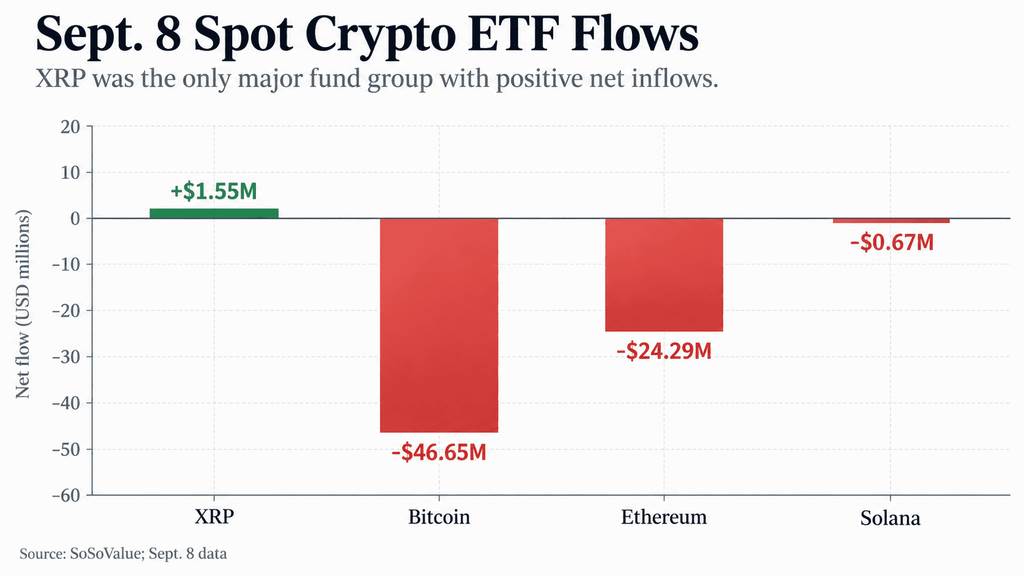
The Bitcoin ETF recorded an outflow of approximately US$46.65 million, the Ethereum Fund lost approximately US$24.29 million, and Solana products withdrew approximately US$668,000. Although the $1.55 million entering XRP products itself was relatively small, the direction of money flow during that trading session distinguished XRP from the rest of the major cryptocurrency ETF markets.
This divergence follows a stronger cumulative trend. The XRP ETF has previously recorded inflows for 11 consecutive trading days, bringing approximately US$170 million in capital to the product, while its strongest week of 2026 generated US$110.49 million in new capital. As of early September, cumulative inflows had reached approximately US$1.66 billion to US$1.68 billion.
Institutional ownership has also become more obvious. Goldman Sachs became the largest disclosed holder of the XRP ETF, with approximately $87.4 million, while companies such as Jane Street and Millennium Management also appeared on the list of significant reported holders.
A single trading session does not establish a permanent rotation from Bitcoin or Ethereum to XRP, especially since the Bitcoin ETF market is still much larger. However, the persistence of XRP inflows is becoming increasingly remarkable as demand continues at a time when a wider range of cryptocurrency investment products are struggling to attract capital.
XRP prices strengthen with ETF demand
Recent positive ETF capital flows are also consistent with the improvement in XRP market prices. On September 9, XRP traded at approximately US$1.43, up approximately 2.7% in 24 hours and 7.4% in 7 days, with daily trading volume approaching US$2.87 billion.
The relationship is not always direct. During the early recorded inflow of XRP ETFs, prices fell and came under pressure from rising government bond yields, suggesting that institutional fund demand alone was not enough to determine the short-term market direction.
The latest situation presents a more favorable combination. ETF flows are back in positive territory and XRP itself is moving higher, which may provide investors with a clearer signal that institutional buying and spot market demand are moving in the same direction.
As institutional participation increases, concentration of ownership remains another factor worth monitoring. Data on the largest XRP holders provides additional context on how token supply is distributed among major addresses, which is particularly important as the investor base evolves.
David Schwartz rekindled the debate over XRP over Bitcoin
The growth of regulated XRP products coincides with David Schwartz rekindled one of the most ambitious long-running debates on cryptocurrencies. The former chief technology officer of Ripple recently said he believes XRP may eventually surpass Bitcoin in market value.
Schwartz's argument is not based on the Bitcoin collapse. Instead, he suggested that the entire digital asset market could become bigger, allowing both cryptocurrencies to appreciate, but XRP would grow faster due to the capabilities and speed of XRP Ledger.
Current numbers show how ambitious this scenario is still. Bitcoin's market value is approximately US$1.58 trillion, while XRP is approximately US$88.9 billion, making Bitcoin approximately 17.7 times larger than XRP.
Considering that there are approximately 62.74 billion XRPs in circulation, assuming that Bitcoin's valuation remains unchanged, the price of XRPs needs to be close to US$25.10 each to match Bitcoin's current market value. This is not a price target. Any increase in Bitcoin's market value will increase the XRP beyond the price it needs.
Compared to the previous peak of XRP relative to Bitcoin, the gap also looks much wider. On January 1, 2018, XRP was the world's second-largest cryptocurrency, with a market value of approximately US$92.6 billion, compared with US$229.1 billion for Bitcoin. At the time, XRP was worth about 40% of Bitcoin, but today it is only about 5.6%.
XRP's institutional case is growing, but the gap with Bitcoin remains huge
The "flip" discussion is still highly speculative, but the institutional developments behind it are more specific. XRP now has growing demand for spot ETFs, an expanding CME derivatives market, and Canadian ETF options operating within a regulated cross-border framework.
The key question is whether these developments can translate into sustained capital inflows, rather than just more ways to trade the asset. XRP's recent ability to attract ETF funds when competing cryptocurrency funds have withdrawn provides an encouraging sign, but closing the huge valuation gap with Bitcoin requires dramatic adoption growth in scale.
At present, the more important development is not whether XRP can surpass Bitcoin, but that XRP continues to approach the regulated market structure around the industry's largest digital asset, providing institutions and traditional investors with more access to exposure than ever before.