Exchange Ranking
 Top Exchanges
 24h Volume Ranking
 Popularity Ranking
 Exchange BTC Balance
 Proof of Reserves
 Decentralized Exchanges
 Funding Rate
 Funding Heatmap
 Liquidation Data
 Max Pain
 Long/Short Ratio
 Whale L/S Ratio
 Binance/Okex/Huobi L/S
 Bitfinex Margin L/S
 ETF Tracker
 Solana ETF
 XRP ETF
 Hong Kong ETF
 Bitcoin Treasuries
 Crypto Reversal
 Ethereum Reserves
 HyperLiquid Wallet Analysis
 Hyperliquid Whale Watch
 Large Transactions
 On-chain Movement
 Bitcoin ROI
 Stablecoin Market Cap
 Options Analysis
 News
 Articles
 Economic Calendar
 Features
 Wallet
 Contract Calculator


 Security
 Collections
 Watchlist
 Following
Rep. Hank Hill: Regulators are making progress in regulating digital assets, but the United States still lacks the lasting, market-stable framework that only Congress can provide.
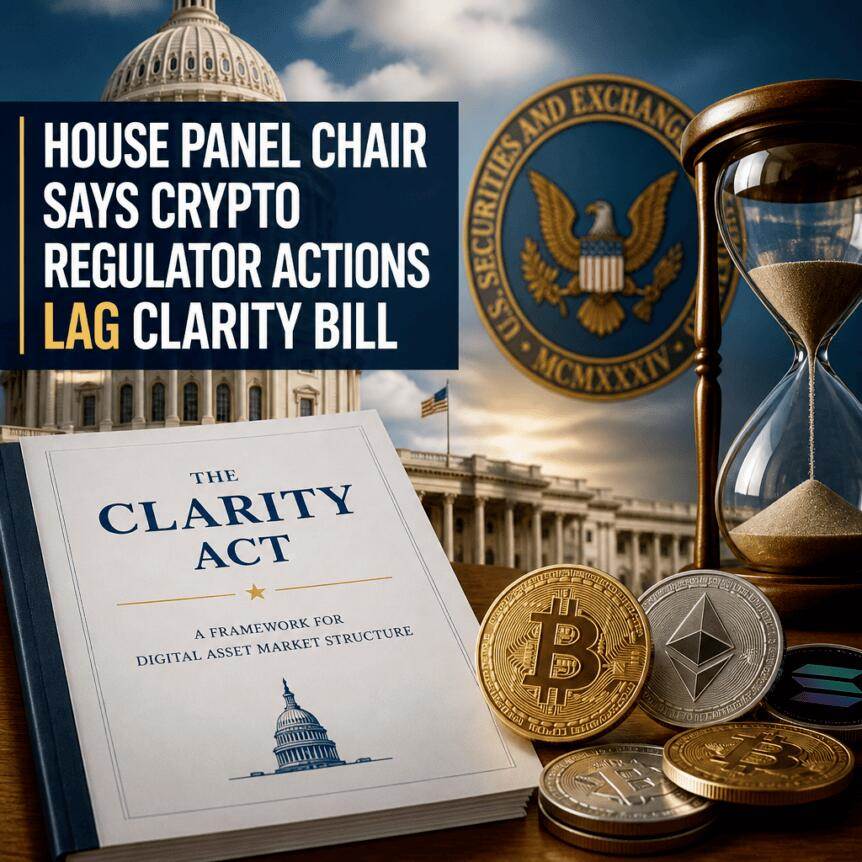
Rep. French Hill of Arkansas, chairman of the House Financial Services Committee, said this week that regulators have made progress in regulating digital assets, but the United States still lacks the lasting and market-stable legal framework that only Congress can provide.
Hill pointed out in an interview with Fox Business on Wednesday that after the U.S. Senate failed to pass the Digital Asset Market Clarity Act (CLARITY Act) last month, the Securities and Exchange Commission (SEC) and the Commodity Futures Trading Commission (CFTC) have taken steps aimed at establishing clearer rules for cryptocurrencies. However, Hill believes that these agencies 'initiatives are "insufficient" compared to a permanent legislative solution.
Core Points
- Hill said that although the CLARITY bill failed and the SEC and CFTC had advanced regulatory proposals, he firmly believed that only Congress could provide lasting certainty.
- Hill is pushing for review of the CLARITY bill during the lame duck session of Congress, hoping to reach a legislative solution before the next Congress begins.
- The limited window between the Senate election in November and the entry of new members in 2027-Hill cited a 22-day session-will determine whether the CLARITY bill can gain momentum.
- With the resignation of SEC Commissioner Hester Peirce, the total number of leadership vacancies in the SEC and CFTC has reached seven, adding to institutional uncertainty.
- Hill's comments came as the heads of the SEC and CFTC announced that they would continue to advance cryptocurrency regulatory plans under the guidance of President Donald Trump.
Hill argued that regulation requires a "permanent law" of Congress
Hill's comments position the current regulatory push as a response to political opportunity rather than an alternative to statutory clarity. According to Hill, because the Senate failed to pass the CLARITY bill last month, the SEC and CFTC took action, including launching a proposed rulemaking process to address different areas of cryptocurrency regulation.
Previous reports have pointed out that the CFTC's proposed framework has attempted to deal with different aspects of enforcement and regulation, but Hill pointed to a broader issue: In the absence of legislation, regulatory outcomes may remain unpredictable for markets over time.
During an interview, Hill said he still wants to see the CLARITY bill advanced during the "lame-duck" session of Congress and described it as a necessary "permanent legal change" to ensure that the United States remains competitive in digital assets and blockchain technology.
Why the "lame duck" session window is critical to the CLARITY Act
Hill also highlighted the constraints faced by congressional lawmakers. He pointed out that there is only a 22-day session between the Senate's mid-term elections in November and the next batch of members entering Congress in 2027. He believes that this short timeline could become a practical factor for lawmakers to support or oppose the CLARITY bill.
Hill said that during the "lame-duck" period, lawmakers may think more about whether they will return to office or leave Congress in January. Such political considerations may affect which measures will be prioritized once the election results are announced.
Increased uncertainty over leadership vacancies in the SEC and CFTC
Hill's comments accompanied signals that the institutional capabilities of the two major cryptocurrency regulators may be uneven. According to reports, a total of seven leadership positions are open in the SEC and CFTC.
Last week, Commissioner Hester Pierce announced her resignation from the SEC, which currently consists of Chairman Paul Atkins and Commissioner Mark Uyeda. On the CFTC side, Michael Selig serves as chairman and sole member.
Leadership changes and vacancies are important for market participants because the regulatory agenda-especially the timetable for rule-making and implementation priorities-often depends on internal consensus and staffing stability. While agencies can still use existing powers to act, long-term job vacancies may slow down decision-making or reshape how agencies coordinate over overlapping jurisdictions.
Regulatory plan continues to advance, but legal clarity remains a gap
希尔的批评也反映了美国加密货币治理中更大的紧张关系:各机构已继续提出并推进监管方法,但行业仍认为,全面的国会框架将减少模糊性。在此案例中,希尔将立法行动定位为锁定长期规则的方式,而不是依赖机构提案变化的节奏。
他的评论紧随SEC和CFTC负责人——分别是阿特金斯和塞利格——宣布将在唐纳德·特朗普总统的指导下继续推进加密货币监管计划的公告之后。尽管如此,希尔表示当前路径还不够,他认为拟议的规则制定无法完全复制立法的稳定性。
投资者和建设者应关注CLARITY法案是否能在有限的“跛脚鸭”会期中切实获得势头,以及SEC和CFTC的领导层更迭是否会影响拟议规则最终确定和实施的速度——特别是鉴于两家机构报告的空缺水平。