Exchange Ranking
 Top Exchanges
 24h Volume Ranking
 Popularity Ranking
 Exchange BTC Balance
 Proof of Reserves
 Decentralized Exchanges
 Funding Rate
 Funding Heatmap
 Liquidation Data
 Max Pain
 Long/Short Ratio
 Whale L/S Ratio
 Binance/Okex/Huobi L/S
 Bitfinex Margin L/S
 ETF Tracker
 Solana ETF
 XRP ETF
 Hong Kong ETF
 Bitcoin Treasuries
 Crypto Reversal
 Ethereum Reserves
 HyperLiquid Wallet Analysis
 Hyperliquid Whale Watch
 Large Transactions
 On-chain Movement
 Bitcoin ROI
 Stablecoin Market Cap
 Options Analysis
 News
 Articles
 Economic Calendar
 Features
 Wallet
 Contract Calculator


 Security
 Collections
 Watchlist
 Following
 BTC
比特币反弹主要源于内部资金轮动而非新增外部资本
根据Glassnode在《链上周报》(The Week Onchain)通讯中引用的链上研究,比特币近期的反弹更多是由市场内部的资金轮动所支撑,而非新鲜的外部资本流入。这一区别对于交易者和长期投资者至关重要,因为主要由现有持有者推动的上涨行情,一旦新买家开始获利了结,可能会迅速停滞。
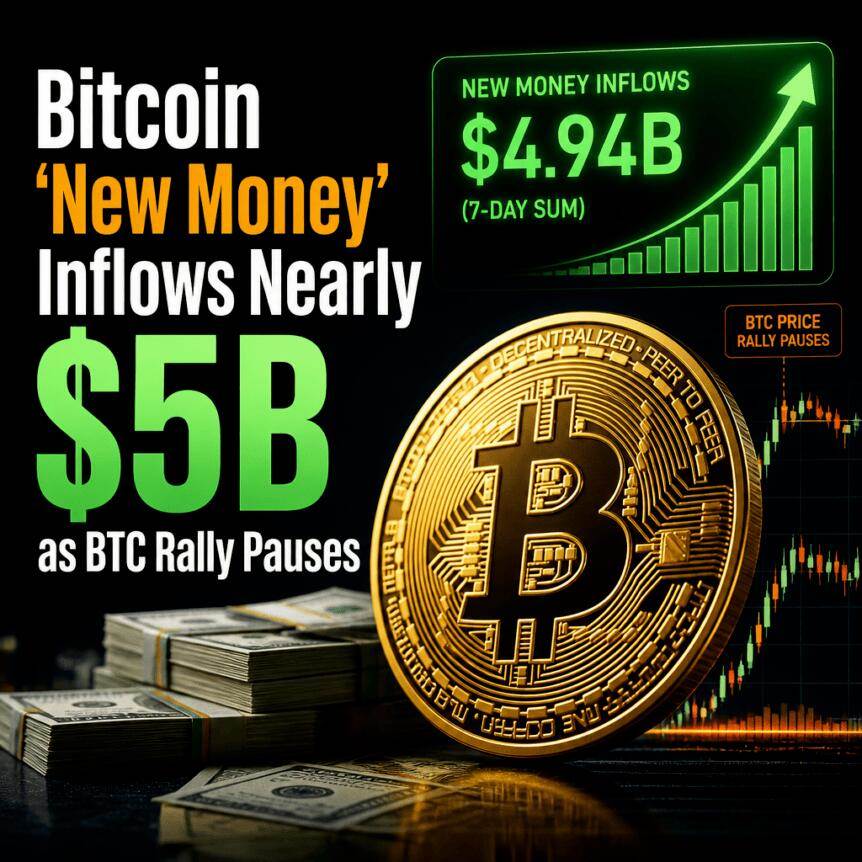
Glassnode数据显示,截至10月5日的30天内,流入比特币的“新资金”约为49亿美元;而同期比特币的已实现市值(Realized Cap,一种反映硬币上次移动价格的链上指标)增长了128亿美元。这一差距表明,大部分上涨来自于已在持有比特币的参与者之间以更高价格换手所致。
核心要点
- Glassnode估算,截至10月5日的30天内,“新资金”流入达到49亿美元,而比特币已实现市值增加了128亿美元。
- Glassnode指出,在此期间,现有投资者的活动约占已实现市值增长的五分之三。
- 当比特币交易价格在85,000美元上方时,短期持有者的获利了结占发送到交易所的硬币比例超过80%。
- Glassnode警告称,如果没有更强的资金流入,上行走势将严重依赖现有持有者在更高级别吸收抛压。
已实现市值增速快于“新资金”流入
在其最新一期《链上周报》中,Glassnode强调了衡量出的新鲜资本流入与比特币已实现市值扩张速度之间的错配。
Glassnode将“新资金”定义为现货购买及其他流入渠道的组合,包括企业国库的购买、稳定币的增长以及美国现货比特币ETF的流入。在截至10月5日的30天内,这些渠道总计增加了约49亿美元。
然而,在同一时期,比特币的已实现市值增加了128亿美元。按照Glassnode的说法,“新资金”仅覆盖了已实现市值增长的不到五分之二。研究认为,剩余部分来自现有持有者基础内的交易行为——即硬币以更高的价格转移到新所有者手中,而不是新的参与者推动市场上涨。
这种关于“力量来源”的问题在ETF环境建立后一直存在。Glassnote指出,自2024年1月ETF推出以来,流入量与已实现市值增长之间的分歧就已经出现。它还指出,2024年和2025年看到的反弹阶段具有类似的混合特征,但“流入量要大得多”。换句话说,当前市场的构成看起来更依赖于持有者之间的重新定价,而不是对外部持续扩大需求的依赖。
在这些流入增加之前,行情的推进取决于现有持有者支付更高的价格。
投资者结构差异影响反弹持续性
For investors, the difference between "new money" and realized market value growth is not just an academic issue. The realized market value is very sensitive to the time and place when the coin was last moved, so a continued increase can reflect the holder's continued willingness to trade at a higher price level. But when gains from realized market value exceed fresh inflows, the durability of the rebound may become more dependent on the behavior of existing holders-especially if rising prices encourage profit-taking.
Glassnode's analysis implicitly raises a risk: if the incoming demand remains moderate, the upward momentum may not accelerate on its own. Instead, it may depend on whether holders continue to trade at rising price levels without being overwhelmed by selling pressure.
So the next question for market participants is not just whether Bitcoin can continue to move higher, but whether the inflow of "new money" will be sufficient to support continued re-rating, rather than just a redistribution of existing supplies.
Profit-taking by short-term holders intensifies after exceeding $85,000
In addition to the divergence between inflows and realized market capitalisation, Glassnode also noted significant changes in the behavior of short-term holders (THs). These are usually investors who hold Bitcoin for a limited time window and are generally more sensitive to volatility reactions.
Research noted that profit-taking activity increased during the weekend, when Bitcoin closed above $85,000 for the first time since January. Glassnode reported that about 86% of coins sent to exchanges that day came from short-term holders-defined in the analysis as investors holding for less than 155 days-who moved coins while they were profitable. Glassnode said the ratio was the highest in the past year, compared with a typical level of less than two-fifths.
This is important because exchange inflow channels can signal potential selling pressure. If more recently acquired coins flow to exchanges during the rally, depth near key resistance levels could thin and prices could be more prone to a correction-even if overall sentiment supports gains.
"Liquidity above" and a familiar ceiling near $87,000
Glassnode's on-chain observations are consistent with the continued price struggle at recent range highs. According to market background cited by Cointelegraph earlier this week, Bitcoin has tried four times to break the $87,000 mark since September 21, but each attempt has been blocked by buyers encountering thicker sell order liquidity on the exchange order book.
At the time of writing of the source report, the BTC/USD price was approximately US$83,000, down about 1% month-to-date, and had been hovering in the US$83,000 region before. Although exchange order book dynamics differ from the realized indicators on the chain, both point to a market where the rebound meets continued selling interest at a higher level.
Glassnode also described that the cost benchmark for short-term holders remains below current prices. According to CryptoQuant data, as of October 7, the realized price of STH was approximately US$78,250 per piece. This means that the STH group is still at net profit-which provides a clear incentive for profit-taking if price movements remain volatile or resistance levels persist.
Looking ahead, investors may be concerned about whether inflows of "new money" are sufficient to absorb the STH-led sell-off and whether realized market values continue to rise without a corresponding increase in exchange inflows from profit-taking groups. If inflows remain moderate and short-term holders continue to distribute profits, Bitcoin's upside could be much more fragile than headline prices suggest.