Exchange Ranking
 Top Exchanges
 24h Volume Ranking
 Popularity Ranking
 Exchange BTC Balance
 Proof of Reserves
 Decentralized Exchanges
 Funding Rate
 Funding Heatmap
 Liquidation Data
 Max Pain
 Long/Short Ratio
 Whale L/S Ratio
 Binance/Okex/Huobi L/S
 Bitfinex Margin L/S
 ETF Tracker
 Solana ETF
 XRP ETF
 Hong Kong ETF
 Bitcoin Treasuries
 Crypto Reversal
 Ethereum Reserves
 HyperLiquid Wallet Analysis
 Hyperliquid Whale Watch
 Large Transactions
 On-chain Movement
 Bitcoin ROI
 Stablecoin Market Cap
 Options Analysis
 News
 Articles
 Economic Calendar
 Features
 Wallet
 Contract Calculator


 Security
 Collections
 Watchlist
 Following
 BTC
 ETH
 ZEC
Key facts
Zakura engineer Roman Akhtariev said that the team plans to introduce post-quantum signature opcodes to the Zcash network in January, but a specific date for network activation has not yet been determined. The plan first targets transparent addresses, which hold approximately 70% of the circulating ZECs.
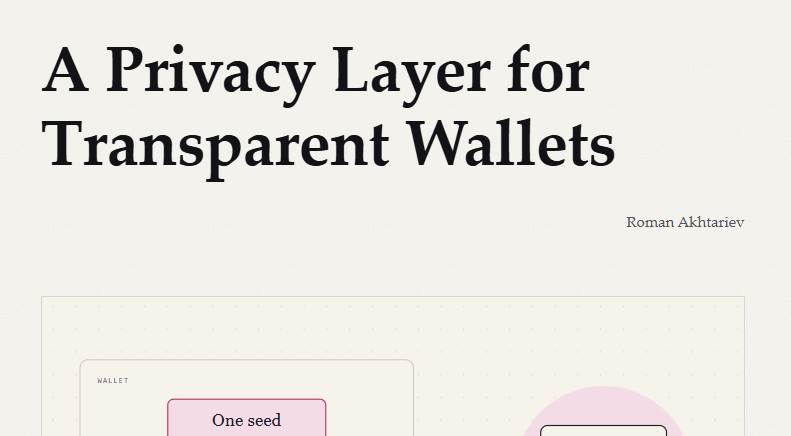
In addition, a privacy tool is being experimentally tested in Vizor Wallet that allows wallets to query balances without revealing to the server which addresses belong to the same owner.
Zcash (ZEC) developer Roman Akhtariev revealed that his team at Zakura plans to make progress on post-quantum signature opcodes in January. This work focuses on transparent (i.e. public) Zcash addresses that hold 70% of the approximately 17 million ZECs in circulation.
Plan to prioritize coverage of transparent funds pools
Akhtariev detailed the plan in an engineering blog post, which also pointed out that using hash-based signatures to achieve full post-quantum security transparent funds pools is another goal for January. There is currently no consensus activation date set.
Shielded addresses have hidden transaction details through zero-knowledge proofs (ZKPs), so separate security measures are required. CoinDesk calculated that the transparent pool accounted for 70%, based on ZecStats data.
Akhtariev's article proposes to combine the existing elliptic curve key for each transparent address with a hash-based signature as a backup scheme, which draws on the WOTS scheme described in IETF standard RFC8391.
Such hash functions are believed to be resistant to attacks from classical and quantum computers, which is different from elliptic curve cryptography used by most wallets today.
Independent tool protects address-dependent privacy
The article also details a private information retrieval system that allows wallets to query their own transaction history without letting the server know which addresses it is checking. Transparent activities are divided into a range of blocks served by different shards, and wallets use private lookups to obtain only the specific records needed, preventing servers from associating addresses belonging to the same owner.
An experimental version of this tool is already available in the Vizor wallet, and users can enable this feature through the "Private Query" setting. Zcash has also proposed a consensus change (ZIP-2005) that aims to restore blocking of funds if current encryption protocols are disabled due to future quantum attacks or other attacks, but this by itself does not make the network quantum-resistant.
The announcement comes amid renewed concerns about wallet security after Ethereum researcher Justin Drake urged cryptocurrency holders to move funds to unexposed addresses. Drake warned that mathematical calculations driven by artificial intelligence could threaten the ECDSA signatures that protect most Bitcoin (BTC) and Ethereum (ETH) wallets. In response, Vitalik Buterin warned against hasty relocation.
Akhtariev's article did not cite the above warning. Zcash's plan stems from the network's existing anti-quantum roadmap, rather than a direct response to the warning. As of now, there have been no cases of actual attacks on wallet keys using artificial intelligence or quantum computing.