Exchange Ranking
 Top Exchanges
 24h Volume Ranking
 Popularity Ranking
 Exchange BTC Balance
 Proof of Reserves
 Decentralized Exchanges
 Funding Rate
 Funding Heatmap
 Liquidation Data
 Max Pain
 Long/Short Ratio
 Whale L/S Ratio
 Binance/Okex/Huobi L/S
 Bitfinex Margin L/S
 ETF Tracker
 Solana ETF
 XRP ETF
 Hong Kong ETF
 Bitcoin Treasuries
 Crypto Reversal
 Ethereum Reserves
 HyperLiquid Wallet Analysis
 Hyperliquid Whale Watch
 Large Transactions
 On-chain Movement
 Bitcoin ROI
 Stablecoin Market Cap
 Options Analysis
 News
 Articles
 Economic Calendar
 Features
 Wallet
 Contract Calculator


 Security
 Collections
 Watchlist
 Following
 BTC
 ETH
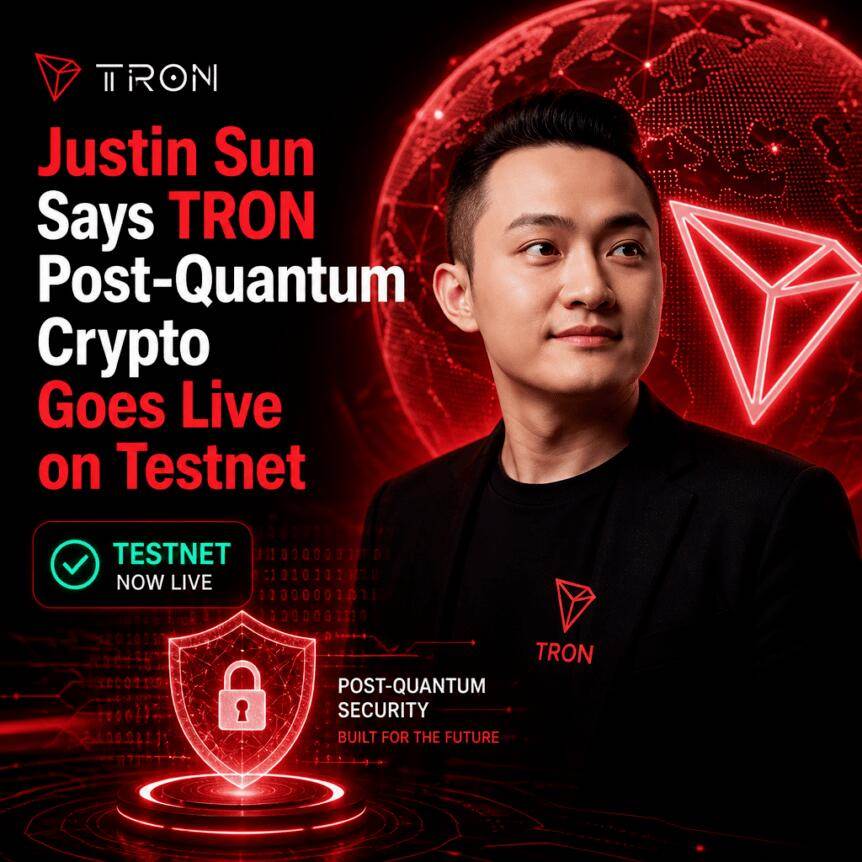
TRON founder Sun Yuchen announced that post-quantum cryptography upgrades have been running on the test network to deal with the "Q-Day" risk in advance.
TRON founder Sun Yuchen said that the network's post-quantum cryptography upgrades are currently running on the test network. He sees the move as an early hedge against future "Q-Day"-the day when quantum computing power becomes powerful enough to threaten current public-key cryptosystems.
At the same time, American blockchain security company AmericanFortress has proposed a solution to make wallets quantum-resistant without requiring users to migrate to new addresses, rotate keys, or transfer funds. The proposal was published in the form of a technical paper but has not yet been peer-reviewed. This situation highlights the existing development momentum in the cryptocurrency field in terms of quantum readiness, but also the uncertainty.
Core Points
- TRON test network is online: Sun Yuchen pointed out that TRON's post-quantum cryptographic function is already running on the test network and claims to be ready to be deployed to the main network at any time.
- Closely linked to the "Q-Day" node: The timeline of this upgrade is closely related to "Q-Day", that is, the moment when quantum computers may crack widely used encryption schemes such as elliptic curve cryptography.
- Keep existing addresses: AmericanFortress's solution aims to protect existing wallet addresses while adding post-quantum protection. It is designed to prevent users from migrating funds.
- Pending status: The plan was published in the form of a technical paper on the Cryptography ePrint Archive and has not yet been peer-reviewed.
TRON introduces post-quantum cryptography into testnet
Sun Yuchen announced on the X platform (formerly Twitter) that TRON's post-quantum cryptography is now put into operation on testnet. He said in the post that the team is closely monitoring progress in the fields of quantum computing and artificial intelligence and is ready to deploy anti-quantum capabilities to the TRON main network when needed.
Sun Yuchen also emphasized the concept of focusing on user security and believed that TRON is expected to become one of the first major blockchain networks to achieve anti-quantification before "Q-Day". Although the term "Q-Day" is often used in the industry to describe a turning point in cryptographic vulnerability, Sun Yuchen's message clarifies the practical goal: shortening the time lag between technical testing and broader deployment.
AmericanFortress proposes a migration-free quantum secure wallet protection solution
Previously reported that Cointelegraph reported on July 28 that AmericanFortress released an encryption plan designed to protect wallets from future quantum attacks without requiring users to move funds, rotate keys or change wallet addresses.
It is reported that the company's core differentiation advantage is that its method is designed to leave existing wallet addresses unchanged while adding post-quantum protection. This approach is important for usability. Many post-quantum proposals in cryptocurrencies implicitly assume that some kind of account migration is needed, which can be operationally difficult and disruptive for everyday users.
The technical paper is public, but peer review has yet to take place
AmericanFortress publishes its proposal as a technical paper on the Cryptography ePrint Archive. The paper was open to the research community, but at the time the article was mentioned, it had not yet passed peer review.
This distinction is important for readers trying to distinguish between "promising engineering concepts" and "verified, independently verified cryptography." In the post-quantum realm, safety assumptions can be subtle and parameters can have long-term implications, so peer review and independent analysis are often key checkpoints before a design is considered robust.
Why quantum readiness in the cryptocurrency field is accelerating
The reason why quantum cryptography has become the focus of the cryptocurrency field is that a sufficiently powerful quantum computer may eventually destroy the elliptic curve cryptography that many networks use to secure transactions.
Bitcoin, Ethereum, and countless other blockchain systems rely on these basic primitives, which means that the risk is not theoretical-if quantum capabilities develop as expected, the security model needs to be replaced or migrated.
This widespread promotion of quantum resilience has been reflected in efforts in multiple industries. Earlier this year, a Strategy-led coalition committed $15 million to fund Bitcoin quantum security research. At the same time, the Ethereum Foundation released a proposal to migrate accounts to quantum-resistant cryptography; according to previous reports from Cointelegraph, Algorand also outlined plans to launch quantum-resistant accounts by 2027.
综合来看,TRON的测试网里程碑和AmericanFortress专注于钱包的设计符合一种常见模式:项目正从高层讨论转向可部署的加密机制,同时在争夺最友好的用户迁移路径。一些方法强调基础设施层面的变化,而另一些则优先考虑最小化钱包层的干扰——这种工程权衡可能会强烈影响采用率。
接下来,读者应密切关注两件事:一是TRON是否能在明确安全性和互操作性细节的情况下从测试网推进至主网;二是AmericanFortress的ePrint提案是否会经过同行评审或进一步的独立审查,从而验证其主张——特别是关于在不牺牲长期安全性的前提下保护现有地址的可行性。