Exchange Ranking
 Top Exchanges
 24h Volume Ranking
 Popularity Ranking
 Exchange BTC Balance
 Proof of Reserves
 Decentralized Exchanges
 Funding Rate
 Funding Heatmap
 Liquidation Data
 Max Pain
 Long/Short Ratio
 Whale L/S Ratio
 Binance/Okex/Huobi L/S
 Bitfinex Margin L/S
 ETF Tracker
 Solana ETF
 XRP ETF
 Hong Kong ETF
 Bitcoin Treasuries
 Crypto Reversal
 Ethereum Reserves
 HyperLiquid Wallet Analysis
 Hyperliquid Whale Watch
 Large Transactions
 On-chain Movement
 Bitcoin ROI
 Stablecoin Market Cap
 Options Analysis
 News
 Articles
 Economic Calendar
 Features
 Wallet
 Contract Calculator


 Security
 Collections
 Watchlist
 Following
过去一年,Hyperliquid以高成交量、低延迟和真实用户活跃度迅速站上加密舞台中央,链上永续合约日交易量多次逼近头部中心化交易所,直接点燃了整个钱包赛道的“接入竞赛”。从主流钱包争抢原生交易入口,到交易所、DEX乃至AI Trading团队纷纷围绕其流动性做文章,Hyperliquid正从一个产品变成流量与资产的交汇点。问题也随之而来:这波争相接入,究竟是确定性的好生意,还是一场必须参与却未必赚钱的暗战?
一、背景
25年笔者是基本上把市面上的Perps类(永续交易平台)的都研究了一圈,见证了hype市场的5倍增长与巅峰减半(9->50+->25)
在跌宕起伏之间,他是真的被竞争对手甩下去?还是因为其hip3与builder fee的开发性降低了平台收益的隐忧?Perps赛道本身也竞品迭出,最近的aster、Lighter、乃至于孙哥也下场,推让赛道抖三抖的sunPerps,宣发的推特space甚至创了在线人数新高的web3行业发布会。
从下图,也可以看出所谓群雄混战之状,有趣的是,这也是正在进行少有的既定市场被瓜分的过程。
回忆曾经DeFi Summer当时所有DEX的竞争,包括Uniswap和Balancer还有Curve,以及众多的Uniswap分叉项目,比如Pancakeswap等等。
At this moment, those who want to create platforms, those who want to aggregate resources from others, those who want to become leaders in the industry, and those who simply want to get a share of the profits—all are present. Throughout this year, various wallets have been competing to introduce perpetual trading capabilities into dex markets. Metamask and Phantom were among the first to do so, and last week, Bitget also launched its own integration services. Other startup products like Axiom, BasedApp, XYZ (which operates on HIP3), along with several AI trading platforms, are all trying to get a foothold in this market by integrating these features.
Thus, there is now a new round of competitive battles in the wallet sector.
Everyone is vying to integrate Hyperliquid’s perpetual trading capabilities. But what exactly is behind this? Is it the benefits of open-source technology, the temptation of referral programs, or simply a reflection of real market demand? Why don’t some leading platforms take any action? Do those who integrate first already dominate the market?
Second, the origins of ecosystems, builder fees, and referral mechanisms
Hyperliquid’s referral mechanism mainly involves builder fees combined with referral bonuses.
I always believed this is a groundbreaking mechanism. It allows Defi builders (developers, quantitative teams, aggregators) to charge additional fees as service income when placing orders on behalf of users. Meanwhile, when users place orders through these platforms or the official website, the total fee remains unchanged.
Its essence is actually similar to the hook mechanism used in Uniswap V4. Both systems use their own order books (or liquidity pools) as infrastructure, allowing various platforms to connect to them. This makes it easier for PerpDex to attract users from different platforms. Additionally, platforms with different types of traffic can offer a more comprehensive range of ecological products, meeting the diverse needs of its users.
This mechanism has already brought in millions of dollars in dividends for some projects since its initial launch. The initial results were impressive, but subsequent performance has been declining.
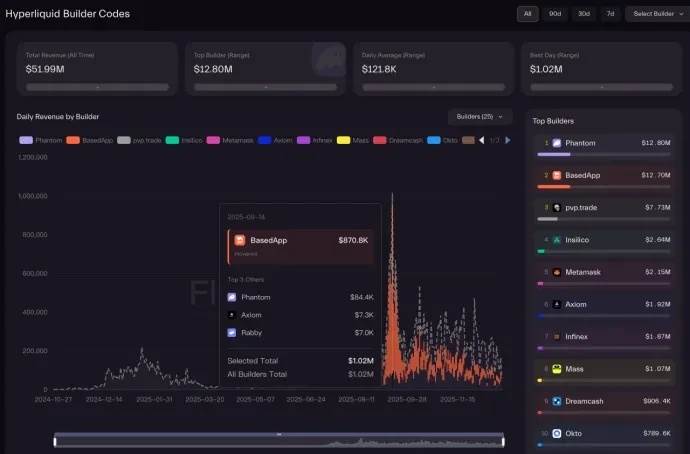
From the chart, we can see many points that require further consideration.
• Why does Metamask have a user base that is at least five times larger than Phantom’s revenue from platform integration?
• Why is there such a big difference in revenue between basedApp and Axiom here? Where is Jupiter?
• Is 12 million in dividends too much or too little? Is this a short-term or long-term issue?
• Are platforms that only allow lightweight integration with HypeEVM or native tokens at a disadvantage?
• Why aren’t platforms like Bn and Okx included in this list?
III. PerpDex’s Open Policy
To answer these questions, we need to understand how various platforms are integrated into PerpDex.
1. Using open API integration
In fact, all the providers have made their APIs available. They’re quite comprehensive, and almost every provider has its own way of defining functions. However, the modules offered are generally as follows: Query-related functions (account status, positions, orders, market data, K-lines, etc.); trading-related functions (placing orders, canceling orders, modifying orders, adjusting leverage levels, withdrawing funds, etc.); and subscription-related functions (real-time price updates from WS, order books, changes in positions).
Since the system itself requires these APIs for market makers to carry out their activities, the user side simply adjusts the trading direction. But users cannot connect to the system like market makers can. Therefore, additional control mechanisms are necessary.
Thus, a traffic limiting mechanism is essential. The innovative aspect of this approach is that it uses both address and IP-based limiting mechanisms, with the threshold dynamically adjusted based on transaction volume. During high-concurrency situations, traffic limiting may become an issue.
The advantage of this official API solution is that it allows quick integration without the need for custom nodes, with low data latency and good consistency in status information.
However, there are also obvious disadvantages: potential IP/region restrictions, susceptibility to traffic limitations. Traffic limits are less of an issue for individual users, but for platforms, it’s difficult to implement such measures, as the number of users can increase at any time, making dynamic scaling challenging.
There’s also the issue of updates. You know, even if an app needs code modifications, there’s still a limit on when updates can be released. If the official API is updated or modified, the app will not have any control over the traffic limits. In addition to being a traffic provider, the app also has to handle customer complaints and risks.
2. Read-only Node Integration Method
Hyperliquid operates on a dual-chain structure, featuring an EVM and core system, all integrated within one program. This architecture is tightly sealed behind closed-source code, making it difficult for outsiders to access or extract specific data. The official documentation only supports the deployment of such read-only nodes—nodes that can retrieve order information, K-line data, and transaction records, but do not allow trading operations.
Additionally, the platform does not provide access to all historical data. The amount of data generated in just two days exceeds 1TB+. If historical data were not stored securely over the course of a year, the costs would far outweigh any potential benefits.
If project developers choose to use read-only nodes to reduce the frequency of accessing official APIs and thereby alleviate traffic issues, this is currently the recommended approach by the official team.
However, implementing this solution presents several technical challenges: there may be occasional data corruption, significant storage requirements, and missing historical data. Moreover, it is necessary to modify the data processing methods used by these nodes.
In my opinion, the biggest problem lies in this semi-opened mechanism, which leads to inconsistencies in data processing.
For example, if I use the K-line data from a read-only node to place an order, but the node itself is delayed (something that happens occasionally), I am forced to use the official API for placing orders. Since the official API operates without delays, there might be discrepancies between the data from both sources. As a result, my market-order placement could potentially result in a transaction at a price I don’t want.
So, whose fault is this? Is the platform sufficiently compensated for these issues? How much more must the platform invest to ensure stability? Is it appropriate to shift responsibility to others?
3. Market choice
这里就呈现了分歧,各家做法都有不同。
• Metamask作为工具化定位的典型代表,直接采用前端接入开放API的方式,甚至直接开源接入代码,简单粗暴的方式带来快速的上线效率,笔者也是难得见到如此保守主义的头部wallet平台,这么快的市场动作。
• 同样这种做法的还有Rabby、Axiom、BasedApp。
• Trust wallet,其实也接入了perps,不过对接的是BN系的aster平台,显然还是自家产品给绿灯。但是内部如何分佣就不确定了。
• Phantom源于solana上的Meme浪潮崛起,在这里更显得对体验的追求,他采用的
是只读节点接入方式,甚至下单的操作,都要通过后端再中转,而不是客户端直接找官方api去下单。
其实市场还有一些神奇的产品,也有不同的角度抉择
比如Trade.xyz是目前Hip3上最高交易量的平台,不追求现有市场的红海混战而是直接开拓股票交易的能力。
VOOI Light也很能干(工程上),是个基于意图的跨链永续dex,他的核心在于同时接入多个perps dex,可以说是用工程量来同时干了上面多个平台的多条路。但是美中不足的是也卡在多接入的储备金复杂性上了,体验不丝滑。
最后笔者近期还体验了多款AI trading平台,几乎是都是开放API接入+多家perps的后端接入方案。体验起来很前沿,有的是纯LLM大模型文字交互,有的是AI决策+follow交易员的方式(这里底层还能和Privy这类Tee托管方案链接起来),实现不用传递私钥给项目方,但可以完成AI辅助perps交易的能力。
不同方案带来不同的体验,稍微能解释一些最终返佣效果数据的差异。
四、思考
前面的社交登录其实只能解决恢复问题,但不能解决自动化交易的问题。
1、储备金复杂度
这块其实是最容易被忽视的。Hyperliquid的复杂性远超想象,不是简单的"接入即用"。
各种平台初期乐观的当他是聚合dex思路的接入,但也忽略了他本质不是个乐高模型,接入了Hyperliquid,那后续市场下行了,那功能还留着吗?如今多少wallet在下线曾经的铭文协议呢?而且下掉平台用户开的用户重新去官方平台找么?
另外,如果Hyperliquid不火了,或许aster、lighter火了,那迁移到新的平台吗?各家的api都不完全一致,如何迁移,如何并行?
要抹平掉这些就要不可避免的增加体验的复杂性。
最终一个既然用户要用一个大而全的入口,那为什么不用官方本身呢?
Front-end integration provides a fast user experience and wide coverage. However, Metamask seems to have suffered a loss—it didn’t earn much money, but it did provide its users with access to its own traffic.
The high-quality experience offered by backend integration is currently the key area where Phantom generates the most revenue. At the same time, it also incurs significant costs. Whether the ROI (return on investment) is positive or not, only those in the industry know for sure.
2. Why can’t total revenue exceed higher levels?
In fact, looking at our own preferences regarding platforms like Hyperliquid, we prefer using the official portal altogether. We mostly operate on the PC side, mainly because we want to have access to advanced features such as profit-taking/stop-loss settings, chart monitoring, and margin trading options. After all, this market is dominated by high-end players.
On the other hand, users who prefer using mobile devices want to be able to monitor market conditions anytime, anywhere, and manage their positions along with price management, rather than engaging in complex analysis.
Therefore, Phantom’s advantage gradually diminishes after it starts offering new users an initial experience, as its focus remains on the mobile side.
Meanwhile, companies like BasedApp, which have both apps and a web interface, can meet the needs of both groups. However, due to competition from the official web interface, their potential gains are limited.
But since Hyperliquid’s app will be launched soon, this market will become even more limited.
It can only be said that the differences in architecture determine the value of integration. However, the extent of this value depends on the depth of integration. Ultimately, this model’s limitations stem from competition within the industry. Users who use the entry platform are difficult to retain compared to those on the original platform.
If wallets can offer advanced features for mobile devices, such as advanced charting tools, alerts and notification systems, and automatic trading capabilities, then there is indeed a sense of differentiation. It’s clear that Phantom will soon introduce more advanced features in its updates, all with the goal of retaining these users.
The way out of this situation lies in AI trading, automatic trading (a trading mode not officially available yet), and integrating multiple traders into one platform. There are also issues related to resource allocation across various platforms, as well as problems like high losses caused by AI trading. Even with common private key hosting methods like Prvy and TurnKey, it remains true that those who know how to use these tools will do so, while those who don’t won’t have any options.
3. User growth and ecosystem expansion
Of course, many platforms aim to avoid making money. After all, relying on transaction fees to cover costs is hardly profitable. But if they can attract users who want to use Perps, or meet the perpetual trading needs of existing users, then it can be considered an effective way to expand the ecosystem.
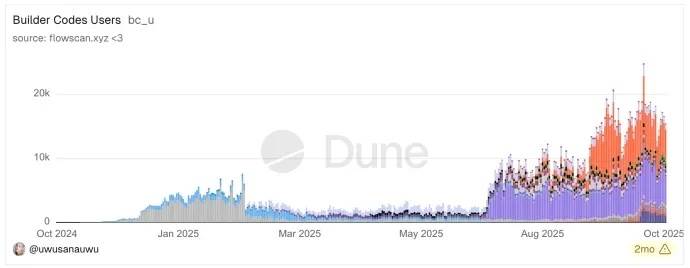
We can draw conclusions from data collected from HL on the blockchain. This group is actually quite small.
As seen in the chart below, the number of users served by each platform is only a few thousand per day, totaling less than 10,000 users.
Moreover, considering the monthly active users of Hyperliquid itself, its revenue is essentially based on a model that relies on wealthy traders. This represents a typical pyramid structure in contract trading markets, where the top 5% of users account for over 90% of both Open Interest and Volume.
Currently, there are approximately 1.1 million wallets on Hyperliquid, with 217,000 monthly active users and 50,000 daily active users. But what’s crucial here is that these top 5% of users control 70% of all open contracts (worth $5.4 billion). More than 100 of these top users possess a total portfolio worth up to $33 million each, and their Open Interest accounts for 920 times more than that of the average user.
In contrast, the underlying users, who make up 72.77% of the total user base (175,000 users), contribute only 0.2% of the total contracts, with an average portfolio value of just $75.
This structure indicates that the contract market is essentially a battleground between professional institutions and high-net-worth individuals. While retail investors contribute significantly to the user base and activity levels, their financial impact is negligible.
This structure reflects a somewhat counterintuitive trend: Hyperliquid indeed generates high profits, having become one of the most profitable exchanges in just one year.
However, its profits ultimately come from high-end traders like those known as “giant whales.” Their motives may be related to resistance against regulations, transparency, or quantitative trading strategies.
But the integration of various platforms actually results in the creation of regular users. Therefore, it will take a long-term process of user education to shift users who currently engage in malicious activities within CEXs to a more competitive environment within Web3Perps
.V. In conclusion, is integrating Perps really a viable business opportunity?
Generally, projects need to adapt to the market conditions. But when a platform reaches its peak popularity, the market can then adapt to it. Hyperliquid is currently enjoying such treatment, but it may not be able to maintain this status indefinitely. It’s possible that the sudden increase in trading volumes among competitors in the market is due to expectations of new token distributions, resulting in non-realistic trading outcomes.
Moreover, many of HL’s measures are relatively correct. Compared to many other platforms in the past, HL always tries to take control of everything and reap all the benefits. I specifically criticize Opensea for creating a system that forces users to follow the lead of the leading platform. Every time there are high costs involved, it interferes with the flow of goods and affects the real pricing in the market. As a result, countless NFTs become heirlooms.
At HL, they have opened up the EVM and various dex APIs, so soon the market will see a plethora of derivatives.
RWA assets, especially those in the US stock market and gold, are becoming important new sources of traffic and growth points in the Perp DEX sector. TradeXYZ has accumulated 19.1 billion USD in PERP volume, with an average of 320 million USD per week, or 45.7 million USD per day. This is proof enough.
Hyperliquid’s generosity is evident both during token distributions and repurchases. Many times, by using staking mechanisms, users can earn significant profits.
After all the twists and turns, the competition for leading positions can be handled by those platforms themselves. Speaking of the ongoing battle between various platforms and third-party providers, integrating third-party providers generally involves low returns. Whether it’s from the perspective of user growth or platform commissions, it doesn’t seem to be a viable business model.
It’s easy to imagine that once real returns are seen after integration, many platforms will still be reluctant to give up the benefits offered by third-party providers. Instead, they will opt for self-developed solutions and efforts to attract new users. The battle in this field isn’t over yet; it will continue for another year. But only those new users obtained from non-Cex platforms can be considered truly effective users.