Exchange Ranking
 Top Exchanges
 24h Volume Ranking
 Popularity Ranking
 Exchange BTC Balance
 Proof of Reserves
 Decentralized Exchanges
 Funding Rate
 Funding Heatmap
 Liquidation Data
 Max Pain
 Long/Short Ratio
 Whale L/S Ratio
 Binance/Okex/Huobi L/S
 Bitfinex Margin L/S
 ETF Tracker
 Solana ETF
 XRP ETF
 Hong Kong ETF
 Bitcoin Treasuries
 Crypto Reversal
 Ethereum Reserves
 HyperLiquid Wallet Analysis
 Hyperliquid Whale Watch
 Large Transactions
 On-chain Movement
 Bitcoin ROI
 Stablecoin Market Cap
 Options Analysis
 News
 Articles
 Economic Calendar
 Features
 Wallet
 Contract Calculator


 Security
 Collections
 Watchlist
 Following
Over the past two years, the prediction market has quietly undergone a “identity transformation” in the crypto world: from a marginal tool used by niche players to predict hot events, it has evolved into a system where real funds are involved, and its predictions reflect collective expectations. With platforms like Polymarket and Kalshi achieving record-high trading volumes during elections, macroeconomic events, and crypto markets, the prediction market is being re-evaluated by institutions, researchers, and even regulatory bodies. By 2026, AI agents will be able to make automated predictions, regulatory frameworks will become clearer, and blockchain data will be more closely linked to real-world events. This trend is driving the prediction market towards becoming an “information infrastructure.” Based on market data and industry trends for 2024–2025, CGV’s research team has attempted to identify 26 key trends that will shape the prediction market in 2026.
I. Structural Trend Analysis
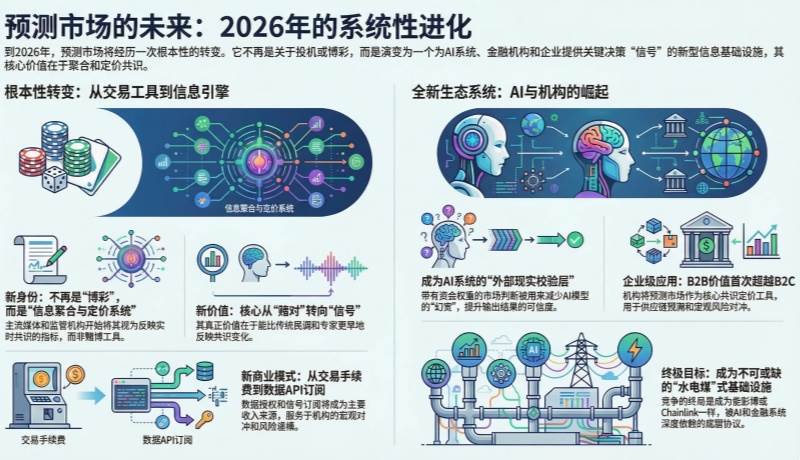
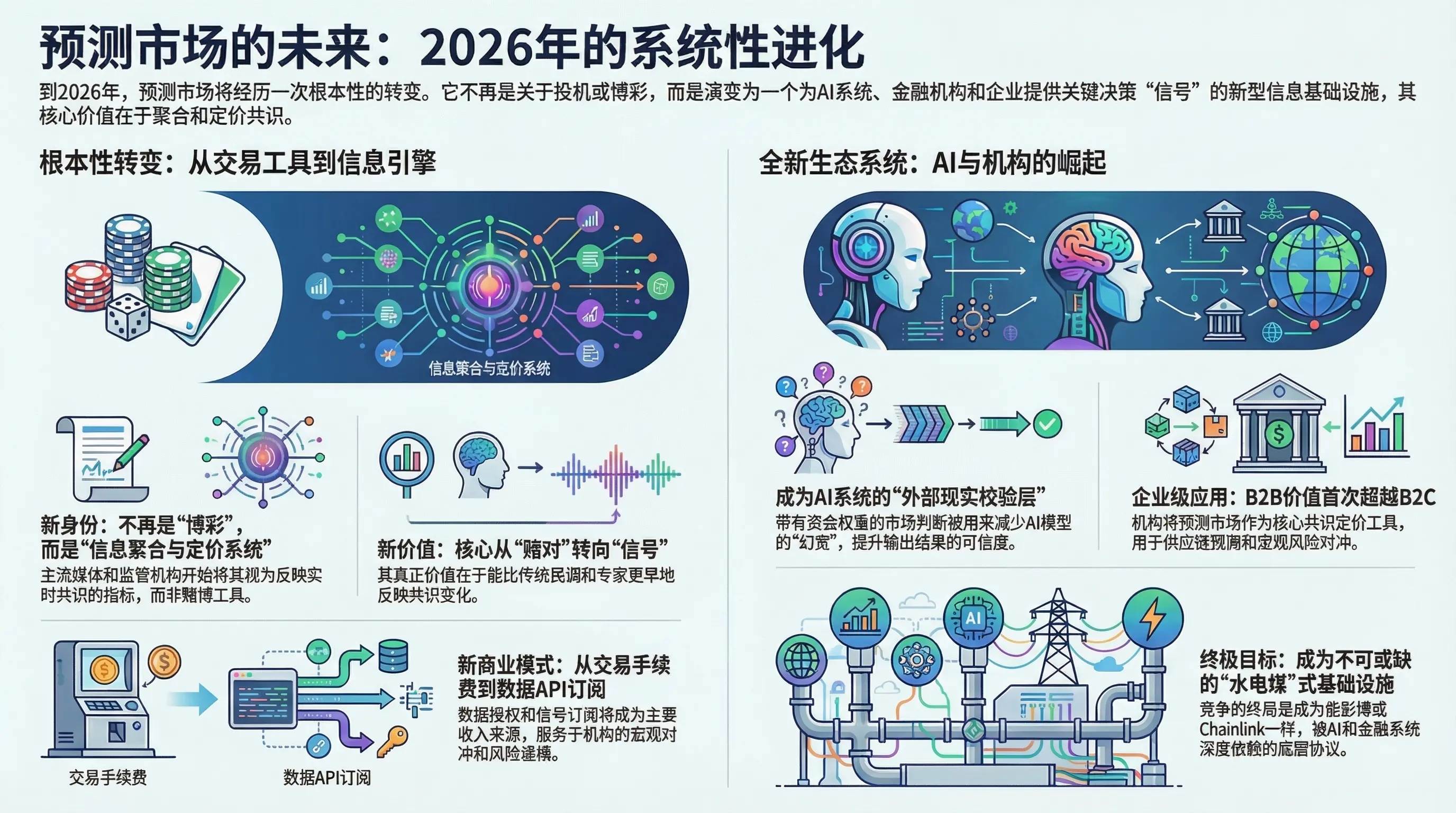
1. By 2026, the prediction market will no longer be classified as “gambling” or “derivatives”.
It will be redefined as a decentralized information aggregation and pricing system. By 2025, platforms like Polymarket and Kalshi will have accumulated trading volumes exceeding $27 billion. Mainstream media outlets such as CNN, Bloomberg, and Google Finance are widely integrating their probabilistic data, using it as real-time consensus indicators rather than just gambling odds. Academic studies (e.g., those conducted by Vanderbilt University and the University of Chicago) have shown that predictive markets can provide more accurate predictions in political and macroeconomic events compared to traditional polls. By 2026, with traditional financial giants like ICE investing in Polymarket and distributing its data to global institutions, regulatory bodies such as the CFTC are expected to increasingly view it as an information aggregation tool, driving a paradigm shift from “gaming indicators” to “decentralized pricing systems”.
2. The core value of predictive markets lies not in “winning the bet,” but in providing “signals.”
What matters most in a market is its ability to reflect changes in consensus early on. By 2025, Polymarket and Kalshi were able to predict changes in probabilities related to Federal Reserve decisions and sports events, one or two weeks ahead of mainstream economists and polls. Relevant reports show that their Brier scores are significantly better than those of polls and experts: a Brier score of 0.0604 is significantly better than the good standard of 0.125 and the excellent standard of 0.1. Moreover, as trading volume increases, predictions become more accurate, and Brier scores improve further. By 2026, with the surge in demand for hedging using probabilistic signals to manage macro risks, platform data will be integrated more frequently into financial terminals. The value of these signals will far exceed trading returns, making them real-time “public opinion indicators” for institutions and media.
3. Predictive markets will move from being “event-based” to being “state-based.”
It’s not just about “who will win”, but rather about “what state the world is in”. By 2025, the platform has introduced markets that track ongoing trends, such as “Bitcoin price ranges for 2026” or “probability of economic recession”. The Open Interest (OI) has risen from low levels at the beginning of the year to over a billion dollars. Kalshi’s macroeconomic indicators market also shows rapid growth. By 2026, long-term trend-based markets are expected to dominate liquidity, providing a continuous pricing mechanism for global conditions, rather than being driven by individual events.
4. It’s predicted that prediction markets will become an essential component of AI systems, serving as a “external reality verification layer”.
AI won’t rely solely on data anymore, but rather on “judgments weighted with financial resources”. In 2025, Prophet Arena benchmark tests showed that AI models achieved similar accuracy rates when predicting real-world events compared to prediction markets. Kalshi collaborated with Grok, while Polymarket generated AI summaries. Weighted probabilities based on financial resources serve as a check to reduce AI-induced hallucinations. By 2026, with protocols like RSS3 MCP becoming more mature by the end of the year, prediction market probabilities will be widely used in updating AI models, creating a closed loop between reality, markets, and models, thereby enhancing the credibility of AI outputs.
5. For the first time, information, financial resources, and judgments will be integrated into the same system.
This is what distinguishes prediction markets from social media and news platforms. By 2025, Polymarket’s data will be integrated with Bloomberg and Google Finance, creating a efficient cycle of information input → funding pricing → decision-making output. Unlike Twitter’s unmotivated opinions, the funding mechanism ensures the authenticity of the predictions. By 2026, this closed loop is expected to expand to enterprise risk management and policy evaluation, generating external value. Prediction markets, distinct from mere content platforms, will become a new type of decision-making infrastructure.
6. Prediction markets will no longer be considered a “niche market” in the crypto industry.
They will be integrated into the broader narrative of AI × Finance × Decision-Making Infrastructure. In 2025, ICE invested $2 billion in Polymarket, while Kalshi was valued at $11 billion. Traditional giants like DraftKings and Robinhood also started offering prediction products. Total trading volume exceeded $27 billion, and data streams were embedded in mainstream terminals. By 2026, with increased adoption by institutions and integration with AI, prediction markets are expected to shift from being a niche market in the crypto industry to becoming a core part of AI × Finance × Decision-Making Infrastructure, similar to Chainlink’s role in the oracle field.
II. Product Formulation
7. Single-event prediction markets will reach maturity in 2026.
The focus of innovation lies not in the user interface, but rather in the underlying structure. By 2025, it is predicted that the total trading volume in the market will reach approximately $27 billion. Of this amount, Polymarket will contribute over $20 billion, while Kalshi will contribute around $17 billion. Markets involving single events, such as sports competitions, macroeconomic indicators, and political events, will remain dominant. However, the monthly growth rate will slow down in the later stages, with adjustments occurring after reaching a peak at the end of the year. The focus of innovation will shift towards underlying structures. For example, Azuro Protocol’s LiquidityTree model continues to optimize liquidity management and profit distribution. By 2026, such infrastructure improvements are expected to enable single-event markets to enter a stable and efficient phase, allowing larger institutions to participate more actively.
8. Multi-event combination markets will become the mainstream form of trading.
Predictions will no longer involve individual events, but rather the combined pricing of a set of related variables. In 2025, Kalshi’s “combos” trading feature will become very popular, enabling the trading of combinations of sports outcomes and macroeconomic events. This feature will attract institutional investors significantly. Experimental markets based on conditional relationships, such as the probability of event correlations, will further improve the accuracy and depth of pricing. By 2026, with clearer regulations and increased inflows of capital from institutions, multi-event combination markets are expected to become the norm, enabling more complex risk management and diversified exposure. Overall, the depth of trading will greatly increase.
9. “Long-term market” models will begin to emerge.
Predicting structural outcomes for the next 6 months, 1 year, or even 3 years. By 2025, Polymarket and Kalshi will expand their services across various markets, including predictions regarding Bitcoin prices and economic indicators. Open Interest (OI) is expected to rise significantly, reaching hundreds of millions of dollars by the end of the year. Similar protocols will be introduced to facilitate borrowing of positions, thereby easing capital lock-ups. By 2026, long-term markets are expected to dominate liquidity, providing more reliable structural consensus aggregation. Open Interest is expected to double further, attracting long-term institutional investors.
In October 2025, Google Finance will integrate data from Kalshi and Polymarket, enabling Gemini AI to generate probabilistic analyses and charts. Other platforms like Bloomberg will also begin integrating these signals into their products. By 2026, this integration trend will become more widespread. Probability-based predictions will become standard input for macro research, corporate risk management, and decision-making processes, shifting from front-end trading to institutional-level tools. In December 2025, CNN and CNBC also signed multi-year agreements with Kalshi, incorporating probability-based data into financial programs such as “Squawk Box” and “Fast Money.” B2B prediction markets will once again surpass their B2C counterparts in terms of value.
Companies and institutions require “consensus-based pricing” more than individual investors do. By 2025, the accuracy of internal application cases within companies (such as supply chain management and project forecasting) will continue to surpass traditional methods. With the increasing demand for hedging against macroeconomic and sports events, transactions in B2B scenarios will account for a significant portion of total transactions. By 2026, the value of B2B transactions is expected to exceed that of retail B2C transactions for the first time. Institutions will view prediction markets as a key tool for consensus-based pricing, driving the industry towards enterprise-level infrastructure. In 2025, the market size for supply chain analysis reached $9.62 billion, with an estimated CAGR of 16.5% until 2035. As a “consensus-based pricing tool,” prediction markets can be integrated into AI-driven demand forecasting and risk management systems.
Prediction markets that focus on “low speculation” will have a longer-lasting impact.
In 2026, markets will reward designs that promote restraint. In 2025, Kalshi achieved monthly transaction volumes exceeding $500 million, accounting for over 60% of total transactions. Although Polymarket announced the launch of POLY tokens in Q1 2026, its low-speculation approach continued to drive growth throughout the year. By 2026, designs that emphasize restraint are expected to gain advantage in terms of regulatory compliance, real liquidity, and institutional trust. Low-speculation platforms will have an edge in terms of long-term valuation and sustainability.
III. AI × Prediction Markets
13. AI agents will become one of the main participants in prediction markets.
It’s not about speculation, but rather continuous participation and automatic calibration. By the end of 2025, infrastructure such as the RSS3 MCP Server and Olas Predict will be capable of enabling AI agents to autonomously scan events, gather data, and place bets on platforms like Polymarket and Gnosis. The processing speed of these AI agents far exceeds that of humans. Tests conducted in Prophet Arena have shown that the involvement of AI agents significantly improves market efficiency. By 2026, with the maturation of the AgentFi ecosystem and the opening of more interfaces for protocols, AI agents are expected to account for over 30% of trading volume. They will become the primary providers of liquidity, rather than mere short-term speculators.
14. Human predictions will increasingly serve as “training data” rather than the main subject of trading.
Prediction markets will begin to serve models, not humans. In 2025, benchmarks from Prophet Arena and SIGMA Lab show that human participation in market probability calculations is being used extensively for training and testing large models, resulting in significant improvements in accuracy. The massive amounts of data generated by the platforms have become high-quality training sets. By 2026, this trend is expected to deepen further, with prediction markets prioritizing the optimization of AI models. Human bets will play more of a signaling role rather than being the main activity. Platform design will continue to evolve around the needs of models.
15. Multi-agent prediction games will become the new source of intelligence.
预测市场本身变成一个多智能体博弈场。2025年,Talus Network的Idol.fun和Olas等项目已将预测市场视为Agent集体智能战场,多Agent通过竞争博弈产生超出单一模型的预测精度;Gnosis条件令牌支持复杂交互。到2026年,多Agent博弈预计成为主要Alpha生成机制,市场将演变为自适应多智能体环境,吸引开发者构建专属Agent策略。
16、预测市场会反向约束AI的幻觉问题
“没法下注的判断”,会被视为低可信度输出。2025年,Kalshi与Grok合作以及Prophet Arena测试中,资金加权市场概率作为外部锚点,有效校正AI偏差;相关模型在无市场验证的输出上表现较差。到2026年,这一约束机制预计标准化,“无法在预测市场下注的判断”将被AI系统自动降权,提升整体输出可靠性和抗幻觉能力。
17、AI将推动预测市场从“概率”走向“分布”
不只是一个数字,而是一整条结果曲线。2025年,Opinion和Presagio等平台引入AI驱动oracle,输出完整概率分布而非单一数字;Prophet Arena显示,分布预测在复杂事件中精度更高。到2026年,AI模型的分布输出将与市场深度整合,提供细粒度结果曲线,长尾事件定价精度显著提升,平台UI和API将默认支持分布视图。
18、预测市场会成为世界模型(World Model)的外部接口
Real-world changes → market-based pricing → model updates, forming a closed loop. By the end of 2025, protocols such as RSS3 MCP Server will enable real-time contextual processing, allowing agents to update their world models based on market probabilities. The Prophet Arena will begin to establish a preliminary feedback loop. By 2026, this closed loop is expected to be fully developed. Predictive markets will become the standard external interface for AI world models. Real-world events will be quickly reflected in pricing, driving model iteration and accelerating AI’s ability to understand and adapt to dynamic environments.
IV. Financial and Business Model Considerations
19. Transaction fees are not the ultimate model for predicting markets.
True value lies in data, signals, and influence. In 2025, Kalshi achieved significant revenue through transaction fees. However, Polymarket continued to prioritize low/fee-free strategies, yet managed to gain dominance through data distribution and influence capture—its cumulative trading volume exceeded $20 billion, attracting investments from traditional giants like ICE. As mainstream platforms such as Google Finance and CNN integrate predictive data by 2025, data licensing and signal subscription will become major sources of income, contributing over 50% of platform revenues. Institutions will pay to use real-time probability signals for macro hedging and risk modeling. Platform valuations will shift from trading volume to data asset weight, promoting sustainable business evolution.
20. Predictive signal APIs will become core commercial products.
Especially in the fields of finance, risk management, policies, and macroeconomics. By 2025, unified APIs such as FinFeedAPI and Dome will begin to serve institutions, providing real-time OHLCV data and order book information from Polymarket and Kalshi. Google Finance officially integrated these APIs in November, allowing users to directly query predictions for various events. By 2026, as institutions adopt faster regulatory processes (as emphasized by companies like Grayscale and Coinbase), predictive API solutions will become standard products, similar to supplementary features on Bloomberg terminals. Institutions will pay for these services to automate risk management, simulate policy outcomes, and hedge against Federal Reserve decisions. The market size is expected to grow from current billions to tens of billions of dollars, with leading platforms dominating the market through exclusive licenses.
21. The ability to provide explanatory content will become a crucial advantage in predictive markets. Explaining the results of predictions is more important than simply making predictions themselves. In December 2025, CNN signed a data cooperation agreement with Kalshi, embedding probabilistic insights into reports and relying on the platform to explain market fluctuations. Mainstream media frequently cites changes in consensus from Polymarket and Kalshi as “real-time indicators of public opinion.” By 2026, providers who only offer probabilistic forecasts will be marginalized, while platforms with strong explanatory capabilities will be preferred by AI systems, think tanks, and institutions, creating a network effect. The impact of predictive markets will go beyond trading operations, similar to how traditional media builds authority through data analysis. 22. Predictive markets will become essential tools for new research institutions.
Predictive markets are not media outlets, but rather research engines. By 2025, data from predictive markets has been used in benchmark tests by organizations such as the SIGMA Lab at the University of Chicago. Their accuracy surpasses that of traditional polls, enabling them to be utilized in macro-level research. With the integration of Google Finance, users can generate probability charts and analyses using Gemini AI. By 2026, as institutions begin to adopt predictive markets more extensively (as highlighted in reports from Vanguard and Morgan Stanley, among others), they will become integral components of new research frameworks, serving as real-time decision-making tools. These platforms will play a crucial role in risk assessment for businesses, early warning systems for government policies, and validation of AI models. They will evolve into “research infrastructure,” similar to the role of data terminals in the financial sector, driving a comprehensive shift from front-end trading to back-office tools.
Five, Regulatory Measures and Market Dynamics
In 2026, regulatory focus will shift from determining whether something is allowed to determining how it should be used.
The focus will no longer be on banning certain activities, but rather on their uses and boundaries. In 2025, the U.S. CFTC approved Kalshi and Polymarket to operate legally in certain categories, such as sports and macroeconomic events. While election-related markets remain restricted, non-financial events have received clear approvals. Under the EU’s MiCA framework, several predictive platforms have begun testing within regulatory sandboxes. By 2026, as institutional investment increases and mainstream media begins to incorporate probability analysis as a standard metric (such as CNN and Bloomberg), regulatory attention will shift towards regulating the use of these platforms—for example, anti-manipulation rules, information disclosure requirements, and cross-jurisdictional boundaries. This shift will be similar to the development path of the derivatives market, leading to the scaling of global compliance platforms.
24、合规预测市场更可能从“非金融用途”切入
如政策评估、供应链、风险预警。2025年,Kalshi成功避开政治事件限制,转向经济指标和体育市场,实现累计交易量超170亿美元;企业内部应用(如供应链风险预测)已在Google、Microsoft等公司证明更高准确率。到2026年,合规平台预计优先从非金融用途扩张——政策评估(如气候事件概率)、企业风险预警和公共事件(如奥运奖牌分布),这些领域监管阻力最小,却能吸引机构和政府客户;CFTC和欧盟监管趋势显示,此切入点将打开主流大门,避免博彩标签。
25、头部预测市场不会赢在流量,而是赢在“被引用”
谁被AI、机构、研究系统调用,谁才是赢家。2025年,Polymarket和Kalshi的概率已被Google Finance、Bloomberg终端和主流媒体(如Forbes、CNBC)广泛集成并引用,作为实时共识指标优于传统民调;SIGMA Lab等学术基准测试进一步提升其权威性。到2026年,随着AI Agent和研究机构需求爆发,头部平台竞争将转向被调用频率——被Gemini、Claude等模型作为外部校验源,或被Vanguard、Morgan Stanley等机构嵌入风控系统;流量虽重要,但引用网络效应将决定胜者,形成类似Chainlink oracle的基础设施地位。
26、预测市场的终极竞争,不在市场之间,而在是否成为基础设施
2026年之后,预测市场要么成为“水电煤”,要么被边缘化。2025年,ICE等传统金融巨头投资Polymarket,TVL已超数十亿美元,数据流开始嵌入主流终端;AgentFi和MCP协议于年末奠定AI闭环基础。到2026年,竞争本质将转向基础设施属性——是否成为AI世界模型的实时接口、金融终端的标准信号层和决策系统的底层共识引擎;成功者将如Bloomberg或Chainlink般不可或缺,而纯交易平台可能被边缘化;这一分水岭将决定赛道从加密叙事彻底迈向全球信息基础设施。
结语
预测市场已经不需要再证明“是否可行”,真正的分水岭在于:它是否开始被当作决策信号,而不只是交易工具。当价格被研究者、机构和系统性模型反复引用时,预测市场的角色就已经发生了变化。
到2026年,预测市场的竞争重点将不再是热度和流量,而是信号的稳定性、可信度以及被调用的频率。能否成为长期被使用的信息基础设施,将决定它是走向下一阶段,还是停留在一次周期性叙事中。