Exchange Ranking
 Top Exchanges
 24h Volume Ranking
 Popularity Ranking
 Exchange BTC Balance
 Proof of Reserves
 Decentralized Exchanges
 Funding Rate
 Funding Heatmap
 Liquidation Data
 Max Pain
 Long/Short Ratio
 Whale L/S Ratio
 Binance/Okex/Huobi L/S
 Bitfinex Margin L/S
 ETF Tracker
 Solana ETF
 XRP ETF
 Hong Kong ETF
 Bitcoin Treasuries
 Crypto Reversal
 Ethereum Reserves
 HyperLiquid Wallet Analysis
 Hyperliquid Whale Watch
 Large Transactions
 On-chain Movement
 Bitcoin ROI
 Stablecoin Market Cap
 Options Analysis
 News
 Articles
 Economic Calendar
 Features
 Wallet
 Contract Calculator


 Security
 Collections
 Watchlist
 Following
When AI, encryption, and mysticism begin to intersect, the narrative in the cryptocurrency world becomes more “absurd but true”. In mid-December, against the backdrop of volatile markets and low spirits, an app called “Life Chart” became very popular among users. By entering personal information, the app could generate a “life chart” from age 1 to 100 using the Eight Characters Theory. The red and green candles in this chart resembled Bitcoin’s daily charts. This tool, created by blogger @0xSakura, seems like mere entertainment, but it actually taps into the emotions of the current cryptocurrency market. When prices become unpredictable and traditional narratives fail to provide guidance, more and more people turn to this tool to interpret the uncertain future using familiar charting methods.
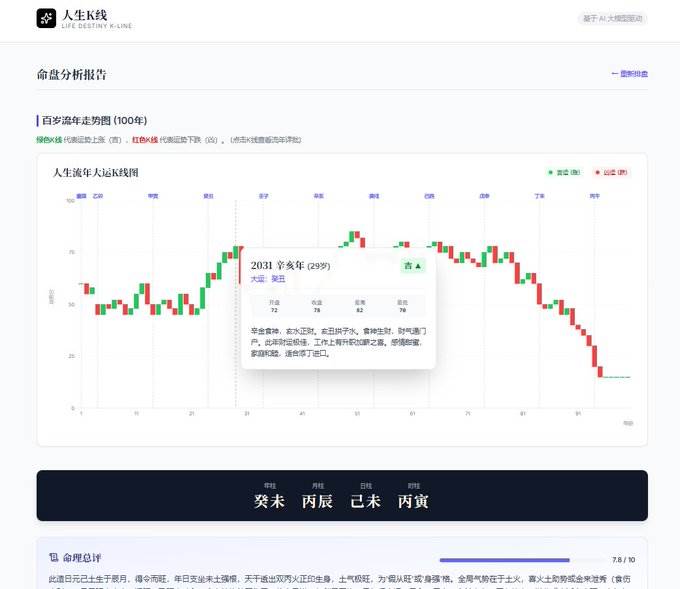
This tool went viral on Twitter. Its first post received over 3.3 million views, and within three days, the number of website visits and API calls exceeded 300,000. People started sharing their charts, and many found that the generated charts closely matched the trajectories of their own lives.
Even more astonishing is that, within 24 hours of its launch, a token based on the same name appeared in the market.
Why can such an entertaining tool generate such strong reactions in the cryptocurrency community?
Behind this is the long-standing influence of mystical theories in trading, as well as a collective expression of anxiety in the cryptocurrency community.
Mystical approaches are common in the trading industry.
It’s not unusual for traders to believe in mystical theories. The same applies to Wall Street.
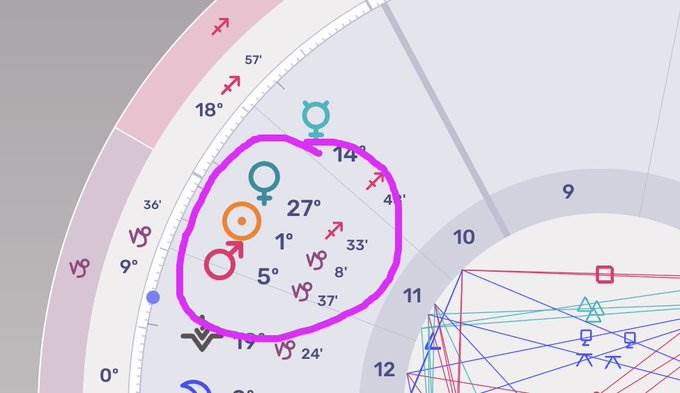
W.D. Gann was one of the most famous market analysts in the 20th century. He was also someone who successfully combined mystical theories with technical analysis, using astrology to predict market trends and make trades.
Soros acknowledged in his book "Financial Alchemy" that he would assess market risks based on the severity of his back pain. When the market is about to reverse, his back becomes extremely painful.
But these stories remain merely “legends” among people; few actually admit to using mysticism to guide their trading decisions.
In private, people may practice feng shui, wear amulets for good luck, or consult masters who can analyze market trends. However, they must keep this secret from their colleagues, otherwise they would be considered unprofessional.
The cryptocurrency industry has broken this taboo.
In an industry inherently full of mystery, mysticism seems to fit perfectly. Some people use astrology to predict the future of BTC, while others use daily fortune-telling to decide whether to place orders.
Moreover, discussions about mysticism in the crypto industry have become more common in recent years. More and more people, either out of trust or curiosity, are joining the ranks of those who use mysticism in trading decisions. There are even many crypto bloggers who specialize in analyzing cryptocurrencies using mystical methods.
The popularity of “Life Charts” is a clear example of this.
Many users discuss their “life trajectories” in the community, either seriously or in jest. They don’t see it as superstition; they simply use a more interesting approach to share their feelings about uncertainty with others.
The role of mysticism among traders has changed. It has moved from being a secret on Wall Street to becoming a public topic on social media in the cryptocurrency industry.
Why is mysticism more popular in the crypto industry?
Why do crypto traders need mysticism?
The answers to this question can be roughly divided into three reasons:
Psychological compensation for anxiety regarding uncertainty;
The crypto market is an ideal environment for creating anxiety.
Trading operates 24/7, without any circuit breakers – sharp rises or falls can occur at any moment.
Here, even a tweet from a popular trader can instantly reduce the market value of a currency by hundreds of millions or even billions of dollars. Founders of well-prepared projects might disappear overnight and flee the market.
Traders are constantly faced with “unknown risks”. What’s truly terrifying isn’t the risk itself, but rather the unknown.
Economist Frank Knight pointed out in 1921 that risk can be quantified as a probability (like rolling a dice), while uncertainty cannot be quantified as something unknown (like whether war will break out tomorrow).
Humans inherently fear uncertainty. When humans cannot quantify risks, they instinctively create “false certainty” to alleviate their anxiety.
And mysticism serves as the perfect medium for such false certainty.
When you don’t know where to go, checking the daily trading calendar can at least provide some guidance.
Within the crypto community, @AstroCryptoGuru, a crypto astrologer with 51,000 followers, uses Bitcoin’s “creation block time” (January 3, 2009) along with planetary cycles to make predictions.
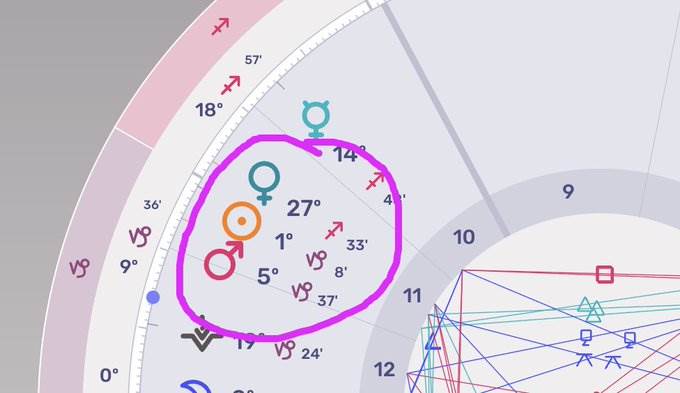
Saturn signals correspond to bear markets, while Jupiter signals indicate the peak of bull markets. He claimed to have successfully predicted the peak of the bull market in December 2017, the bear market in 2022, and the high point of the BTC price surge in 2024.
This method of linking specific dates with celestial events provides traders with a clear “signal to wait for” when market conditions are uncertain, even if that signal comes from space.
Statements like “Don’t trade during lunar phases, as prices will drop sharply during full moons, and your birth chart indicates a BTC bull market next year” don’t require complex technical analysis or difficult book readings. All you need to do is believe in “fate.”
A study conducted by the University of Michigan in 2006 found that stock markets in 48 countries experienced a 6.6% lower return during full moons compared to new moons.
This isn’t because the moon actually affects markets, but because collective superstition influences traders’ behavior. When enough people believe that prices will drop during full moons, they sell their assets early, leading to actual price drops.
In the cryptocurrency world, this kind of collective anxiety is even more intense, especially during bear markets. All forms of “fundamental analysis” and “value investing” become meaningless, making metaphysical analysis seem more reliable.
Therefore, traders need metaphysics—not because it’s always accurate, but because it provides an explanation. Even if that explanation is false, it’s still easier to accept than the uncertainty of a chaotic market.
Cognitive biases lead to self-reinforcement.
Why does metaphysics always seem effective?
The reason why metaphysics continues to be popular in the cryptocurrency community is not only because it helps alleviate anxiety, but also because it seems to be genuinely effective. This isn’t about the metaphysics itself being accurate, but rather about cognitive biases in the brain that reinforce themselves over time. One of the most typical examples of this is the confirmation bias: when you believe that “the market will plummet during a full moon,” you remember all the cases where prices dropped after a full moon, while ignoring those days when prices rose or remained stable. When your “life chart” indicates a bull market this year, you might attribute every small increase to “fate being fulfilled,” while interpreting plunges as “short-term corrections that don’t affect the overall trend.”
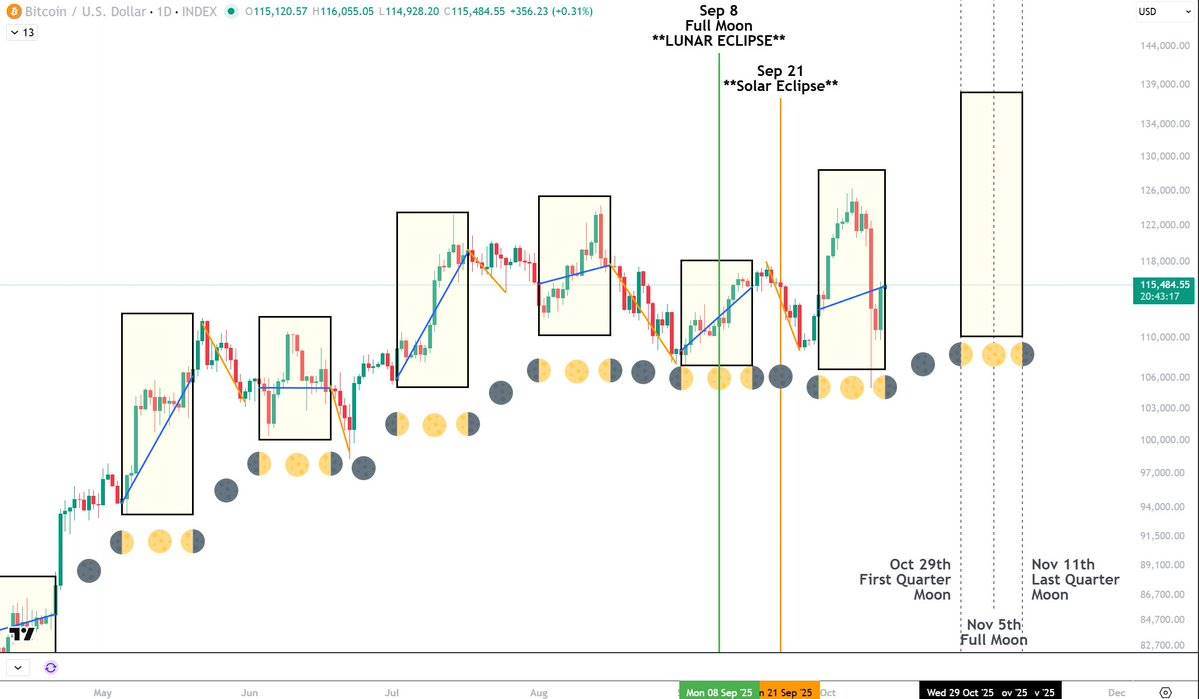
Source: @Drazzzzz
The social media environment in the cryptocurrency community amplifies this bias several times over.
“I traded ETH contracts based on Tarot card readings, and made 20% profits in just three days!” Such posts are likely to be widely shared, liked, and screenshoted.
But traders who lose money due to Tarot card readings won’t post anything, and their stories won’t be noticed.
As a result, the information flow in the community is filled with cases where metaphysics is proven true, while failed attempts are ignored.
Similar examples can be found everywhere on Twitter. For example, in March this year, @ChartingGuy predicted that the blood moon would occur at a certain time. There was room for interpretation regardless of whether the market rose or fell: “Peak ahead,” “Delayed fulfillment,” “Requires consideration from other planetary perspectives.”
If BTC did indeed experience a correction during that period, then this post would be repeatedly cited as “divine prediction.”
When BTC experiences a sharp decline, traders desperately need a reason for it. We look at social media, and technical analysis suggests that the price has fallen below support levels. Macroeconomic analysis points to Japan’s interest rate hikes as the cause. But these explanations are too complicated and uncertain.
Metaphysics, on the other hand, offers a simple explanation: “Saturn is in a retrogradation phase, and the cryptocurrency market is entering a bear market cycle.”
This explanation doesn’t require any understanding of market trends, policies, or data. It simply relies on the belief that celestial movements affect markets. Thus, this explanation quickly became accepted as common knowledge.
What’s more, the ambiguity of metaphysics means it can never be disproven.
Masters say that trading should be avoided during times of unfavorable celestial conditions. If you lose money, it’s because you didn’t follow their advice. If you make money, it’s because your birth chart favors this trend. The Tarot cards show significant fluctuations in the near future, and whether you gain or lose money, it’s still a manifestation of these celestial influences.
This characteristic of being able to explain anything makes metaphysics highly effective in the cryptocurrency world.
So, traders aren’t blindly following superstitions. Instead, their brains are using the most efficient way to process information: remembering what’s useful and ignoring what’s not. They use simple explanations instead of complex analyses.
Metaphysics isn’t popular because it’s accurate, but because it always seems accurate.
Another reason why metaphysics is popular in the cryptocurrency world is that it has become a form of social currency.
Another reason is that metaphysics has become a form of social currency.
There will always be differences in opinions when discussing technical analysis. But there are no right or wrong answers in matters related to mysticism—only shared experiences and understanding. The question “Is your life’s trajectory accurate?” has been widely discussed. This isn’t because people truly believe in it, but because it’s a topic that anyone can participate in, without any need for specialized knowledge.
There’s an example that can well illustrate the need for mysticism.
In the past, our readers often asked if we could add a feature that allowed them to check their fortune. As more people requested this, we finally created a “Today’s Fortune” section on the website.
It’s not necessarily true that people use these predictions to make decisions. But everyone wants a common topic to discuss every day, something that provides comfort and reassurance.
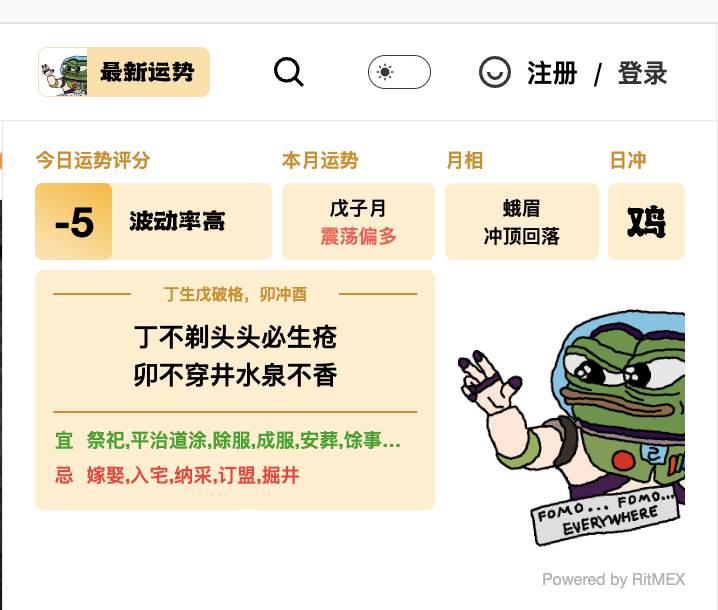
When you say in a group chat, “Today is a bad day for business; I won’t place any orders,” no one will argue that it’s not scientific. Instead, people will respond, “Me too. Let’s avoid this period together.”
The essence of such interaction is to confirm that each person’s concerns are valid.
A Pew Research survey in 2025 showed that 28% of American adults consult astrology, tarot cards, or fortune-telling at least once a year.
Mysticism is no longer just a fringe culture; it’s a common psychological need. The cryptocurrency community has simply transformed this need from something used privately into something displayed publicly.
In this market where there are no authoritative answers, mysticism doesn’t provide solutions. It provides companionship instead.
So, are your life’s trajectories accurate?
The popularity of “Life K-line” stems from using the methods commonly used in the cryptocurrency world to express what every trader has on their mind, but dared not admit: our sense of control over the market is just as fragile as our sense of control over our own fate.
When you see that your “Life K-line” indicates a bear market for this year, you won’t actually sell all your assets right away. But you will feel less guilt when you make losses, and more comfort when you miss out on opportunities.
“It’s not my problem; it’s just that my life cycle isn’t right.”
In this 24/7 market, full of uncertainties, what we really want to predict isn’t the direction of our lives, but rather the psychological support that keeps us playing the game.