Exchange Ranking
 Top Exchanges
 24h Volume Ranking
 Popularity Ranking
 Exchange BTC Balance
 Proof of Reserves
 Decentralized Exchanges
 Funding Rate
 Funding Heatmap
 Liquidation Data
 Max Pain
 Long/Short Ratio
 Whale L/S Ratio
 Binance/Okex/Huobi L/S
 Bitfinex Margin L/S
 ETF Tracker
 Solana ETF
 XRP ETF
 Hong Kong ETF
 Bitcoin Treasuries
 Crypto Reversal
 Ethereum Reserves
 HyperLiquid Wallet Analysis
 Hyperliquid Whale Watch
 Large Transactions
 On-chain Movement
 Bitcoin ROI
 Stablecoin Market Cap
 Options Analysis
 News
 Articles
 Economic Calendar
 Features
 Wallet
 Contract Calculator


 Security
 Collections
 Watchlist
 Following
 BTC
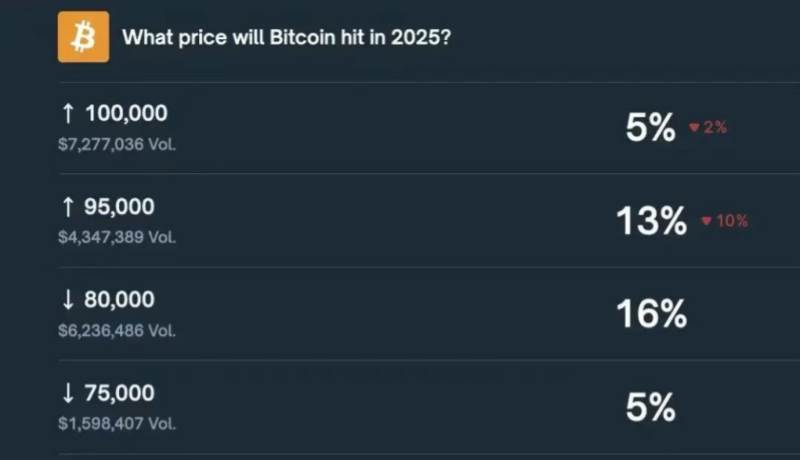
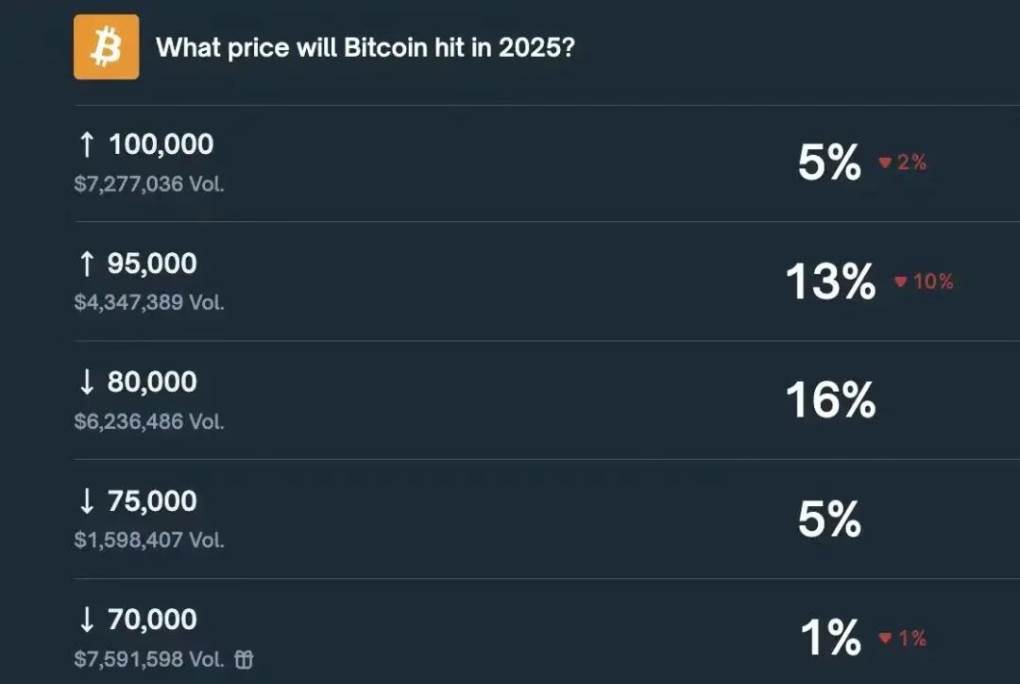
Against the backdrop of tight liquidity at the end of the year and the divergence in ETF flows, prediction markets were able to predict Bitcoin’s price movements. Data from Polymarket shows that traders believe the probability of Bitcoin falling below $80,000 for the rest of December is only 16%, while the likelihood of it falling below $75,000 drops to 5%. The consensus among investors is that Bitcoin will remain around $90,000. Unlike the volatile emotions expressed on social media, prediction markets use real-world data to make their judgments: even though there are short-term pressures, market participants prefer to believe that Bitcoin will maintain its price range at the end of the year, rather than experiencing another period of significant price drops.
At the same time, the probability of Bitcoin breaking through the $100,000 mark by the end of the year is also only 5%. These figures provide a clear picture of the market situation: in the remaining days of 2025, the most likely trend for Bitcoin is to fluctuate within its current price range.
I. Market Expectations
● Latest data from Polymarket shows traders’ collective expectations regarding Bitcoin’s price at the end of the year. According to data from December 24th, the probability of Bitcoin falling below $80,000 in December is 16%, while the probability of it falling below $75,000 is 5%.
● At the same time, the probability of Bitcoin rising back above $100,000 by the end of 2025 is also only 5%. On December 23rd, this probability was 8%, while the probability of it rising back above $95,000 was 25%.
● Currently, Bitcoin’s price is hovering around $90,000, which is a decrease of about 15%-20% compared to the historical high of $108,000 reached in early December.
II. Changes in Emotions
● Market sentiment has undergone a significant shift, from extreme optimism to cautious observation. When Bitcoin exceeded $100,000 for the first time in November this year, the probability of Bitcoin returning to above $100,000 by the end of the year was as high as 70% on Polymarket.
● As prices corrected and time passed, this probability continued to decline, reaching single digits. On December 11th, investors on the Kalshi platform estimated that the probability of Bitcoin breaking through $100,000 by December 31st was approximately 34%, while on Polymarket, the corresponding probability was 29%.
In just two weeks, expectations for a breakout above $100,000 dropped from nearly one-third to 5%, indicating that traders’ expectations for a sharp increase in prices in the short term have significantly cooled down.
III. Key Support Levels
● Although market sentiment has become more cautious, most traders believe that the $80,000 level will be strongly defended. A 16% probability of price drops means that more than 80% of traders believe Bitcoin will hold at this key level.
● Analysts point out that Bitcoin is currently facing resistance at $94,000, and there is a possibility of a breakout to the $98,000 range through an ascending triangle pattern. A breakout and consolidation above $94,000 should drive prices towards the target of around $108,000.
● Factors supporting the current price level include continuous institutional participation. Traders on Polymarket believe that MicroStrategy’s regular purchases this week are highly likely to occur, with a 65% chance of buying more than 1,000 units of Bitcoin.
IV. Risk Factors
● There are several pressures behind the cautious market sentiment. The time window is extremely limited; there is only one week left until the end of the year. Bitcoin needs to rise by more than 11% to reach $100,000. Historical data shows that the probability of a significant increase at the end of the year is low.
● Macroeconomic uncertainties are also increasing. The Fed’s interest rate cut path is unclear, and the expected rate cut range for 2026 has been revised downward, thereby reducing the attractiveness of interest-free assets like Bitcoin. Institutional investor behavior also affects the market.
● The average daily purchase rate of Bitcoin by companies continues to decline, indicating that institutional investors may be becoming increasingly tired. Geopolitical and regulatory risks also deter speculative funds from attempting to buy at high prices.
V. Short-term outlook
● Analysts believe that Bitcoin will likely remain volatile in the short term, with $90,000 becoming the key support level. Any upward breakout would require strong catalysts, such as dovish signals from the Fed or large-scale purchases by institutions. Downward risks come from年底的抛售压力 and increased volatility due to scarce liquidity.
● Cryptocurrency trader Daan Crypto Trades suggests that Bitcoin prices might only rise to around $98,000, which is the support level they previously tested. He added, “This is also a place where a lot of liquidity is concentrated.”
● Most institutions believe that Bitcoin has a higher chance of returning to $100,000 by the first half of 2026. It will be difficult to overcome this hurdle in the last week of the year.
VI. Long-term perspective
● Although short-term prospects are uncertain, analysts remain optimistic about Bitcoin’s long-term trend. Jurrien Timmer, head of Fidelity’s global macro department, pointed out that over the 145 weeks from 2022 to 2025, Bitcoin achieved a compound annual growth rate of 105%, which aligns closely with long-term trends.
● Timmer believes that although Bitcoin may experience further corrections in 2026, with prices potentially falling to the range of $65,000 to $75,000, he emphasized that these levels have always represented strong buying opportunities.
● Julien Bittel, head of macro research at Global Macro Investor, believes that the traditional four-year halving cycle is no longer the main factor driving Bitcoin’s price movements. The extended debt refinancing cycle and evolving liquidity dynamics suggest that the current market structure could continue into 2026.
Bitcoin could reach a price level of $300,000 by 2029.

When markets shift their focus from chasing the historic high of $100,000 to protecting the key resistance level of $80,000, the picture depicted by traders on Polymarket becomes clearer. The current probability of prices falling below $80,000 seems more like a reflection of market resistance to extreme volatility during periods of scarce liquidity at the end of the year, rather than an absolute confidence in Bitcoin’s strength.
As the time remaining for trading in 2025 dwindles, Bitcoin behaves like a coin hovering at $90,000 in value. It has lost its momentum to make further gains, and there seems to be no reason for it to decline further. Analyst Jurrien Timmer pointed out that Bitcoin has achieved a compound annual growth rate of 105%, which aligns closely with long-term regression models