Exchange Ranking
 Top Exchanges
 24h Volume Ranking
 Popularity Ranking
 Exchange BTC Balance
 Proof of Reserves
 Decentralized Exchanges
 Funding Rate
 Funding Heatmap
 Liquidation Data
 Max Pain
 Long/Short Ratio
 Whale L/S Ratio
 Binance/Okex/Huobi L/S
 Bitfinex Margin L/S
 ETF Tracker
 Solana ETF
 XRP ETF
 Hong Kong ETF
 Bitcoin Treasuries
 Crypto Reversal
 Ethereum Reserves
 HyperLiquid Wallet Analysis
 Hyperliquid Whale Watch
 Large Transactions
 On-chain Movement
 Bitcoin ROI
 Stablecoin Market Cap
 Options Analysis
 News
 Articles
 Economic Calendar
 Features
 Wallet
 Contract Calculator


 Security
 Collections
 Watchlist
 Following
Over the past year, there has been a quiet but significant shift in the robotics industry. As the autonomous decision-making capabilities of AI agents become more mature, and blockchain-based payments and machine-readable agreements are gradually implemented, robots are no longer just remote-controlled hardware devices. They now possess the ability to collaborate, settle transactions, and even “participate in economic activities.” The capital market has already shown signs of this trend—many investment firms view humanoid robots as a long-term structural opportunity, with related companies experiencing rising valuations and financing levels. The robotics industry is shifting from focusing on hardware performance to adopting a composite system that combines intelligence, funding, and organizational capabilities. A true machine economy that can integrate into societal operations is taking shape at an accelerated pace.
Introduction
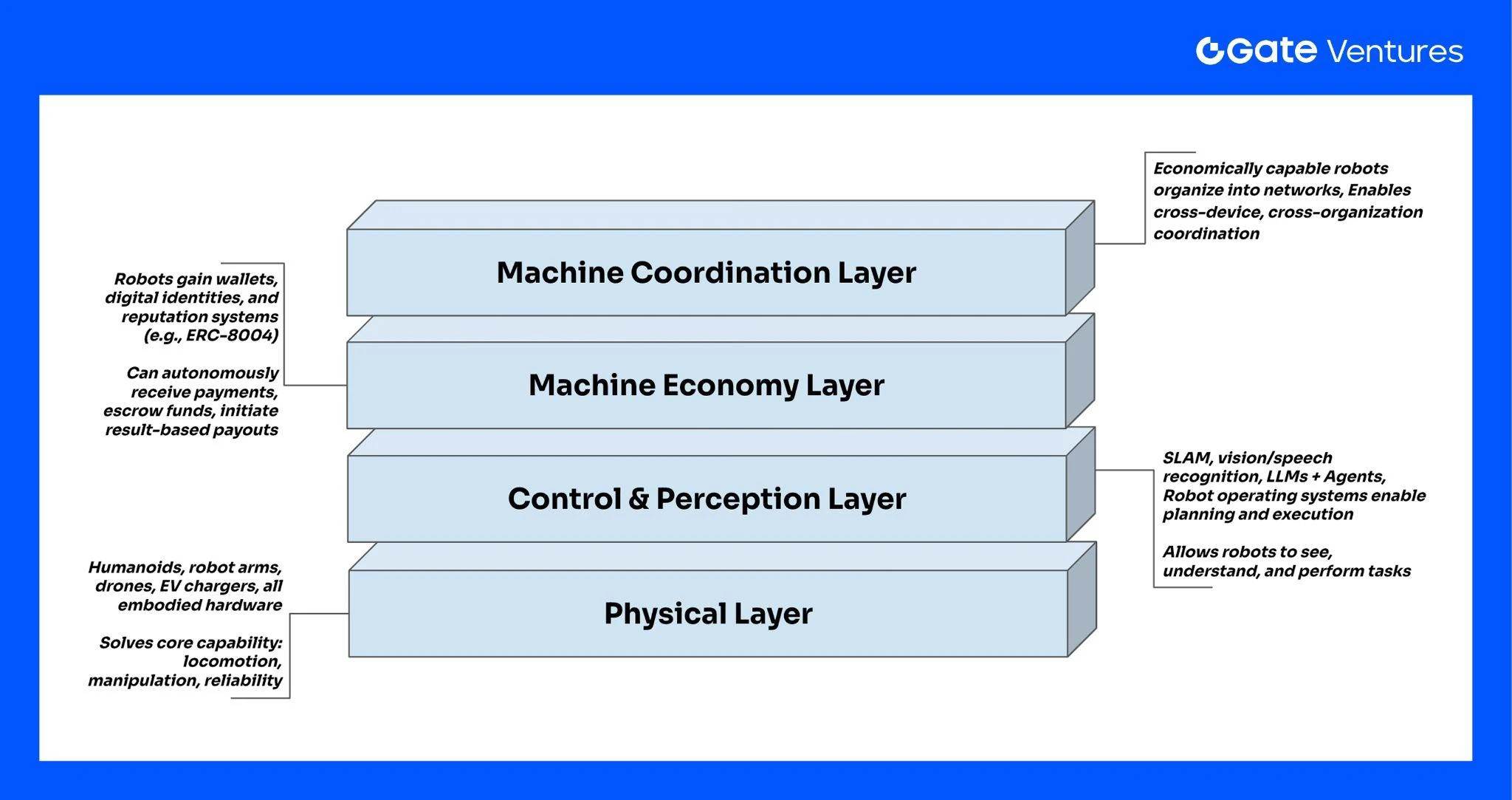
To understand the future direction of the robotics industry, we can break down the entire ecosystem into four clear levels:
Source: Gate Ventures
The first level is the Physical Layer: This includes humanoids, robotic arms, drones, EV charging stations, and all other devices with physical structures. These devices address basic movement and operational issues, such as walking, grasping, mechanical reliability, and cost considerations. However, machines at this level still lack “economic behavior capabilities,” meaning they cannot independently perform tasks like charging, paying, or purchasing services.
The second level is the Control & Perception Layer: This includes traditional robot control theories, SLAM algorithms, perception systems, speech and vision recognition technologies. It also encompasses LLM-based agents, as well as robot operating systems with advanced planning capabilities, such as ROS and OpenMind OS. This layer enables machines to “understand, perceive, and execute tasks” effectively. However, economic activities like payments, contracts, and identity management still require human intervention in the background.
The third layer is the Economic Settlement Layer: True transformation begins here. Machines now have wallets, digital identities, and credit systems (such as ERC-8004). They can directly pay for computing power, data, energy, and transportation rights through mechanisms like x402, on-chain settlements, and Onchain Callback. Additionally, they can receive payments for completing tasks, manage funds, and initiate result-based payments. This layer transforms robots from mere “business assets” into “economic entities” capable of participating in markets.
The fourth layer is the Machine Coordination Layer: Once robots can make autonomous payments and manage their identities, they can form larger organizations—such as drone fleets, cleaning robot networks, or EV energy grids. These organizations can automatically adjust prices, schedule tasks, compete for resources, share profits, and even operate as autonomous economies under DAO principles.
Through these four layers, we can see that the future of robot ecosystems will not be just a hardware revolution, but rather a systematic reshaping of elements like physics, intelligence, finance, and organization.
This not only redefines the capabilities of machines, but also changes the way value is captured. Whether they’re robotics companies, AI developers, infrastructure providers, or those working with encrypted payment and identity protocols, all will find their place in this new robotics economy.
Why is the robotics industry experiencing a boom at this moment?
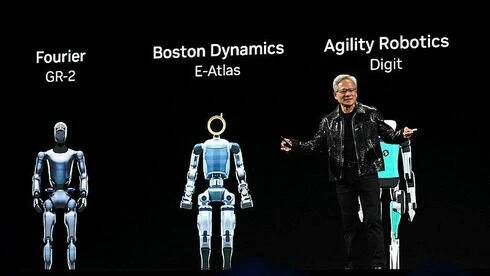
Over the past few decades, the robotics industry has remained confined to laboratories, exhibition stands, and specific industrial scenarios, never truly reaching the stage of large-scale commercialization and widespread deployment. However, after 2025, this milestone will be reached. Based on considerations from both the capital market and technological maturity, as well as insights from industry experts like NVIDIA CEO Jensen Huang, there is one clear signal:
"The time for ChatGPT-style solutions in general robotics is just around the corner."
This isn’t just hype—it’s based on three key industry trends:
1. Basic technologies such as computing power, models, simulation, and perception control are becoming more mature simultaneously.
2. Robot intelligence is shifting from closed-loop control to open-ended decision-making driven by LLMs/Agents.
3. There’s a shift from individual robot capabilities to system-level capabilities: robots will become capable of “collaboration, understanding, and efficient operation.”
Jensen Huang even predicts that humanoid robots will enter widespread commercial use within the next five years. This prediction aligns closely with the actions of the capital market and industry players in 2025.
At the capital level, massive financing proves that the “robot revolution” has already been priced by the market.
In the years 2024–2025, the robotics industry witnessed unprecedented levels of funding and investment. In just 2025 alone, there were several financings worth over $500 million. Some notable instances include:
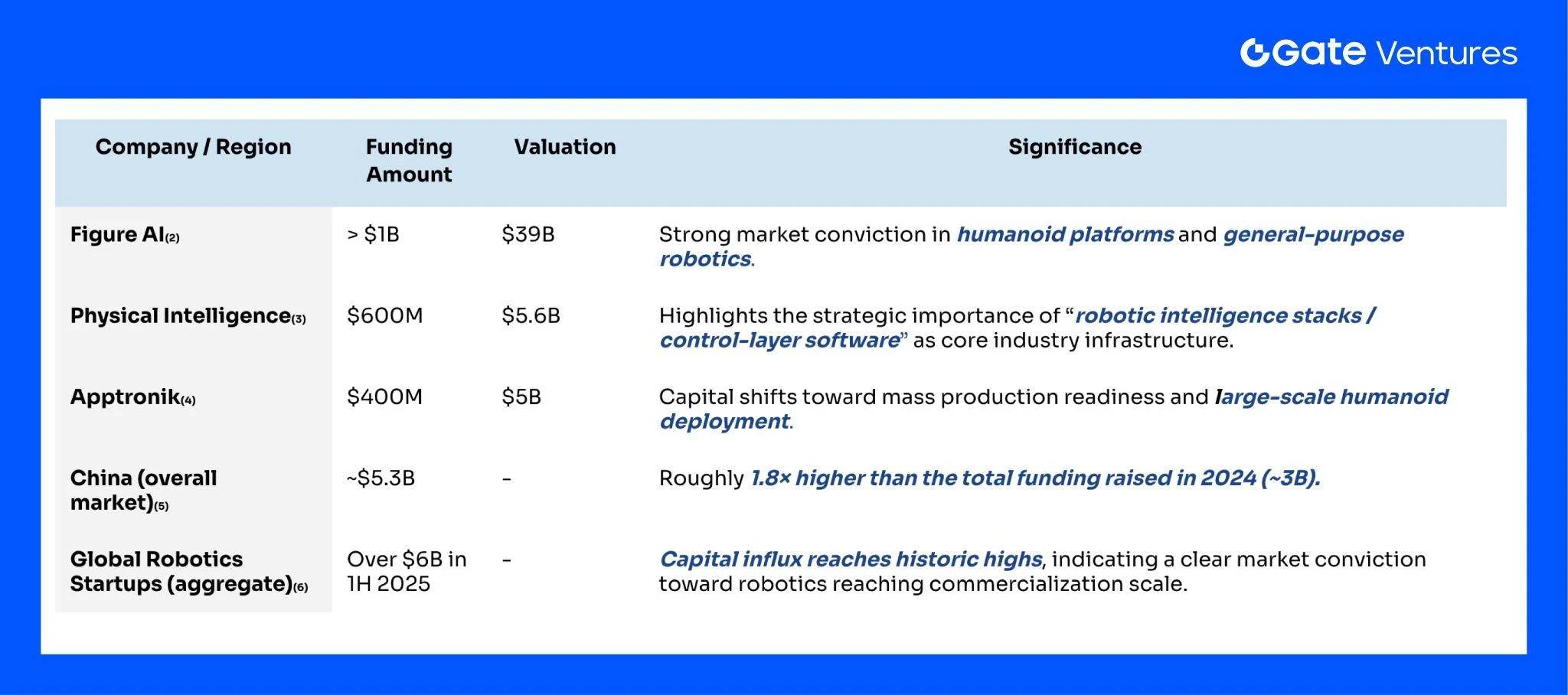
Source: Gate Ventures
Investors clearly indicated that the robotics industry has reached a stage where investments can be effectively evaluated.
Common characteristics of these financings are:
● These are not “concept financing” efforts, but rather investments in production lines, supply chains, general intelligence systems, and commercialization strategies.
● These are not isolated projects, but rather comprehensive solutions that integrate hardware and software components, as well as complete services for the entire lifecycle of robots.
Investors won’t invest billions without proper justification; this reflects confidence in the maturity of the industry.
At the technical level, there were significant breakthroughs.
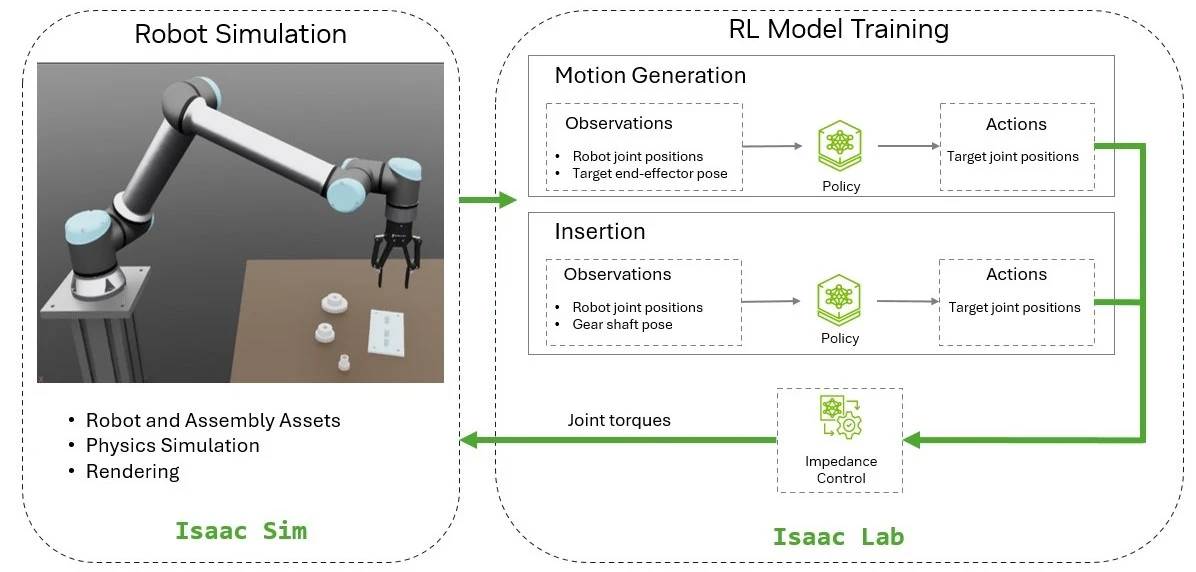
In 2025, the robotics industry experienced a rare phenomenon known as “multidisciplinary convergence.” First, advancements in AI agents and large language models allowed robots to evolve from mere “operable machines” that could only execute commands to “intelligent entities” capable of understanding language, breaking down tasks into smaller steps, and making decisions based on visual and tactile information. Multimodal perception and new generation control models (such as RT-X and Diffusion Policies) enabled robots to possess basic capabilities similar to those of general intelligence.
Source: Nvidia
At the same time, simulation and migration technologies have become increasingly sophisticated. Tools like Isaac and Rosie have significantly reduced the gap between simulation and reality, enabling robots to undergo large-scale training in virtual environments at low costs, and then be reliably transferred to the real world. This addresses the fundamental problems that plagued robots in the past: slow learning speeds, expensive data collection, and high risks in real-world environments.
Advances in hardware also play a crucial role. Key components such as torque motors, joint modules, and sensors are becoming more affordable due to larger-scale supply chains. China’s rapid rise in the global robotics supply chain further enhances industry productivity. With many companies starting production, robots now have the foundation for “replicable and scalable” industrial applications.
Finally, improvements in reliability and energy efficiency mean that robots can meet the minimum requirements for commercial applications. Better motor control, redundant safety systems, and real-time operating systems enable robots to operate smoothly over long periods in enterprise-level scenarios.
These factors mean that the robotics industry now has all the necessary conditions to move from laboratory demonstrations to large-scale deployment in the real world. This is precisely why the robotics revolution is happening right now.
Commercialization: From prototypes to mass-produced devices, finally reaching real-world deployment.
2025 will also be the year when the path to commercialization of robots becomes clearly visible for the first time. Leading companies such as Apptronik, Figure, and Tesla Optimus have successively announced plans for mass production, marking a significant milestone in the development of humanoid robots, as they move from prototype stages to a stage where they can be produced on a large scale. At the same time, many companies are starting to implement pilot projects in areas with high demand, such as warehousing and logistics, and factory automation, to test the efficiency and reliability of robots in real-world scenarios.
With the improvement in hardware production capabilities, the “Operation-as-a-Service” model is beginning to gain market acceptance. Companies no longer need to invest large amounts of money at once, but can instead subscribe to robot services on a monthly basis, thereby significantly improving the return on investment. This model becomes a key business innovation that drives the large-scale adoption of robots.
In addition, the industry is rapidly developing a complete set of services that were previously lacking, including maintenance networks, spare parts supply, remote monitoring, and operation platforms. As these capabilities are realized, robots will be able to operate continuously and achieve a complete commercial cycle.
Overall, 2025 will be a pivotal year for robots, as they move from being capable of being built to being capable of being sold, used, and affordable by everyone. For the first time, a sustainable positive cycle in commercialization is emerging.
Web3 X Robot Ecosystem
With the imminent explosion of the robotics industry by 2025, blockchain technology also finds its place within this context, providing several crucial capabilities to support the robotics ecosystem. Its core values can be summarized into three main aspects: i) data collection for robotics systems; ii) cross-device coordination networks for machines; and iii) economic networks that enable machines to participate autonomously in the market.
Decentralization combined with token-based incentives creates new sources of data for robot training. However, the quality of these data still requires improvement through backend data processing mechanisms like
. The main challenges in training Physical-AI models lie in the scarcity of real-world data, its coverage, and the difficulty of obtaining high-quality physical interaction data. DePIN/DePAI offers a new solution to address these issues, enabling Web3 to determine who can contribute data and how this contribution can be sustained over time.
However, from an academic perspective, while decentralized data has potential in terms of scale and coverage, it doesn’t necessarily mean it’s of high quality. It still needs to be filtered, cleaned, and corrected before being used for large-scale model training.
Essentially, Web3 addresses the issue of “data supply motivation,” rather than directly ensuring “data quality.”
Traditional robotics training data comes mainly from laboratories, small teams, or internal collections within companies, and the volume of such data is often insufficient.
The DePIN/DePAI model in Web3 allows ordinary users, device operators, or remote controllers to become data contributors through token incentives, thereby significantly increasing the scale and diversity of data sources.
The projects include:
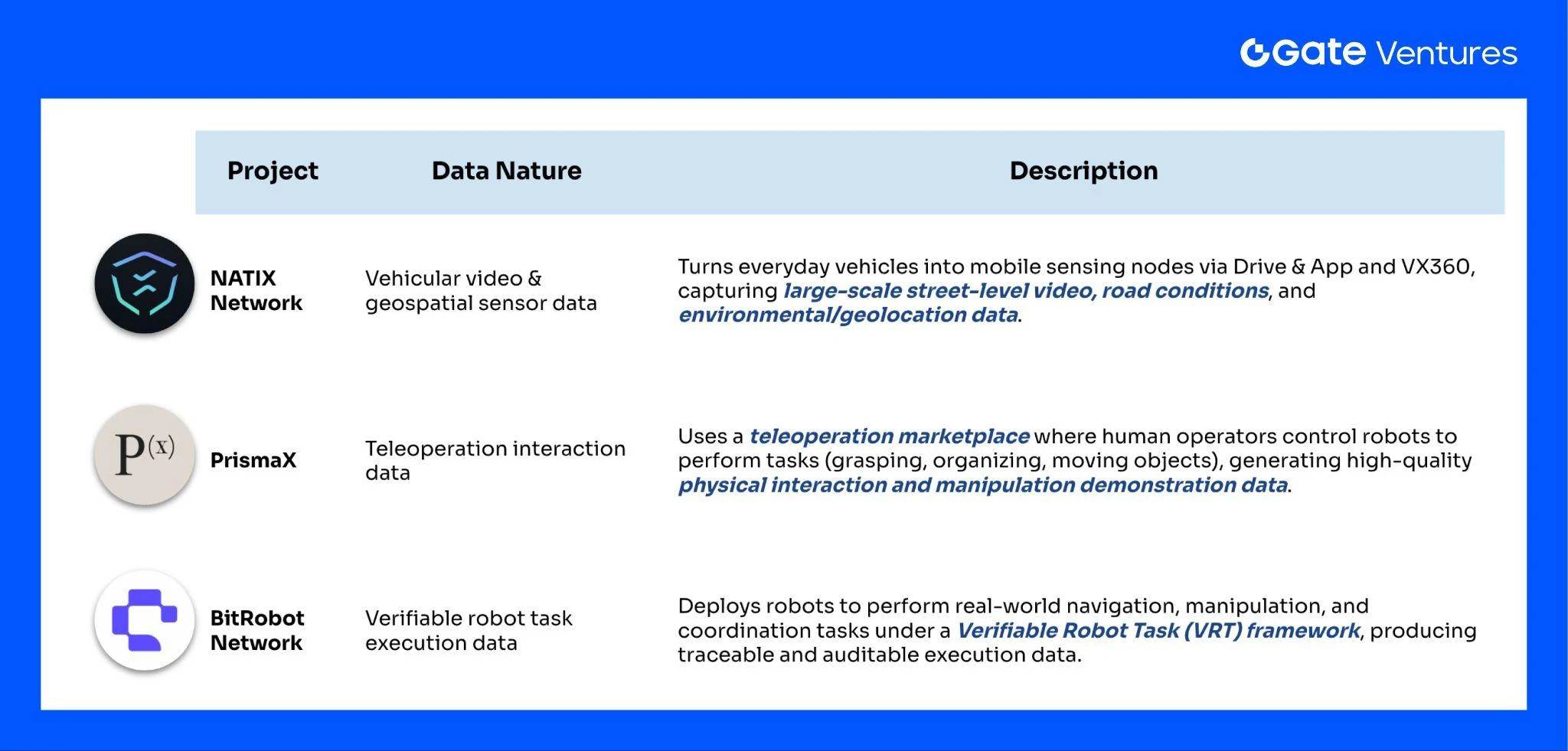
. Source: Gate Ventures.
● NATIX Network: Converts ordinary vehicles into mobile data nodes through Drive&App and VX360, allowing for the collection of video, geographical, and environmental data.
● PrismaX: Collects high-quality robot physics interaction data (such as grasping, moving objects, etc.) through remote control of markets.
● BitRobot Network: Enables robot nodes to perform verifiable tasks (VRT), generating data related to real-world operations, navigation, and collaboration behaviors.
These projects demonstrate how Web3 can effectively expand the supply of data, addressing scenarios that are difficult to cover by traditional systems.
However, according to academic research, crowdsourcing/decentralized data often suffers from structural issues such as low accuracy, high noise levels, and significant biases. Many studies in the academic community have highlighted these problems regarding crowdsourcing and mobile crowdsensing:
1. Data quality varies greatly, with significant differences in noise levels and formats.
Differences in devices, operating methods, and understandings among contributors lead to inconsistent data, which needs to be filtered out.
2. Structural biases are common. Participants tend to gather in specific areas or groups, resulting in sampling distributions that do not match those in the real world.
3. Raw crowdsourced data cannot be directly used for model training.
Autonomous driving, embodied AI, and robotics research consistently emphasize that high-quality training datasets require a complete process involving data collection, quality review, redundancy alignment, data augmentation, long-tail completion, and label consistency verification. It cannot be used as is after just data collection. (7)
Therefore, Web3’s data network provides a broader range of data sources. However, whether these data can be directly used for training depends on the backend data engineering efforts.
The true value of DePIN lies in providing a “continuous, scalable, and cost-effective” data foundation for Physical AI
. Rather than immediately solving the problem of data accuracy, Web3 addresses issues like:
● “Who is willing to contribute data over the long term?”
● “How can we encourage more real devices to participate?”
● “How can we transition data collection from a centralized model to a sustainable open network?”
In other words, DePIN/DePAI provides the foundation for both data volume and coverage, making Web3 an essential component of the “data source layer” in the era of Physical AI. But it isn’t the only guarantee of data quality.
Cross-device machine coordination networks: General-purpose operating systems provide the necessary communication layers for robot collaboration
Currently, the robotics industry is moving from single-machine intelligence to group collaboration. However, there remains a key bottleneck: robots from different brands, models, and technologies cannot share information, interact with each other, or use a unified communication medium. This means that multi-machine collaboration relies on proprietary closed systems developed by manufacturers, which greatly limits large-scale deployment.
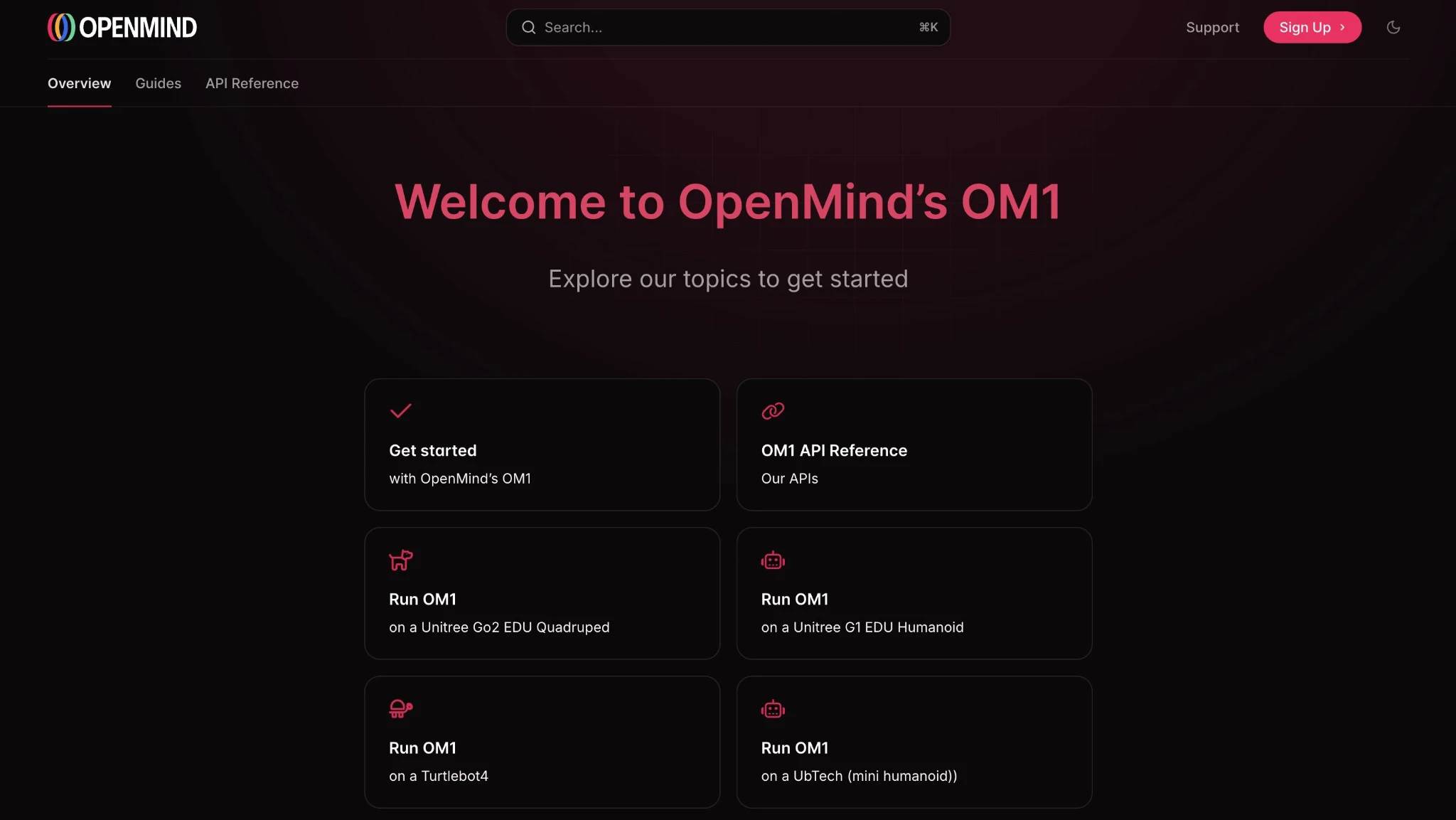
In recent years, the emergence of General Robot Operating Systems has seen significant progress. OpenMind is one example of such systems that offer new solutions to this problem. These systems aren’t traditional “control software” but rather intelligent operating systems that can be used across different robots. Just like Android in the mobile industry, they provide a common language and infrastructure for communication, cognition, understanding, and collaboration among robots.
In traditional architectures, sensors, controllers, and reasoning modules within each robot are isolated from each other, making it impossible to share semantic information between devices. However, General Operating Systems enable robots to communicate with each other through unified perception interfaces, decision-making formats, and task planning methods. This allows robots to achieve:
● Abstract descriptions of the external world (vision/sound/touch → structured semantic events)
● Unified interpretation of instructions (natural language → action plans)
● Shared multimodal state representation
In other words, robots now have a cognitive layer that can understand, express, and learn. As a result, robots are no longer isolated actuators but can be integrated into larger-scale robotic networks.
Additionally, the greatest breakthrough of General Operating Systems lies in their compatibility across different brands and types of robots. For the first time, robots from different manufacturers can communicate using the same language. All robots can access a unified data bus and control interfaces through the same operating system.
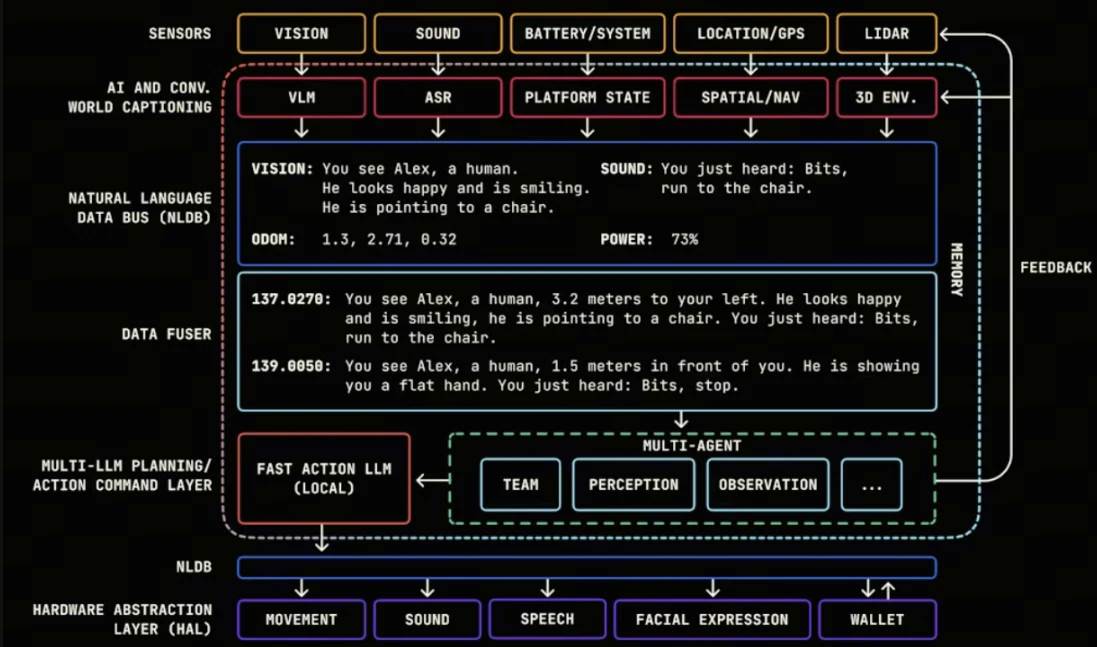
Source: Openmind
This cross-brand interoperability enables the industry to discuss
for the first time: ● Multi-robot collaboration
● Task bidding and scheduling
● Shared perception / shared map
● Joint task execution across different spaces
The premise of collaboration is “understanding the same information format”. General-purpose operating systems are addressing this underlying language issue.
In the system of cross-device robot collaboration, Peaq represents another key infrastructure direction: providing a underlying protocol layer that allows robots to have verifiable identities, receive economic incentives, and participate in network-level coordination. (9)
What it addresses isn’t how robots “understand the world”, but rather how robots “participate in collaboration as individuals within the network”.
Its core design includes:
1. Robot identity
Peaq provides decentralized identity registration for robots, devices, and sensors, enabling them to:
● Access any network as independent entities
● Participate in trusted task allocation and reputation systems
This is a prerequisite for robots to become “network nodes”.
2. Autonomous economic accounts
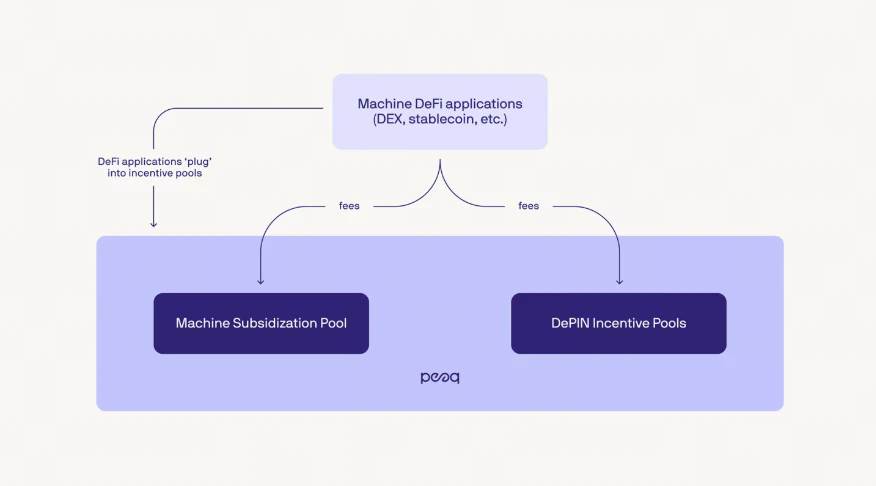
Source: Peaq
Robots are given economic autonomy. Through native support for stablecoin payments and automatic billing logic, robots can automatically reconcile transactions and make payments without human intervention. This includes:
● Sensor data is settled based on usage
● Pay-per-use billing for computing power and model inference
● Immediate settlement after robots provide services to each other (transportation, delivery, inspection)
● Access to infrastructure such as autonomous charging and rental spaces
Additionally, robots can use conditional payments:
● Automatic payment upon task completion
● Funds automatically frozen or returned if results do not meet expectations
This makes robot collaboration more reliable, auditable, and capable of automatic arbitration. It’s a key capability for large-scale commercial deployment.
Moreover, the revenue generated by robots from providing services and resources in the real world can be tokenized and recorded on the blockchain. This allows values and cash flows to be represented in a transparent, traceable, tradable, and programmable manner. Thus, an asset representation system based on machines can be created.
As AI and blockchain systems become more mature, the goal is for machines to be able to earn, pay, borrow, and invest autonomously. This would enable direct M2M transactions, creating an autonomous network of machine-based economies. Ultimately, collaboration and governance could be achieved through DAO mechanisms.
3. Coordination of tasks across multiple devices
At a higher level, peaq provides a framework for coordinating between machines, enabling them to:
● Share status and availability information
● Participate in task bidding and matching
● Schedule resources (computing power, mobility, sensing capabilities)
This enables robots to work together, just like nodes in a network, rather than operating independently. Only when language and interfaces are standardized can robots truly join together in collaborative networks, rather than remaining isolated within their own closed ecosystems.
Companies like OpenMind strive to standardize the way robots “understand the world and execute commands”. On the other hand, Web3-based coordination networks like Peaq explore ways to enable different devices to collaborate effectively within larger networks. These are just examples of many attempts being made, reflecting the industry’s rapid progress towards unified communication layers and open interoperability systems.
The machine economy network that supports robots’ autonomous participation in markets is crucial.
If cross-device operating systems address how robots communicate with each other, while coordination networks solve problems related to cooperation, then the essence of the machine economy network lies in transforming robot productivity into sustainable capital flows, allowing robots to cover their own costs and create a closed loop.
One key missing component in the robotics industry is “autonomous economic capabilities”. Traditional robots can only execute pre-set instructions, but they cannot independently manage external resources, set prices for their own services, or settle costs. In complex scenarios, they must rely on human intervention for accounting, approval, and scheduling. This severely reduces efficiency, making large-scale deployments even more difficult.
x402: Providing robots with the necessary qualifications to be economic entities.
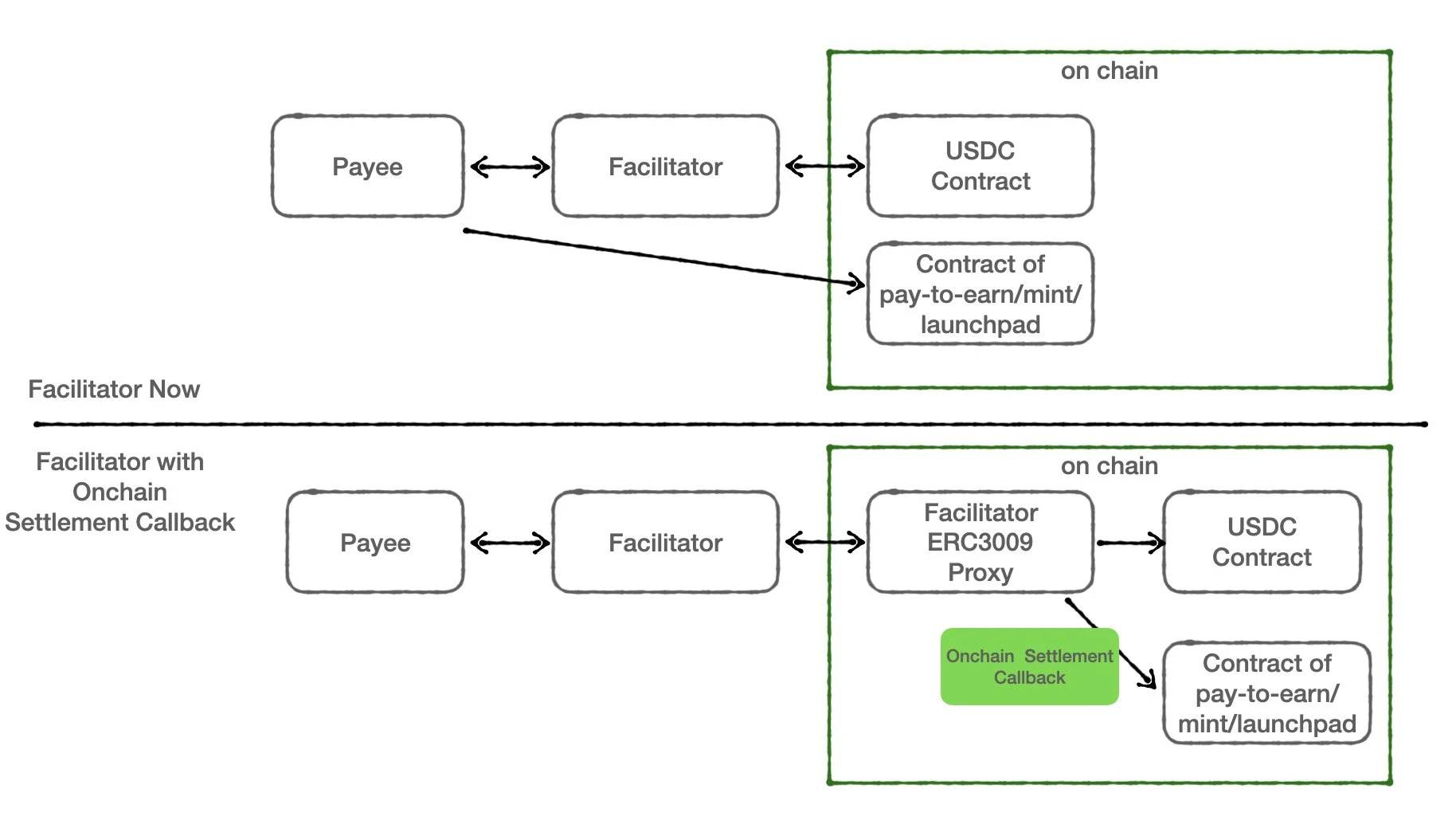
Source: X@CPPP2443_
x402, as the new standard for agent-based payments, provides robots with this essential capability. Robots can directly initiate payment requests via the HTTP layer, and use programmable stablecoins like USDC for atomic settlements. This means that robots can not only complete tasks but also independently purchase all necessary resources for those tasks:
● Computing power invocation (LLM inference / control model inference)
● Scenario execution and device rental
● Labor services provided by other robots
From now on, robots can consume and produce resources independently, just like economic entities.
In recent years, there have been several successful examples of cooperation between robot manufacturers and encrypted infrastructure providers, indicating that the machine economy network is moving from concept to reality.
OpenMind × Circle: Enabling robots to support stablecoin payments natively
Source: OpenmindOpenMind
By integrating this technology into robots’ cross-device operating systems, robots can use stablecoins for payments and settlements directly during task execution.
This represents two significant breakthroughs:
1. Robot task execution processes can be seamlessly integrated with financial settlements, eliminating the need for backend systems
2. Robots can conduct transactions across platforms and brands without any restrictions
For machine collaboration, this is a fundamental capability towards an autonomous economy.
Kite AI: Building an agent-native blockchain foundation for the machine economy
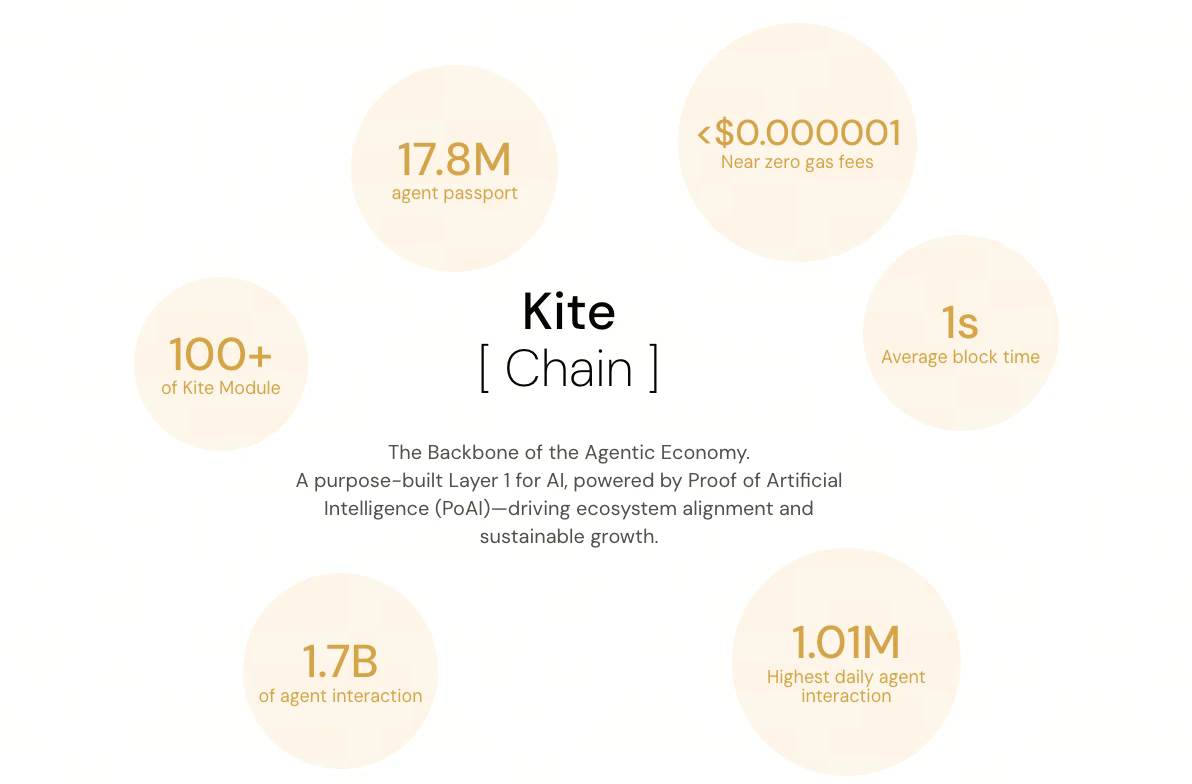
Source: Kite AI. Kite AI further advances the underlying structure of the machine economy by providing blockchain-based identities for AI agents, integrated wallets, and automated payment and settlement systems. This allows agents to execute various transactions independently on the blockchain.
It creates a complete “autonomous agent operating environment,” which aligns well with the autonomous participation in markets that robots are intended to achieve.
1. Agent/Machine Identity Layer (Kite Passport): This layer assigns encrypted identities and multi-layer key systems to each AI agent (which can later be mapped to specific robots). This allows for precise control over who spends money and on behalf of whom. It also enables immediate revocation and accountability, essential for treating agents as independent economic entities.
2. Native Stablecoins + x402 Protocol Integration: Kite integrates the x402 payment standard at the blockchain level. Stablecoins like USDC are used as default settlement assets, enabling agents to send, receive, and reconcile transactions through standardized authorization processes. This approach optimizes transactions between machines for high-frequency, small-value payments (with sub-second confirmation times, low costs, and auditability).
3. Programmable Constraints and Governance: Through blockchain-based policies, agents can set spending limits, allow certain merchants/contracts to be listed in a whitelist, define risk control rules, and track their activities. This ensures a balance between security and autonomy when managing machine wallets.
In other words, if OpenMind’s operating system enables robots to “understand the world and collaborate with others,” then Kite AI’s blockchain infrastructure allows robots to “survive within the economic system.” Through these technologies, the machine economy network creates a system of “incentives for collaboration” and “value loops.” This not only enables robots to “pay for things,” but more importantly, it allows them to:
● Receive income based on performance
● Purchase resources as needed (self-sustaining cost structure)
● Participate in market competition through online reputation systems (verifiable fulfillment)
This means that robots can now participate in a complete economic incentive system: they can work, earn money, spend money, and even optimize their behavior independently.
Summary
Outlook
Looking at these three directions, the role of Web3 in the robotics industry is becoming increasingly clear:
● Data layer: Provides large-scale, multi-source data collection capabilities, and improves coverage in niche scenarios;
● Collaboration layer: Introduces unified identities, interoperability, and task governance mechanisms for cross-device collaboration;
● Economy layer: Offers a programmable framework for economic behavior through online payments and verifiable settlements.
These capabilities together lay the foundation for the future of the machine internet, allowing robots to collaborate and operate in a more open and auditable technological environment.
Uncertainty
Although the robotics industry is on the verge of achieving a significant breakthrough by 2025, there are still many uncertainties in the process of transitioning from “technologically feasible” to “scalable and sustainable” solutions. These uncertainties stem not from single technical bottlenecks, but rather from complex interactions at the engineering, economic, market, and institutional levels. Is economic viability truly achievable? Although robots have made progress in areas such as perception, control, and intelligence, their widespread deployment ultimately depends on real commercial demand and economic returns. At present, most humanoid robots and general-purpose robots remain in the pilot and validation stages. It remains unclear whether companies are willing to pay for robot services over the long term, or whether the OaaS/RaaS model can demonstrate stable ROI across various industries. There is insufficient long-term data to support these claims. Additionally, the cost-effectiveness of robots in complex, unstructured environments has not yet been fully established. In many scenarios, traditional automation or manual alternatives remain cheaper and more reliable. This means that technical feasibility does not necessarily translate into economic necessity, and the uncertainty around commercialization will directly affect the pace of industry expansion. The biggest challenge facing the robotics industry lies not in whether tasks can be completed, but rather in whether robots can operate reliably, efficiently, and at low costs over the long term. In large-scale deployments, hardware failure rates, maintenance costs, software upgrades, energy management, as well as security and liability issues, can all become systemic risks.
即便通过 OaaS 模式降低了前期资本支出,隐藏在运维、保险、责任与合规中的成本仍可能侵蚀整体商业模型。若可靠性无法跨越商业场景的最低门槛,机器人网络与机器经济的设想将难以落地。
生态协同、标准收敛与制度适配
机器人生态正同时经历 OS、Agent 框架、区块链协议、支付标准的快速演化,但当前仍高度碎片化。跨设备、跨厂商、跨系统协作的成本较高,通用标准尚未完全收敛,这可能导致生态割裂、重复建设与效率损失。
与此同时,具备自主决策与经济行为能力的机器人正在挑战现有监管与法律框架:责任归属、支付合规、数据与安全边界仍不清晰。若制度与标准无法与技术演进同步,机器经济网络将面临合规与落地层面的不确定性。
总体而言,机器人规模化应用的条件正在逐步形成,而机器经济体系的雏形也在产业实践中显现。Web3 × Robotics 虽然仍处于早期阶段,但已展现出值得关注的长期发展潜力。