Exchange Ranking
 Top Exchanges
 24h Volume Ranking
 Popularity Ranking
 Exchange BTC Balance
 Proof of Reserves
 Decentralized Exchanges
 Funding Rate
 Funding Heatmap
 Liquidation Data
 Max Pain
 Long/Short Ratio
 Whale L/S Ratio
 Binance/Okex/Huobi L/S
 Bitfinex Margin L/S
 ETF Tracker
 Solana ETF
 XRP ETF
 Hong Kong ETF
 Bitcoin Treasuries
 Crypto Reversal
 Ethereum Reserves
 HyperLiquid Wallet Analysis
 Hyperliquid Whale Watch
 Large Transactions
 On-chain Movement
 Bitcoin ROI
 Stablecoin Market Cap
 Options Analysis
 News
 Articles
 Economic Calendar
 Features
 Wallet
 Contract Calculator


 Security
 Collections
 Watchlist
 Following
 AAVE
The Aave loan agreement is currently in the midst of a controversy, with growing tensions between the team and the community. This has objectively affected the confidence of holders of AAVE tokens themselves.
Early today, one of AAVE’s largest holders, aside from the project team and the protocol contract, sold off 230,000 AAVE units (worth approximately $38 million). This led to a short-term decline in AAVE’s value by 12%. It is reported that this holder purchased AAVE at an average price of $223.4 per unit, starting from the end of last year to early this year. Today, the average selling price was around $165 per unit, resulting in a loss of $13.45 million.
Note: The holder’s address is https://debank.com/profile/0xa923b13270f8622b5d5960634200dc4302b7611e.
The incident originated from disputes over fee distribution.
To understand Aave’s current community crisis, we need to look at a recent change made to Aave’s frontend interface.
On December 4th, Aave announced a partnership with Cow Swap. Aave will use Cow Swap as the default transaction path for its frontend exchange functions. This allows for better pricing opportunities due to Cow Swap’s anti-MEV functionality.
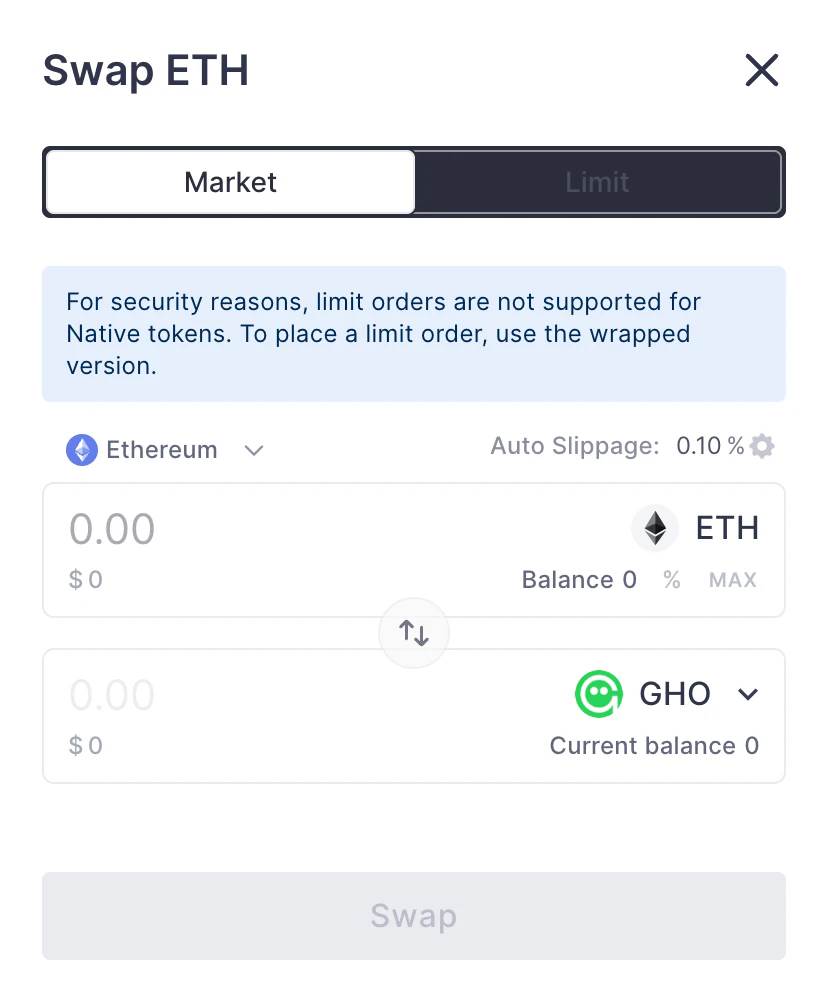
This seemed like a normal feature upgrade, but the community quickly realized that when using ParaSwap, the additional fees generated by this function (including referral fees or positive slippage fees) were supposed to go into Aave DAO’s treasury account. However, after switching to Cow Swap, these fees instead went into Aave Labs’ account.
Community representative EzR3aL was the first to notice this change, which Aave did not mention explicitly. In the governance forum, he questioned the Aave team and estimated that by tracking Aave’s revenue flows on Ethereum and Arbitrum, this fee could generate around $200,000 per week, with an annual income of over $10 million. This means that Aave has transferred at least tens of millions of dollars from community addresses to the team’s account, without anyone else even knowing about it.
The core issue is: Who actually owns the Aave brand?
As EzR3aL’s post gained traction, many AAVE holders felt betrayed. After all, Aave neither communicated with the community nor provided any information about this change, which made some people want to hide this decision.
In response to the community’s concerns, Aave Labs replied positively to EzR3aL’s post, stating that there should be a clear distinction between the protocol layer and the product layer. Aave’s frontend exchange function is entirely managed by Aave Labs, who are responsible for funding, development, and maintenance. This function operates independently of the DAO’s management system. Therefore, Aave Labs has the right to decide how to operate and make profits… The revenue that previously flowed into Aave DAO’s address was actually donations from Aave Labs, not a mandatory contribution.
In short, Aave Labs believes that Aave’s frontend interface and related functions are essentially part of the team’s products. The revenue generated from these activities should be considered company property, and should not be confused with the protocols and revenues controlled by the DAO.
Upon these words being spoken, a heated debate quickly erupted within the community regarding the ownership of the Aave protocol and its products. A well-known DeFi analyst wrote an article titled “Who Really Owns Aave?”
On December 16th, the conflict intensified once again. Ernesto Boado, former CTO of Aave, proposed a solution on the governance forum, suggesting that control over Aave’s brand assets—including the domain name, social media accounts, and naming rights—should be transferred to the token holders of AAVE. These assets would be managed by an entity controlled by a DAO, with strict anti-occupation measures in place.
The proposal received nearly ten thousand views and hundreds of high-quality responses on the Aave governance forum. All participants in the Aave ecosystem expressed their opinions regarding this proposal. Although some argued that the implementation plan was insufficient and could lead to further conflicts, most respondents supported the proposal.
The founder expressed his support, but the community did not agree with it.
As tensions rose, Aave founder Stani appeared on the forum and said, “This proposal takes us in a direction that is detrimental to the Aave ecosystem. It attempts to simplify complex legal and operational issues into a simple ‘yes/no’ vote, without providing any clear implementation plans. Handling such complex issues should involve specialized structured processes, with multiple interim checks and specific solutions to reach consensus. For these reasons, I will vote against this proposal…”
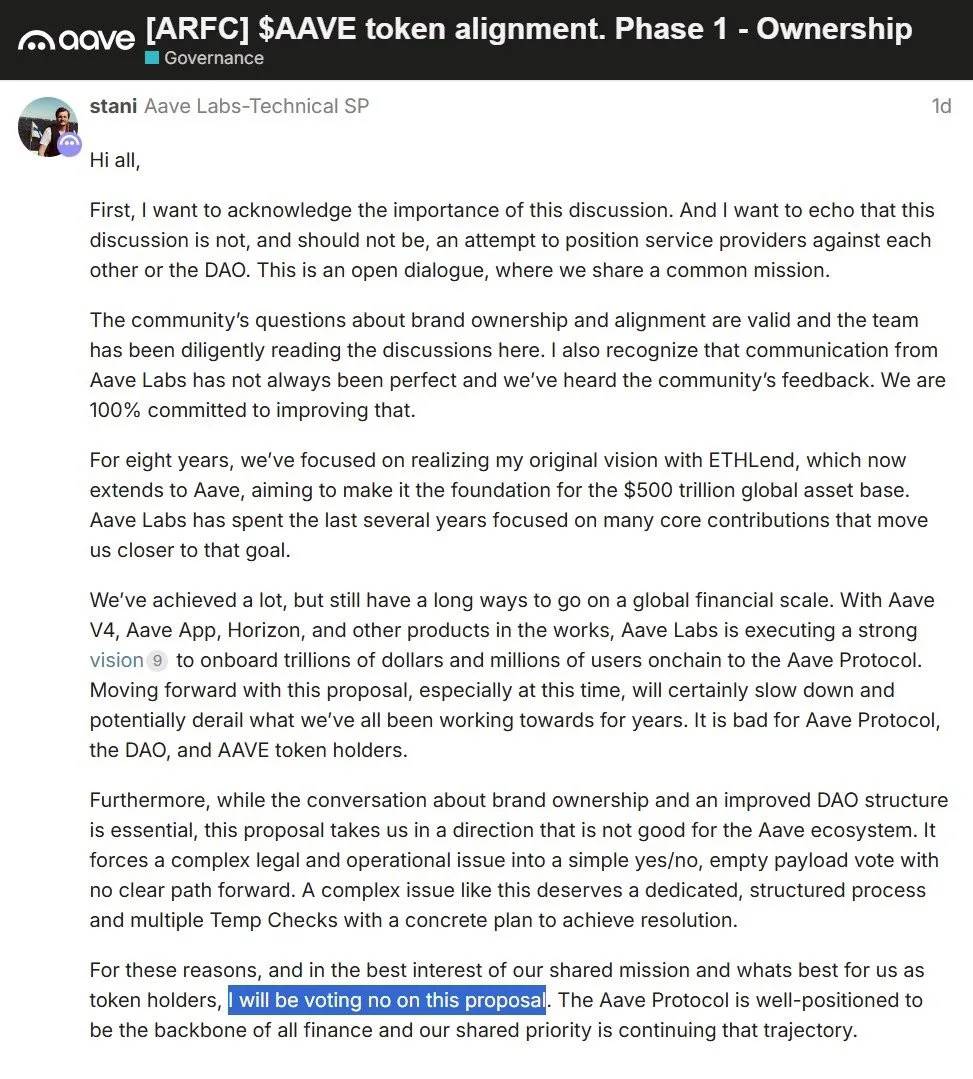
From a commercial operation perspective, it might be true that Stani argued that the proposal was too hasty. However, under the current discussion atmosphere, this statement could easily be interpreted as “Aave’s founder does not agree to transfer brand assets to coin holders.” This clearly further exacerbates the tensions between the community and the team.
After Stani’s statement, some offensive comments were posted below the original post. Many users expressed their dissatisfaction through forums and social media. Some long-time users mentioned that they considered selling off their AAVE tokens for the first time. Others who are loyal supporters of AAVE said, “ holders of AAVE should realize that this is just another DeFi junk coin. It isn’t better or worse than other coins.”
The latest developments in the community involve the situation mentioned at the beginning of this article: a top-tier individual has lost millions of dollars and decided to withdraw from the market.
Can AAVE still be purchased?
Just two weeks ago, AAVE was still favored by top institutions like Multicoin Capital. Its excellent brand reputation, substantial capital, clear growth prospects, strong revenue, and repurchase activities all proved that AAVE was a “true value coin” distinct from other similar projects.
But in just two weeks, a crisis involving issues related to cost allocation, brand control, and relationships within the team and community has caused AAVE to quickly fall from its position as a “value coin representative” into the center of controversy. In fact, AAVE even made it to the short-term decline list due to emotional factors.
As of the time of writing, Aave Labs has announced that it has initiated an ARFC vote regarding Ernesto’s proposal. This vote allows AAVE holders to express their opinions clearly, thereby determining the future direction of the project. The results of this vote, along with how Aave Labs handles the situation, will likely have a significant impact on the community’s perception of Aave and the price performance of AAVE in the short term.
It’s important to note that this incident isn’t simply a “negative development” or a change in performance. Instead, it represents a serious challenge to Aave’s current governance structure and equity boundaries.
If you believe that Aave Labs will continue to align its actions with those of the Aave DAO for the long term, then the current conflicts may be just a result of communication and procedural issues. In that case, prices might be a good opportunity to enter the market. However, if you believe that these disputes reveal underlying structural problems within the team and the protocol, such as unclear equity distribution and lack of institutional constraints, then this situation could be just the beginning.
From a broader perspective, Aave’s controversy isn’t unique. As DeFi becomes more mature, and protocols start to generate significant revenue, some structural problems between protocols, teams, and communities will inevitably emerge. Aave has been brought to the forefront not because it made more mistakes, but because it has gone further than others.
The debate over costs, branding, and control involves more than just AAVE. It’s a question that the entire DeFi industry will eventually face.