Exchange Ranking
 Top Exchanges
 24h Volume Ranking
 Popularity Ranking
 Exchange BTC Balance
 Proof of Reserves
 Decentralized Exchanges
 Funding Rate
 Funding Heatmap
 Liquidation Data
 Max Pain
 Long/Short Ratio
 Whale L/S Ratio
 Binance/Okex/Huobi L/S
 Bitfinex Margin L/S
 ETF Tracker
 Solana ETF
 XRP ETF
 Hong Kong ETF
 Bitcoin Treasuries
 Crypto Reversal
 Ethereum Reserves
 HyperLiquid Wallet Analysis
 Hyperliquid Whale Watch
 Large Transactions
 On-chain Movement
 Bitcoin ROI
 Stablecoin Market Cap
 Options Analysis
 News
 Articles
 Economic Calendar
 Features
 Wallet
 Contract Calculator


 Security
 Collections
 Watchlist
 Following
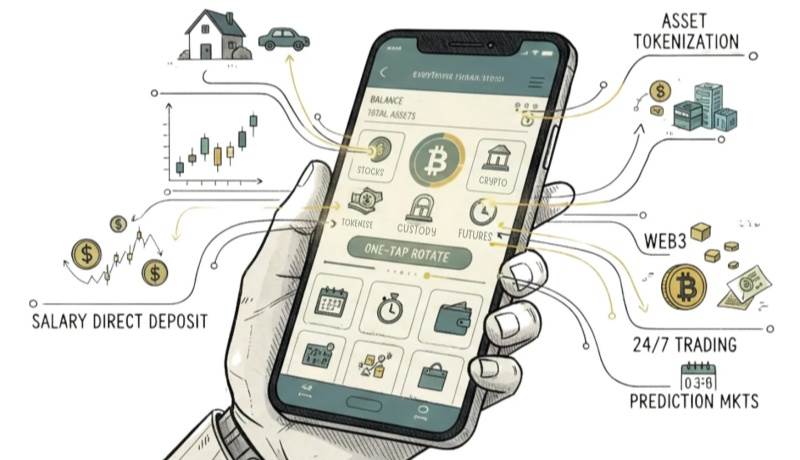
On December 17th, Coinbase introduced what they called “The Financial Future”. This app allows for trading stocks around the clock—five days a week, 24 hours a day. It also supports trading cryptocurrencies on centralized exchanges and on the blockchain. Users can engage in futures and perpetual contract trading, as well as participate in prediction markets (such as election or political predictions). All of these activities are supported by AI-driven financial analysts. All transactions can be completed via mobile devices, and users can instantly switch between different asset classes.
A week earlier, Robinhood already offered similar services: tokenized stocks in Europe, futures trading five days a week, 24 hours a day, and cryptocurrencies that generate income. Robinhood also plans to launch Robinhood Social in 2026.
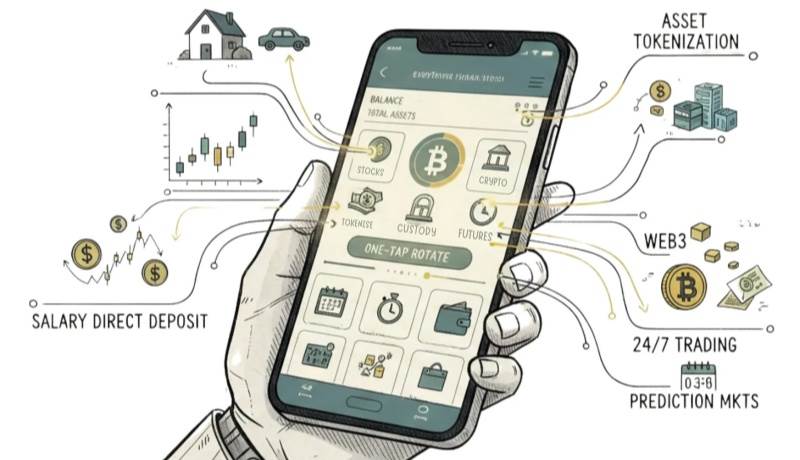
X’s marketing slogan describes this as an evolution towards a “universal app”. However, people often overlook that this isn’t just about adding new features. It represents a break with the artificial boundaries between different types of financial assets, which were created due to regulatory and technical limitations.
In this analysis, I will explain why financial apps are re-integrating after a decade of fragmentation, and what this means for both the users and the platforms involved.
The issue of fragmentation
Over the past decade, we’ve seen the emergence of numerous fintech apps that provide support for various aspects of the financial system. For example, there are apps for stock trading, cryptocurrencies, payments, and savings.
It gives users the option to choose their preferred solution, allowing each company to focus on one solution at a time. However, in practice, this leads to chaos.
Do you want to sell stocks and buy cryptocurrencies instead? Due to the T+1 settlement period, your stock transaction will be processed on Monday, with the settlement occurring on Tuesday. Then, when you request a withdrawal, it will take 2-3 days for the funds to be credited to your account. After that, you need to transfer the money to Coinbase, which takes another 1-2 days. In total, it takes about five days from “I want to rotate my funds” to “funds are available”. During these five days, the opportunities you might have seen may have already passed, while your funds remain unchanged.
You originally wanted to purchase Bitcoin at $86,000 on December 18th, but five days later, you were able to buy it at $90,000. This situation becomes even worse for more volatile investment opportunities, such as meme coins, initial coin offerings (ICOs), or public offerings (IPOs).
This fragmentation isn’t limited to geographical areas. An Indian investor who wants to buy NVIDIA shares has to go through multiple procedures, including KYC authentication, opening an account with a brokerage firm that allows Indian investors to invest in US stocks, and depositing additional funds. In the end, they can only buy one share.
We’re all aware of these issues, but it wasn’t until recently that the necessary infrastructure was developed to address them.
What’s changed: The infrastructure.
Three major structural changes have made it possible to create a unified platform.
● Tokenization eliminates time barriers. The trading hours for traditional stocks are limited to the trading session of the New York Stock Exchange, which runs from 9:30 a.m. to 4:00 p.m., five days a week. In contrast, cryptocurrencies can be traded 24 hours a day. The concept of tokenizing stocks on Layer-2 networks suggests that reasonable mechanisms could enable stocks to be traded around the clock.
Tokenized stocks on Robinhood in Europe are now available for trading five days a week, 24 hours a day. Coinbase will follow suit in the future.
● The regulatory environment is becoming clearer. Over the past few years, various Bitcoin ETFs have been launched, stablecoins have been legalized, and frameworks for tokenization have received widespread discussion. Prediction markets have also obtained approval from the U.S. Commodity Futures Trading Commission (CFTC). Although the regulatory environment isn’t perfect, it’s sufficient to allow platforms to create multi-asset products without worrying about being shut down.
● Mobile wallet infrastructure is now mature. Embedded wallets can now seamlessly handle the complexities of cross-chain transactions. Privy (now acquired by Stripe) allows users to create wallets using existing email addresses, without the need to enter mnemonic phrases. Fomo is a recently launched cryptocurrency trading app that enables non-cryptocurrency users to trade tokens from Ethereum, Solana, Base, and Arbitrum, without the need to choose a network. It also supports Apple Pay for deposits. All complex operations are handled by the backend. Users simply click “Buy Tokens” to complete the transaction.
The theory of liquidity integration
explains why this transformation is necessary: funds that remain idle in various applications are essentially wasted resources.
在统一模式下,您只需持有一个账户余额。卖出股票后,资金即可立即用于购买加密货币。无需结算窗口、提现等待期或银行中介。五天的机会成本也随之消失。
整合流动性的平台在效率方面更胜一筹。由于流动性池更深,它们能够提供更优的执行速度。由于所有交易对共享相同的基础流动性,它们可以支持更多交易对。它们可以像银行一样,为搁浅资本提供收益。此外,由于摩擦减少,用户交易量增加,它们也能获得更多手续费收入。
Coinbase操作指南
Coinbase是这种重新组合策略最鲜明的例证。该公司于2012年成立,最初只是一个简单的加密货币交易所,用户只能购买比特币和以太坊。仅此而已。在接下来的几年里,他们增加了机构托管、质押服务以及允许用户借出加密货币以获取收益的“赚取”产品。到2021年,他们已发展成为一个提供全方位服务的加密货币平台。
此后,他们的业务不断扩展:Coinbase Card用于加密货币消费,Coinbase Commerce用于商家支付,而Base则是他们自己的Layer 2区块链。
The official launch on December 17th marks the realization of Coinbase’s vision of creating a “versatile application”. Coinbase now offers 24-hour stock trading services, and plans to launch the Coinbase Tokenize service for institutional investors at the beginning of next year, allowing them to trade real assets. Additionally, Coinbase has integrated prediction markets through Kalshi, enabling futures and perpetual futures trading. The platform also features a Solana DEX trading interface within its app. Coinbase has expanded its basic app to 140 countries/regions, enhancing the social trading experience on the platform.
Coinbase is becoming a leading blockchain-based financial operating system. All asset categories can be managed through a single interface and account. The goal is to enable users to perform all their transactions without leaving the platform.
Robinhood has followed the same strategy. They initially offered commission-free stock trading, later added cryptocurrency and gold subscription services (with a 3% rebate on cash withdrawals and 3.5% interest rate), futures trading, as well as tokenized stock trading in Europe.
Both platforms share the same philosophy: users don’t want to use different applications for stocks, cryptocurrencies, and derivatives. They want a unified account balance, a single interface, and instant fund transfer capabilities.
Social trading: A new differentiating factor
While asset bundling solves the issue of liquidity, it doesn’t address the problem of finding suitable assets for users.
面对数百万种资产选择,用户如何找到交易标的?他们如何构建自己的投资组合?
社交功能正是在这里大放异彩。Coinbase的基础应用包含一个信息流,用户可以在这里查看其他用户正在购买的商品。Robinhood计划于2026年推出Robinhood Social。eToro自2007年以来就一直在提供类似的功能,向跟单交易者支付其所持资产的1.5%作为佣金。
在链上,我们有Fomo、0xPPL和Farcaster——这些是早期尝试社交交易功能的加密货币应用。这些应用允许用户查看朋友和他们欣赏的人的投资标的,关注他们,并跟踪他们的交易。
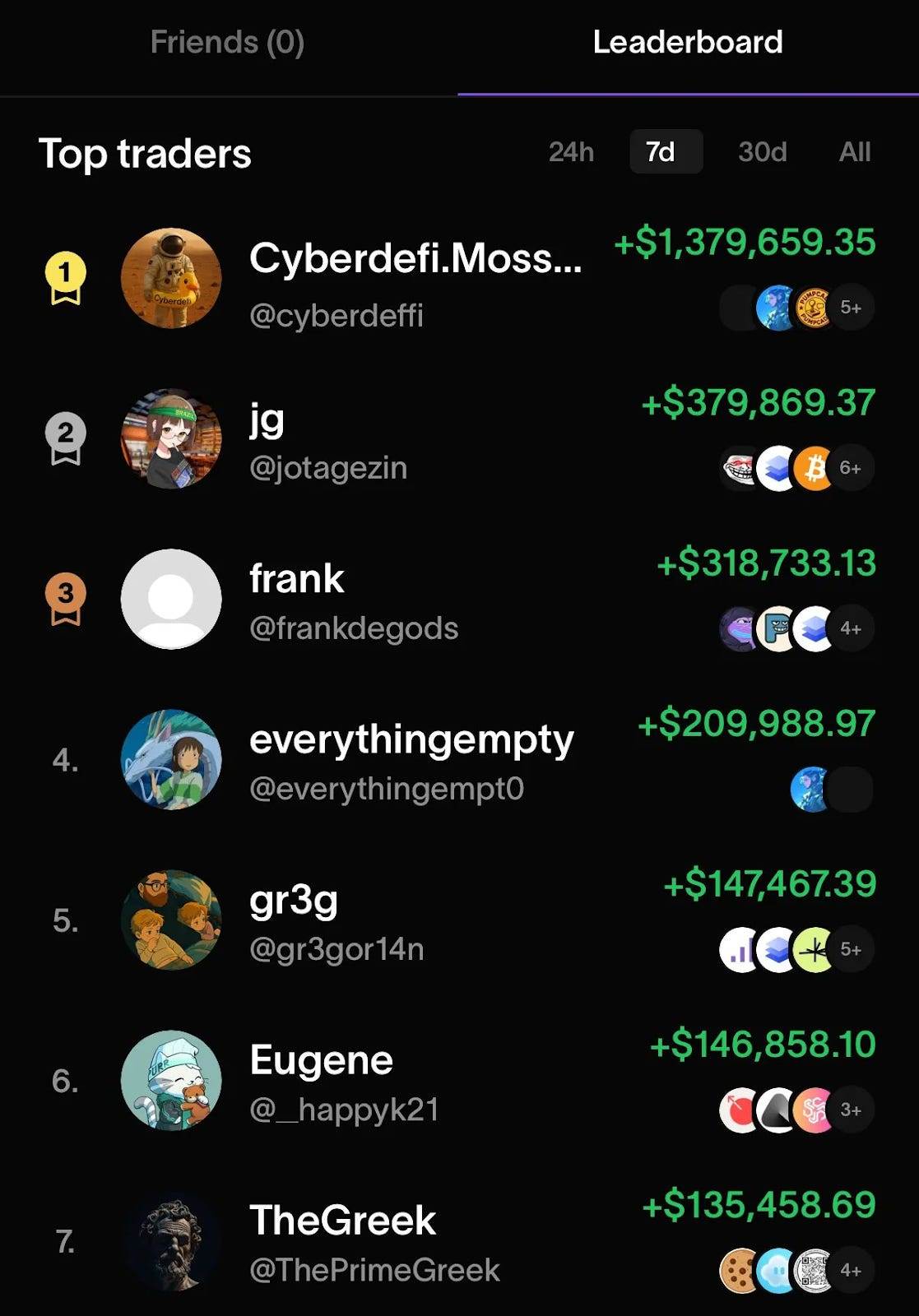
Fomo排行榜页面
社交交易是指用户可以实时查看其他用户的交易,并一键复制。它大大降低了决策难度:用户无需独立研究,只需跟随自己信任的交易策略即可。一旦围绕某个平台形成社群——用户关注交易者,建立声誉——用户就不容易流失。这增强了交易应用程序的防御性和用户粘性。
中心化交易所的跟单交易自2022年就已存在,但其普及率仍不足2%。移动应用则寄希望于更佳的用户体验能够改变这一现状。他们的判断是否正确,将决定社交功能最终能否成为真正的差异化优势,还是仅仅沦为又一个功能而已。
悲观论证
让我们坦诚面对现实吧。加密货币原本应该实现金融去中心化,去除中间环节,让用户掌控一切。
现在,我们正在重建中心化平台。Coinbase控制着托管、执行和社交关系网。Robinhood持有嵌入式钱包的私钥。用户信任这些平台能够保持偿付能力、安全性和正常运行。而这一切背后都隐藏着交易对手风险。
Robinhood的代币化股票是追踪价格的衍生品,而非实际股票。如果平台崩溃,你持有的只是欠条。
游戏化问题也愈演愈烈。全天候市场意味着你可以在凌晨三点情绪激动时进行交易。社交媒体动态让你看到别人都在赚钱,从而产生错失恐惧症(FOMO)。推送通知会提醒你每一个市场动向。这简直就是规模化的赌场心理,由深谙如何触发多巴胺反应的设计师们精心打造。
这究竟是民主化,还是仅仅是同一套剥削体系的更漂亮版本,这是一个哲学问题。
这实际上揭示了什么?
我们花了十年时间对金融业务进行拆分。当时的假设是,分散化会带来竞争和选择。
但这种分散化造成了效率低下。资金被搁置,流动性被分割,用户因为资金转移繁琐而让大量资金闲置。新时代正在改变这一切,其最终结果值得关注。
Coinbase and Robinhood are becoming new types of banks. They have control over your wages, savings, investments, and spending habits. They manage all aspects of transactions, including execution, custody, and access rights. They interfere with every transaction that takes place. The only difference is that their interfaces are more user-friendly, the markets are open 24 hours a day, and interest rates are 50 basis points higher.
Either we make finance more convenient, instant, and frictionless, thereby democratizing finance… or we’re just changing the role of gatekeepers, but still maintaining a system where decisions are made by a few people.
Anyway, the era of fragmentation is over. In the coming years, we will see whether integrating financial services onto open platforms can lead to better results than trying to get rid of the fragmented banking system we currently have. Or maybe we’re just switching brands, but still ending up with a system that remains highly centralized.