Exchange Ranking
 Top Exchanges
 24h Volume Ranking
 Popularity Ranking
 Exchange BTC Balance
 Proof of Reserves
 Decentralized Exchanges
 Funding Rate
 Funding Heatmap
 Liquidation Data
 Max Pain
 Long/Short Ratio
 Whale L/S Ratio
 Binance/Okex/Huobi L/S
 Bitfinex Margin L/S
 ETF Tracker
 Solana ETF
 XRP ETF
 Hong Kong ETF
 Bitcoin Treasuries
 Crypto Reversal
 Ethereum Reserves
 HyperLiquid Wallet Analysis
 Hyperliquid Whale Watch
 Large Transactions
 On-chain Movement
 Bitcoin ROI
 Stablecoin Market Cap
 Options Analysis
 News
 Articles
 Economic Calendar
 Features
 Wallet
 Contract Calculator


 Security
 Collections
 Watchlist
 Following
As the crypto market moves away from a stage where growth is solely driven by narrative-based strategies, 2026 is seen by many institutions as a true “watershed.” With ETF funds playing a leading role, clearer regulatory boundaries, and the rapid implementation of RWA and on-chain income-generating products, the market is now focusing more on cash flow, real users, and sustainable profitability. Narrative-driven strategies are becoming less effective; whether a project can truly make money and retain investors has become the key criterion for its success or failure.

Key points:
● HIP-3 has removed the technical barriers to launching a new perpetual contract market, thereby creating a demand-driven market creation model. This shifts decentralized exchange (DEX) platforms from competing with centralized exchanges to expanding into areas beyond cryptocurrency assets, such as real-world data.
● The market is shifting from narrative-driven growth to a cash-flow-driven valuation system that emphasizes sustainability. Only a few projects with actual revenue flowing into tokens, such as Hyperliquid and Pump.fun, are likely to dominate the next phase.
● It is predicted that the market will transform private or illegal activities into publicly available on-chain data and collective expectations. This creates real-time probability signals and alternative data that financial institutions, data providers, and AI models can use as an economic mechanism for information aggregation and probability estimation.
● Regulation has led to a fragmented system: prediction markets tend to become more institutionalized in the West, while in Asia they are often restricted. This represents a major short-term constraint, but it also paves the way for prediction markets to evolve into tools that can transform collective beliefs into information and market infrastructure.
1. How HIP-3 can initiate new growth patterns similar to those of PvE
The business model of trading platforms is undergoing changes.
Centralized trading platforms (CEXs) continue to maintain their position due to their structural advantages based on institutional trust, such as the ability to handle fiat currency transactions, custody services, and regulatory approvals. This makes them an ideal entry point for institutional capital, offering stability in terms of liquidity and operational reliability. However, the same regulatory obligations, internal controls, and custody infrastructure also result in high fixed costs. As a result, centralized trading platforms are slower in making decisions and innovating.
In contrast, decentralized trading platforms (DEXs) grow through incentive structures. They naturally coordinate rewards among lenders, traders, and builders on the blockchain. But in the past, launching a new trading platform or market required teams to build everything from scratch, including matching engines, margin systems, and order books. This created extremely high technical barriers to entry.
HIP-3 eliminates this obstacle.
Hyperliquid now allows anyone who has质押了500,000 HYPE tokens to deploy their own perpetual contract market, using the same CLOB engine, margin logic, and settlement systems as the main platform. The technical challenges involved in building such a platform have been eliminated. Market creation has become a standardized process that can be carried out directly on the blockchain. What’s needed are sufficient capital and reliable state machines, rather than a full engineering team. The threshold for entry has shifted from technical capabilities to matters related to capital and state machine design. This change isn’t just about improving efficiency; it also changes the place where innovation can take place. Now, developers can experiment with different liquidity structures, fee arrangements, state machine definitions, and leverage limits, without having to rebuild the backend infrastructure. The challenge lies in identifying “demand surfaces”—that is, determining how many people are interested in certain investments—and then integrating this information into reliable state machines. In fact, a market can now consist of three components: the market itself, the state machines, and the demand data. This expands the range of assets that can be listed on the platform. As Alvin Hsia, founder of Ventuals, explained, “Fat Head” includes traditional financial assets such as index funds, foreign exchange, and commodities. “Chunky Middle” encompasses equity offerings, real-world datasets, and commodity indices. “Long Tail” extends to niche signals like local real estate prices, product premiums, or cultural trends indices. Traditional finance struggles to monetize these data points, but blockchain-based settlement systems can make this possible. HIP-3 actually marks a shift towards demand-driven market creation.
来源:X( alvinhsia)
这使DEX从CEX的竞争者转变为结构上完全不同的存在。
HIP-3不再是为争夺固定的加密原生流动性(PvP动态),而是允许DEX扩张到非加密资产和现实世界数据中。这带来了新的流量、新用户和新形式的需求——一种市场规模不断增大而非重新分配的PvE动态。它还深化了协议层的收入。
一个明确的例子是Hyperliquid的XYZ100市场,在上线三周内累计交易额就突破了13亿美元,展示了当基础设施标准化后,新资产类别规模化速度之快。
简而言之,CEX继续提供稳定性和监管准入,但基于HIP-3的永续DEX在速度、实验性和资产扩张方面获得了优势。它们不是替代品,而是截然不同的增长路径。交易平台的竞争优势将从后端工程转向市场设计和用户体验,而领导地位将取决于哪个协议能将其转化为可持续价值。
2、从叙事驱动估值转向现金流驱动估值
2025年的市场与以往周期有着本质的不同。
曾经提振所有资产的泛滥流动性环境已经消失。资本现在有选择性地流动。价格更多地反映实际业绩而非叙事,无法产生收入的项目正被自然挤出。大多数山寨币仍未恢复2021年的高点,而具有清晰收入的协议即使在市场回调期间也表现出相对强势。
机构资本的到来固化了这一转变。
传统金融(TradFi)框架正被直接应用于加密领域。收入、净利润、费用生成、用户活跃度和利润分配正成为项目评估的首要指标。市场正在远离依靠“讲故事”或预期增长来估值。只有那些拥有真实收入并流回Token的项目,才能获得更高的市场估值。
在这种背景下,Uniswap最近激活费用开关(Fee Switch)的提案具有象征意义。一个旗舰DeFi协议明确选择将现金流与Token价值挂钩,信号表明基本面(而非叙事)现在处于市场定价的核心。
一批明显的领跑者已经出现。
Hyperliquid(HYPE)和Pump.fun(PUMP)是典型案例:
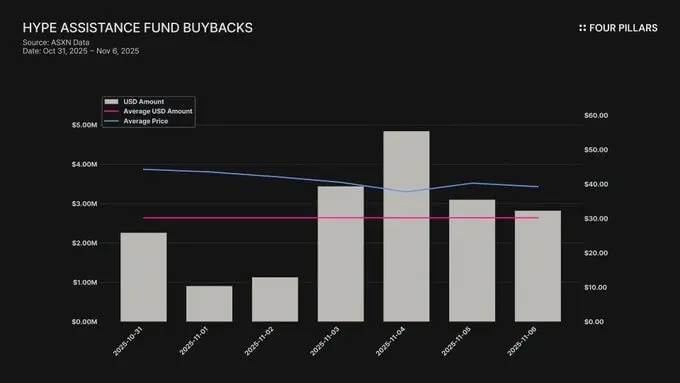
● Hyperliquid是成交量、持仓量(OI)和交易者人数最大的永续DEX。As of November 2025, the total transaction volume has reached $3.1 trillion, with a portfolio size of $9 billion. It is worth noting that Hyperliquid uses 99% of its fees from perpetual contracts to repurchase HYPE, thereby directly linking the protocol’s cash flow to the value of the Token. The total amount repurchased so far amounts to 34.4 million HYPE units, equivalent to approximately $1.3 billion, which accounts for about 10% of the total supply in circulation.
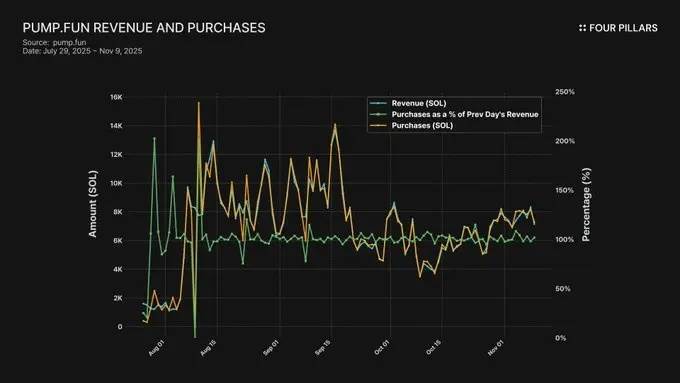
● Pump.fun is a leading platform for meme coins, generating approximately $1.1 billion in cumulative revenue. Its repurchase program has purchased around 830,000 SOL units, valued at approximately $165 million, which represents 10.3% of the estimated circulating value of SOL.
Other projects are also showing strong revenue growth:
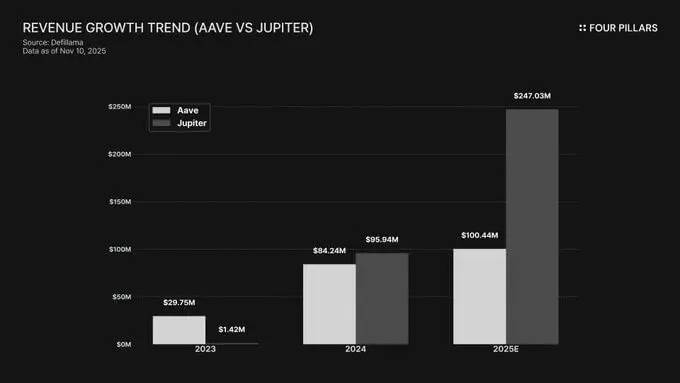
● Aave (AAVE) and Jupiter (JUP) continue to generate stable and growing cash flows. Aave’s annual revenue increased from $29.75 million in 2023 to $99.39 million in 2025. Jupiter’s revenue grew even more dramatically, rising from $1.42 million in 2023 to $246 million in 2025.
● Although Coinbase is a publicly traded company, it still benefits from the clear path of tokenization on the Base chain. Coinbase has diversified its revenue sources: In Q3 2025, subscription and service revenues reached $746.7 million, a 13.9% increase compared to the previous quarter.
This shift is spreading from individual dApps to L1 and L2 ecosystems. Simply having technical capabilities or investor support is no longer enough. Chains that have real users, real transactions, and protocol-level revenue are gaining greater market recognition. The key evaluation indicators are now shifting towards the sustainability of economic activities.
In summary, the market is undergoing a structural transformation. By 2026, the market may be reorganized around those participants who can provide reliable performance metrics as support for their predictions.
3. By predicting market trends, traders can quantify people’s expectations of future events.
Predictive markets are an experiment that transforms previously private or illegal forms of trading into publicly available data on the blockchain. The key advantage is that they allow people to invest real money based on their beliefs, thereby quantifying people’s probabilities of certain events happening in the future. This makes predictive markets not only places for speculation, but also economic mechanisms for aggregating information and estimating probabilities.
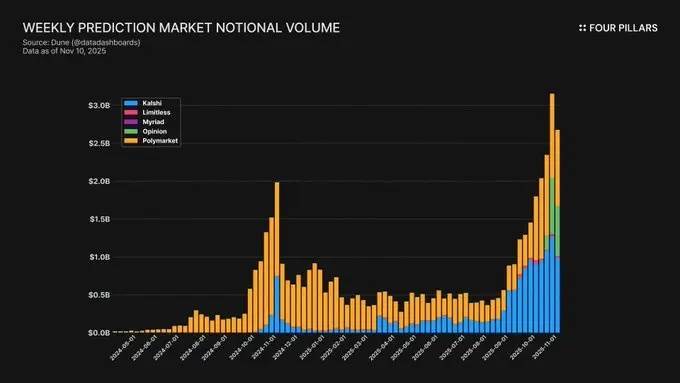
Since 2024, predictive markets have grown rapidly: As of October 2025, the weekly nominal transaction volume was approximately $2.5 billion, with over 8 million transactions per week. Polymarket accounted for 70–75% of the market activity, while Kalshi increased its share to around 20% after gaining approval from the CFTC and expanding into sports and political markets.
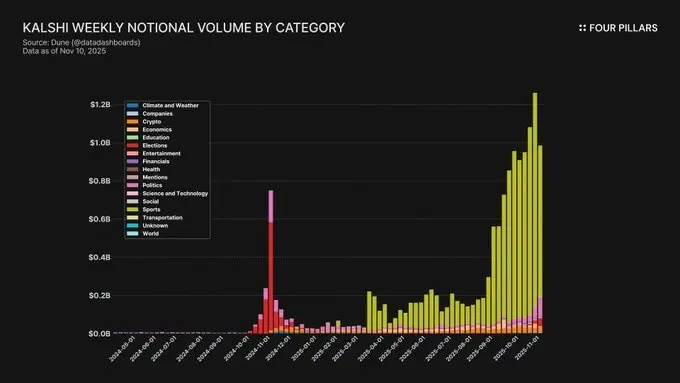
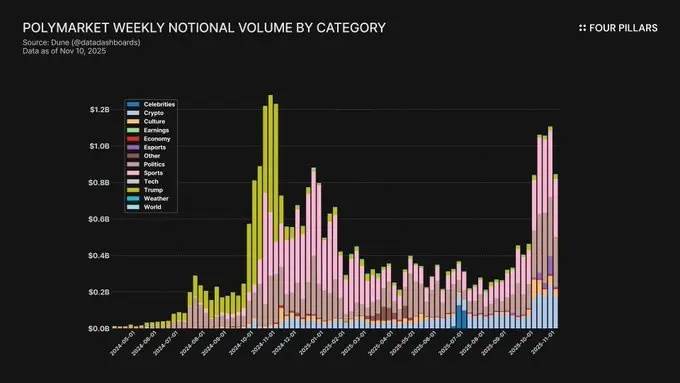
What sets predictive markets apart is their ability to provide real-time data on collective expectations. These data can serve as real-time probability signals for political, economic, sports, and technological events. Financial institutions and AI models are increasingly viewing these markets as alternative sources of data for quantifying expectations.
Source: Gray Scale Research ,
,From an institutional perspective, prediction markets represent not “data-driven gambling,” but rather “financialization of uncertainty.” Since prices reflect consensus probabilities, macro traders can use this to manage risks. Kalshi has already created markets that are linked to inflation data, employment statistics, and interest rate decisions, attracting significant interest from hedge funds.
,, As prediction markets become more mature, they create a new value chain: market (generating signals) →预言机(处理结果)→数据(标准化数据集)→应用(金融、媒体、AI领域)。,
,The main obstacle currently is regulation:
,, ● In Asia: Regions like South Korea, Singapore, and Thailand generally view prediction markets as illegal gambling and impose penalties on users.
,, ● In the West: In the United States, prediction markets are regulated by the CFTC as “event contracts.” Kalshi operates legally with a DCM license, while Polymarket plans to re-enter the US market in 2025 through a purchase of QCX.
,This regulatory difference leads to divisions: the West moves towards institutionalization, while Asia continues to suppress prediction markets. Although these are short-term limitations, in the long run, prediction markets will evolve into infrastructure that transforms collective beliefs into information. They will shift from being “markets for interpreting information” to “markets for producing information,” reinforcing a world where “prices become the primary means of expressing collective expectations.”