Exchange Ranking
 Top Exchanges
 24h Volume Ranking
 Popularity Ranking
 Exchange BTC Balance
 Proof of Reserves
 Decentralized Exchanges
 Funding Rate
 Funding Heatmap
 Liquidation Data
 Max Pain
 Long/Short Ratio
 Whale L/S Ratio
 Binance/Okex/Huobi L/S
 Bitfinex Margin L/S
 ETF Tracker
 Solana ETF
 XRP ETF
 Hong Kong ETF
 Bitcoin Treasuries
 Crypto Reversal
 Ethereum Reserves
 HyperLiquid Wallet Analysis
 Hyperliquid Whale Watch
 Large Transactions
 On-chain Movement
 Bitcoin ROI
 Stablecoin Market Cap
 Options Analysis
 News
 Articles
 Economic Calendar
 Features
 Wallet
 Contract Calculator


 Security
 Collections
 Watchlist
 Following
 BTC
On December 15th, the value of Bitcoin dropped from $90,000 to $85,616, a decrease of over 5% in just one day. There were no major collapses or negative events on that day, and there seemed to be no abnormal selling pressure in the blockchain data. If we only look at news related to the cryptocurrency market, it’s difficult to find a “reasonable” explanation for this decline.
But on the same day, the price of gold was $4,323 per ounce, a decrease of only $1 compared to the previous day.
One asset lost 5%, while another didn’t change at all.
If Bitcoin truly represents “digital gold”, a tool for countering inflation and protecting against the depreciation of fiat currency, then its performance during such risky situations should be more similar to that of gold. However, its behavior this time clearly resembles that of high-beta technology stocks like NASDAQ’s.
What is driving this decline? The answer might lie in Tokyo.
The “butterfly effect” of Tokyo
On December 19th, the Bank of Japan will hold a meeting regarding interest rate policy. Market expectations are that it will raise rates by 25 basis points, raising the policy rate from 0.5% to 0.75%.
0.75% sounds low, but this is the highest rate in Japan in nearly 30 years. Predictions from companies like Polymarket indicate that traders believe there is a 98% chance of such a rate hike.
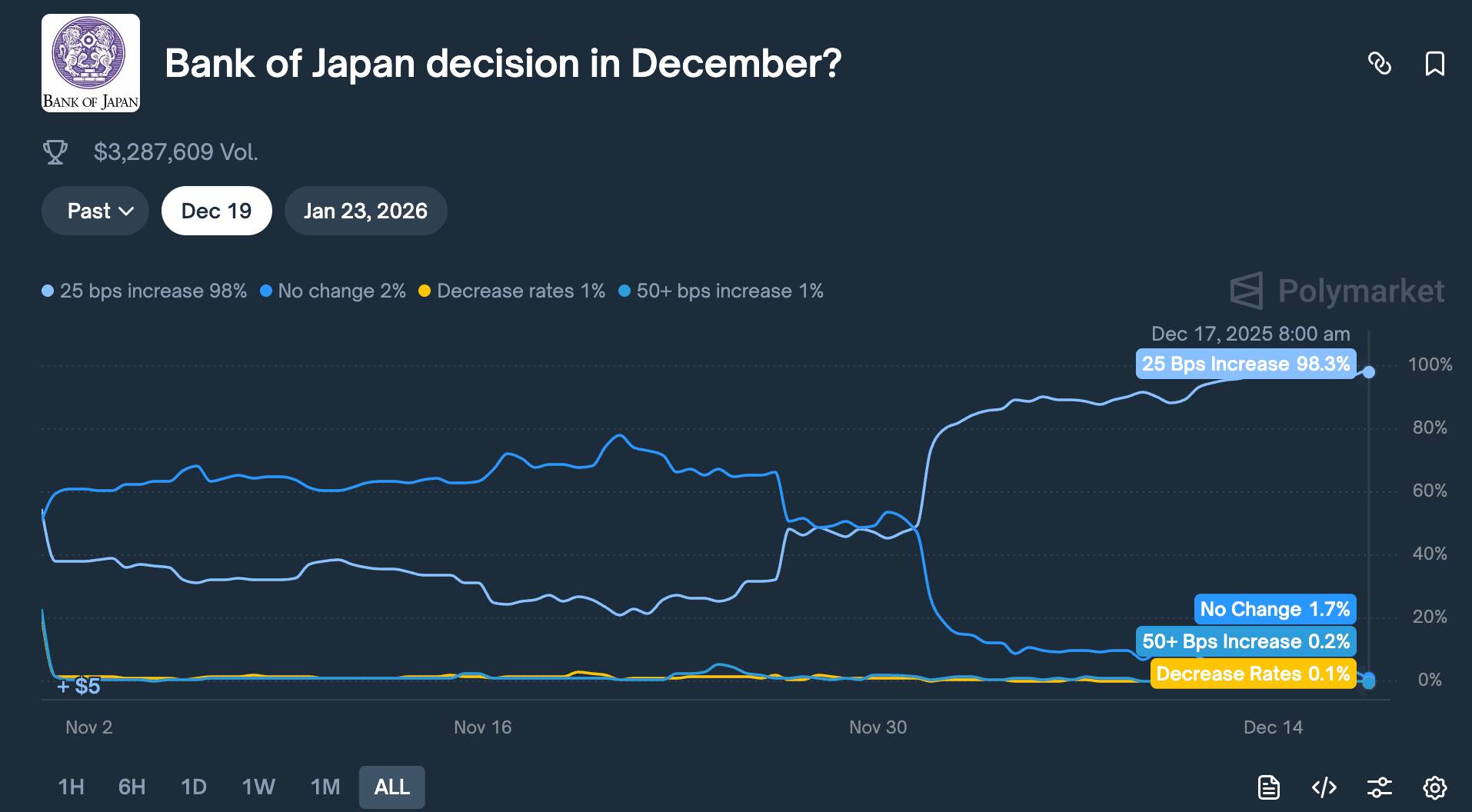
Why would a central bank located in Tokyo decide to cause Bitcoin to lose 5% in just 48 hours?
This has to do with something called “yen arbitrage trading”.
The logic behind this is quite simple:
In Japan, interest rates have been close to zero or even negative for a long time. Borrowing yen costs almost nothing.So, hedge funds, asset management companies, and trading firms around the world have borrowed a large amount of Japanese yen, converted it into US dollars, and then invested in assets that offer higher returns. This can include US government bonds, US stocks, or cryptocurrencies. As long as the return on these assets exceeds the cost of borrowing Japanese yen, the difference between the two rates constitutes profit. This strategy has been in place for decades, with an enormous scale that makes it difficult to accurately quantify. Conservatively estimated, the amount involved could be several hundred billion dollars. Some analysts believe it could even reach trillions of dollars, if derivatives exposure is taken into account. At the same time, Japan has a special status: it is the largest overseas holder of US government bonds, holding approximately 1.18 trillion US dollars in bonds. This means that any change in Japan’s capital flows directly affects the world’s most important bond markets, thereby impacting the pricing of all risky assets. Now, when the Bank of Japan decides to raise interest rates, the underlying logic of this system is challenged. First, the cost of borrowing Japanese yen increases, reducing the potential for arbitrage opportunities. Moreover, expectations of rate hikes will drive up the value of the Japanese yen. These institutions originally borrowed Japanese yen to invest in US dollars. Now, when they need to repay their loans, they must sell their US dollar assets and exchange them back into Japanese yen. The more the yen rises in value, the more assets they will have to sell. This “forced selling” doesn’t choose any particular time or type of asset. They simply sell whatever asset has the best liquidity and is easiest to convert into cash.So it’s easy to imagine that Bitcoin’s 24-hour trading doesn’t have any limits on price fluctuations. The depth of the market is relatively shallow compared to stocks, and Bitcoin is often the first to suffer losses. Looking back at the timeline of Japan’s central bank rate hikes over the past few years, this speculation is somewhat supported by data:
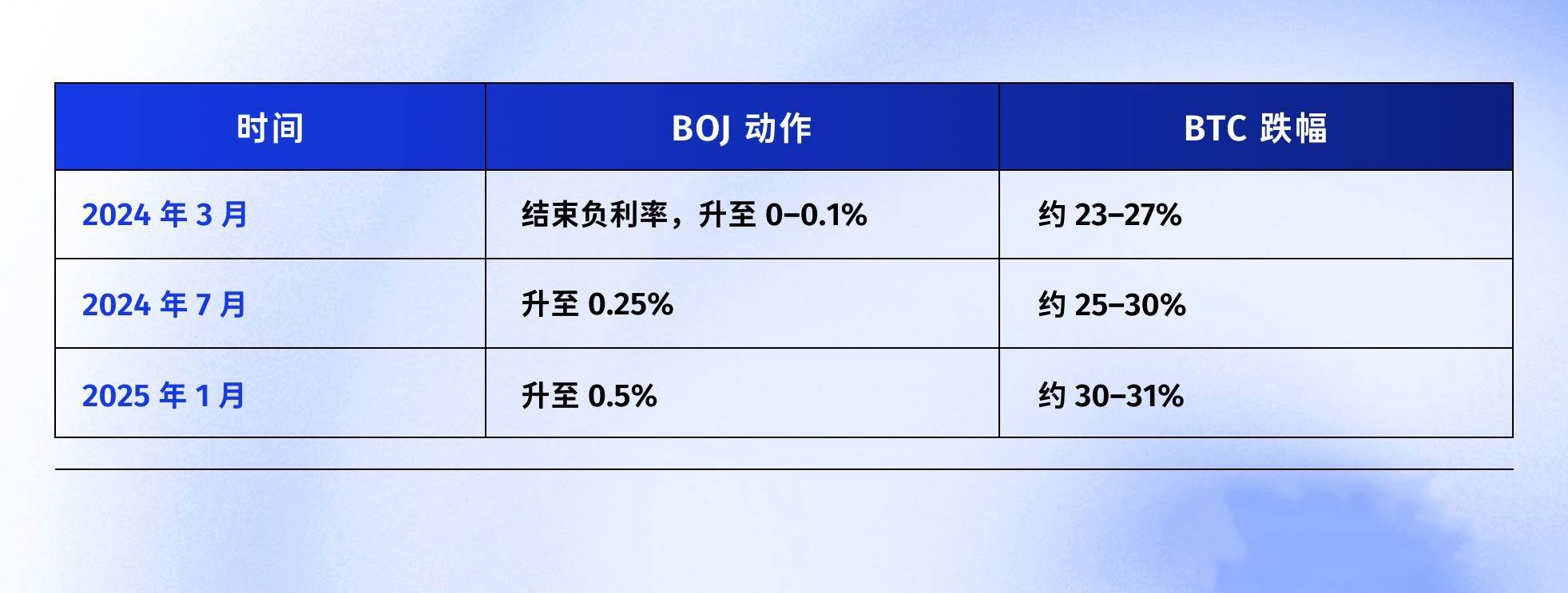
The most recent instance was on July 31, 2024. After the Bank of Japan announced a rate hike to 0.25%, the yen rose from 160 to below 140 against the dollar. Bitcoin dropped from $65,000 to $50,000 within a week, a decrease of about 23%. The entire crypto market lost around $60 billion in value.
According to several analysts, after three previous rate hikes by the Bank of Japan, Bitcoin has experienced losses of more than 20%.
These figures vary in specific start and end points, but the direction is consistent:
Every time Japan tightens monetary policy, Bitcoin becomes a target for losses.
Therefore, I believe what happened on December 15th was essentially the market “running ahead”. Funds began to withdraw before the decision was announced on the 19th.
On that day, there was a net outflow of $357 million from US Bitcoin ETFs, the largest single-day outflow in recent two weeks. Within 24 hours, more than $600 million in leveraged long positions in the crypto market were liquidated.
These aren’t just panic-driven actions by individual investors; they’re results of arbitrage transactions being closed.
Is Bitcoin still considered a digital gold?
The above text explains the mechanism of yen-based arbitrage trading, but one question remains unanswered:
Why does Bitcoin always be the first to suffer losses and be sold?
一个常见的说法是 BTC「流动性好、24小时交易」,这没错,但还不够。
真正的原因是,BTC在过去两年里被重新定价了:它不再是一个独立于传统金融的「另类资产」,而是被焊进了华尔街的风险敞口里。
去年年1月,美国 SEC 批准了现货比特币ETF。这是加密行业等了十年的里程碑,BlackRock、Fidelity 这些万亿级资管巨头终于可以合规地把 BTC 装进客户的投资组合。
资金确实来了。但随之而来的是一个身份转变:持有 BTC 的人变了。
以前买BTC的是加密原生玩家、散户、一些激进的家族办公室。
现在买BTC的是养老基金、对冲基金、资产配置模型。这些机构同时持有美股、美债、黄金,做的是「风险预算」管理。
当整体组合需要降风险的时候,他们不会只卖BTC或只卖股票,而是按比例一起减仓。
数据能看出这种绑定关系。
2025年初,BTC与纳斯达克100指数的30天滚动相关性一度达到0.80,是2022年以来的最高水平。作为对比,2020年之前,这个相关性常年在-0.2到0.2之间徘徊,基本可以视为不相关。
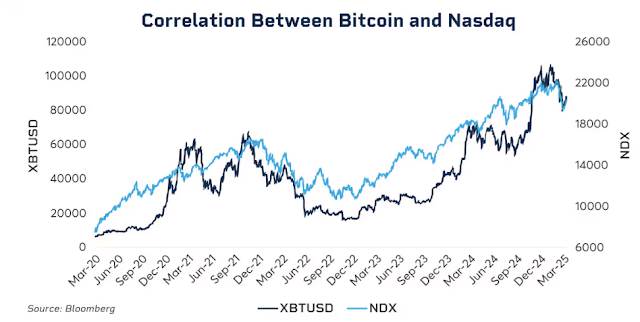
更值得注意的是,这种相关性在市场压力时期会显著上升。
In March 2020, the pandemic caused a sharp decline in economic activity. In 2022, the Federal Reserve implemented aggressive interest rate hikes. At the beginning of 2025, there were concerns about tariffs... Every time risk aversion increases, the correlation between BTC and U.S. stocks becomes more intense.
When institutions are in panic, they don’t distinguish between “this is an encrypted asset” and “this is a technology stock”. They simply look at one label: risk exposure.
This raises an awkward question: Is the narrative of BTC as a digital gold still valid?
If we look at the longer term, gold has risen by more than 60% since 2025, which is the best performance since 1979. Meanwhile, BTC has fallen by more than 30% from its peak.
Both of these assets are considered tools for hedging inflation and counteracting the depreciation of fiat currency. Yet, under the same macroeconomic conditions, their performance is completely opposite.
It’s not that BTC’s long-term value is problematic. Its annualized return rate over five years is still much higher than that of the S&P 500 and NASDAQ.
But at this stage, its short-term pricing logic has changed: it’s now a high-volatility, high-Beta risk asset, rather than a safe-haven tool.
Understanding this is key to understanding why a 25-basis-point increase in interest rates by the Bank of Japan can cause BTC to drop by thousands of dollars within 48 hours.
It’s not because Japanese investors are selling BTC. Instead, when global liquidity tightens, institutions will reduce their exposure to all risk assets using the same logic. And BTC happens to be the most volatile and easiest to liquidate asset in this chain.
What will happen on December 19th?
While writing this article, there are only two days left until the Bank of Japan’s interest rate meeting.
The market has already treated the interest rate hike as an established fact. The yield on ten-year Japanese government bonds has risen to 1.95%, the highest level in 18 years. In other words, the bond market has priced in expectations of monetary tightening ahead.
If the interest rate hike is already well anticipated, will there be any impact on the market on the 19th?
History shows that such impacts will occur, but the extent of those impacts depends on the wording used in the announcement.
The impact of central bank decisions isn’t just about the numbers themselves, but also the signals they send. Even if the interest rate is raised by 25 basis points, if the Bank of Japan Governor Yoshimura says during the press conference that “future decisions will be made based on data,” the market might breathe a sigh of relief.
But if he says “inflation pressures remain high, and further tightening is possible,” then it could be the start of another wave of selling.
Currently, Japan’s inflation rate is around 3%, which is higher than the BOJ’s target of 2%. What the market is worried about isn’t this one interest rate hike, but whether Japan is entering a prolonged period of monetary tightening.
If the answer is yes, then the collapse of yen arbitrage trades won’t be a one-time event, but rather a process that will last for several months.
However, some analysts believe this time might be different.
First of all, speculative funds have shifted from being net shortters to net longers in relation to the yen. The sharp drop in July 2024 was partly due to the market being caught off guard, as many funds were still shorting the yen at that time. Now, the direction of these positions has reversed, so there’s limited room for further appreciation.
Secondly, the yield on Japanese government bonds has risen by more than half a year ago. It has increased from 1.1% at the beginning of the year to nearly 2% currently. In some ways, the market has “generated its own interest rates” on its own. The Bank of Japan has simply confirmed this fact.
Thirdly, the Federal Reserve just lowered interest rates by 25 basis points, indicating that global liquidity is generally tight. Japan is tightening its policies in the opposite direction, but if US dollar liquidity remains sufficient, it may help to counter some of the pressures on the yen.
These factors cannot guarantee that BTC prices will not fall, but they might mean that the decline this time won’t be as extreme as previous times.
Looking at past trends after BOJ rate hikes, BTC prices usually hit rock bottom one to two weeks after the decision, followed by periods of consolidation or rebound. If this pattern holds, late December to early January could be a period of significant volatility. However, it could also be an opportunity for investors to buy at a discounted price after corrections have occurred.
It’s accepted by others, and influenced by their actions.
Putting everything together, the logic is quite clear:
The Bank of Japan raises interest rates → Japanese yen arbitrage trades are closed → Global liquidity becomes tighter → Institutions reduce their positions based on risk budgets → BTC, as a high-beta asset, is sold first.
In this chain of events, BTC hasn’t done anything wrong.
It’s simply placed in a position beyond its control, at the end of the global macro liquidity chain.
You might not agree with this, but this is the new normal in the ETF era.
Before 2024, the price fluctuations of BTC were mainly driven by factors related to the cryptocurrency industry itself: halving cycles, on-chain data, exchange dynamics, and regulatory developments. At that time, BTC had very little correlation with stocks and bonds. To some extent, it could even be considered an “independent asset class”.
After 2024, Wall Street became more important in determining BTC’s value.
BTC was placed within the same risk management framework as stocks and bonds. The structure of its holders changed, and so did its pricing logic.
The market value of BTC increased significantly, from several billion dollars to 1.7 trillion dollars. But this also had a side effect: BTC’s ability to remain immune to macro-economic events disappeared.
A single statement from the Federal Reserve or a decision by the Bank of Japan could cause BTC prices to fluctuate by more than 5% within hours.
If you believe in the narrative of BTC as a “digital gold” asset, believing that it can provide protection during times of chaos, then the trends in 2025 might be somewhat disappointing. At least for now, markets do not treat BTC as a safe-haven asset.
Perhaps this is just a temporary situation. Maybe institutionalization is still in its early stages. Once the allocation ratio stabilizes, BTC may find its own rhythm again. Perhaps the next halving cycle will once again demonstrate the dominance of crypto-related factors…
But until then, if you hold BTC, you need to accept one reality:
You are also holding exposure to global liquidity. What happens in a conference room in Tokyo might have a greater impact on your account balance next week than any on-chain indicator.
这是机构化的代价。至于它是否值得,每个人有自己的答案。