Exchange Ranking
 Top Exchanges
 24h Volume Ranking
 Popularity Ranking
 Exchange BTC Balance
 Proof of Reserves
 Decentralized Exchanges
 Funding Rate
 Funding Heatmap
 Liquidation Data
 Max Pain
 Long/Short Ratio
 Whale L/S Ratio
 Binance/Okex/Huobi L/S
 Bitfinex Margin L/S
 ETF Tracker
 Solana ETF
 XRP ETF
 Hong Kong ETF
 Bitcoin Treasuries
 Crypto Reversal
 Ethereum Reserves
 HyperLiquid Wallet Analysis
 Hyperliquid Whale Watch
 Large Transactions
 On-chain Movement
 Bitcoin ROI
 Stablecoin Market Cap
 Options Analysis
 News
 Articles
 Economic Calendar
 Features
 Wallet
 Contract Calculator


 Security
 Collections
 Watchlist
 Following
As the competition for stablecoins grows worldwide, Brazilian stablecoin company Crown has completed a $13.5 million Series A financing led by Paradigm, with a valuation of $90 million. This is the first time Paradigm has invested in a Brazilian project. What’s more noteworthy is that Crown has completed two rounds of financing within two months, with support from top institutions such as Framework, Coinbase Ventures, and Paxos. Against the backdrop of high inflation in Latin America and rapidly growing usage of stablecoins, this seemingly modest financing signals an accelerating expansion of the stablecoin ecosystem into emerging markets.

Why is Crown worth investing in?
Analyzing something usually requires considering both internal and external factors.
From an external perspective, I believe there are few investment opportunities for stablecoins originating from the United States. Tether and Circle have already dominated most of the market, meaning that investment firms need to target external markets to find greater potential. Similarly, there are not many companies in Brazil that allow foreign capital to invest in companies related to local fiat currencies, and fewer still have stablecoins available in the domestic market.
Brazil is one of the few regions on the American continent that meets most of these criteria—but we'll discuss why later.
Let’s talk about Crown first. According to available data, Crown currently has only slightly over 100 million BRLV stablecoins in circulation. In terms of value in US dollars, this amounts to less than $20 million. The trading volume over the past 30 days has been only 56,000 transactions. It’s clear that the market for Brazilian stablecoins is quite small, especially considering that Crown currently targets only institutional clients.
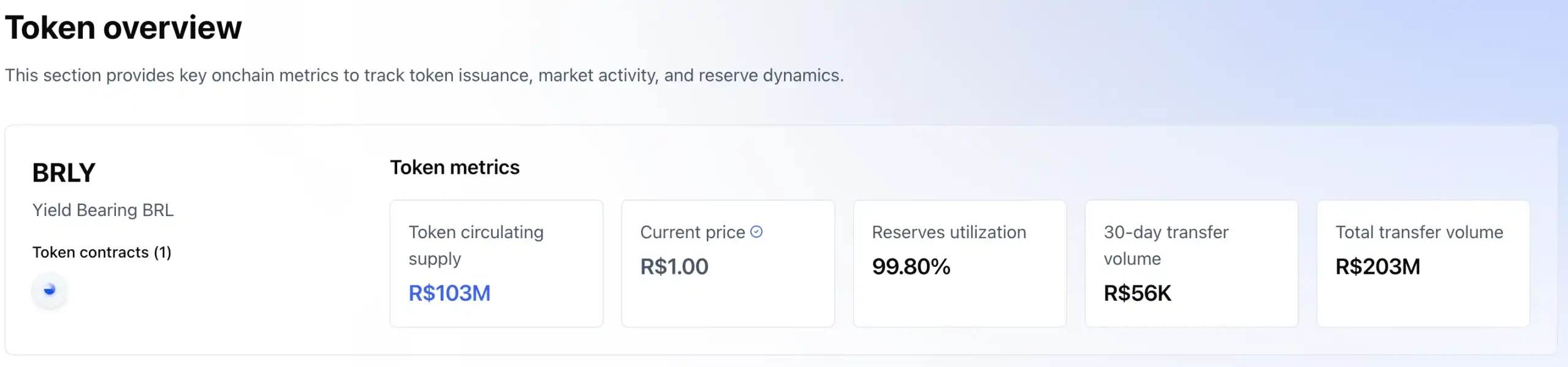
Clearly, the rationale behind investing in Crown is to bet on the team’s ability to achieve success in this market in the future.
John Delaney, co-founder and CEO of Crown, was previously a lawyer in the international finance sector. He also served as the COO of Xerpa, a well-known Brazilian company that received investment from Founders Fund. In 2019, Xerpa launched the “Earned Wage Access” platform, allowing employees to receive their salaries upfront based on the number of days worked (rather than waiting until the end of the month), thereby avoiding high-interest loans. This solution is particularly popular in Brazil, where interest rates are high and financial pressures are significant. It is seen as a tool for improving employees’ financial well-being. The company charges a small fixed fee, with no interest involved.
Vinicius Correa, co-founder and chief engineer, was one of the early engineers at Nubank, a digital bank in Brazil. Nubank’s investors are also very impressive. During its multi-round financing, which totaled $2 billion, investors included Sequoia Capital, Tiger Global, Goldman Sachs, Founders Fund, Tencent, Berkshire Hathaway, among others. Nubank went public on the NYSE in 2021, with an IPO valuation of $41.5 billion. Its current market value is nearly $80 billion.
Alex Gorra, founding partner and head of the ecosystem department, previously served as managing partner at Brainvest, a family office with assets worth $5 billion. He has also worked in positions of leadership at ARX Investments, UBS Group, Rothschild Bank, and JPMorgan Chase. Bruno “BL” Passos, the COO, led a cross-functional team at Hashdex.
The founding team of Crown can be considered a truly outstanding group of professionals. Both founders had previously played a role in helping Brazilian companies grow from scratch. Although BRLV’s current performance isn’t very promising, this doesn’t prevent it from raising over $20 million in funding within just two months.
Additionally, the Crown team stated in their blog that they introduced BRLV with the intention of leveraging USDT and USDC to support the purchase of government bonds. Issuing stablecoins in Brazil could also provide purchasing power for government bonds, thereby stabilizing the economy. This, in turn, would encourage more use of stablecoins—a win-win situation. If US dollar stablecoins serve to sustain the United States, then Brazilian real stablecoins can truly benefit the country.
Why focus on Brazil?
There seem to be many better options than the Brazilian real for creating stablecoins. So why choose Brazil?
You might not believe it, but this country, which was once known only as a football powerhouse, has now become one of the most innovative centers in Latin America, with over 1,500 fintech companies and over 100 million users.
As a capitalist country, Brazil’s banking industry has long been dominated by five major banks: Itau, Banco do Brasil, Bradesco, Caixa, and Santander. These banks account for over 80% of the market, far higher than in the United States (about 50%). Traditional banking services are rigid and costly (credit card interest rates often exceed 300% per year), and bureaucracy is widespread. As a result, tens of millions of low- to middle-income people and those without bank accounts (historically up to 55 million people) are left out of the financial system.
But this also created a significant gap in demand. Fintech companies like Nubank entered the market with low-cost, simple services, quickly filling this void. Although the Brazilian Central Bank couldn’t change the monopoly held by traditional banks, it unexpectedly promoted competition and inclusiveness. It even became a classic example of digital financial regulation worldwide. Its most significant contribution was the launch of the instant payment system Pix in 2020. Pix allows for free, 24/7 real-time transfers. By 2025, its transaction volume exceeded one trillion reais, and it served over 90% of the population. Since its launch, Pix has quickly replaced cash and credit cards as the preferred payment method for 76% of Brazilians. This significantly improved financial inclusion and provided low-cost infrastructure for fintech companies to develop innovative payment and credit solutions that integrate Pix.
I believe you’ve also seen many trading platforms and crypto payment tools integrating Pix in recent news about the Web3 industry. It’s not easy for a central bank in a capitalist country to introduce a payment system that can challenge existing banking systems. But this “beneficial” approach also gives local fintech companies better prospects, as they can serve a larger user base.
That’s why new financial forms like cryptocurrencies are highly accepted in Brazil. Brazil has a population of over 200 million, with nearly 90% of the population owning smartphones. There are over 180 million internet users, and the average person spends more than five hours per day on the internet. Young people, especially those born in the Z generation, have strong demands for mobile finance. In September last year, Circle began supporting the direct conversion of reais into USDC.
Many articles have analyzed the popularity of dollar-backed stablecoins in Brazil as being due to the instability of Brazil’s own currency. However, after thorough research, it seems that this factor plays only a minor role. If this were indeed the case, then investment firms like Paradigm would not have invested so heavily in Brazilian stablecoins and fintech companies. In fact, Brazil did experience severe inflation during the 1980s and 1990s, with monthly inflation rates reaching up to 80%. But in recent years, although the value of the real has remained volatile, Brazil has achieved significant results in stabilizing its currency and reducing inflation. In 2025, Brazil’s inflation rate is expected to range between 4.5% and 5%. While this is still higher than the central bank’s target, it is already better compared to neighboring Argentina. Some Brazilian residents hold dollar-backed stablecoins precisely to hedge against real depreciation, especially given the Fed’s interest rate hikes in previous years. But more often than not, they do so for practical purposes such as foreign trade, tax avoidance, facilitating capital flow, and trading cryptocurrencies. According to Chainalysis data, Brazil ranks fifth in the world in terms of cryptocurrency adoption, behind India, the United States, Pakistan, and Vietnam. From July 2024 to July 2025, Brazil saw an increase in cryptocurrency inflows of $318.8 billion, making it the most active country in Latin America.According to data provided by the cryptocurrency market maker Gravity Team, Brazil has utilized stablecoins as tools for investment and cross-border payments. Currently, stablecoins account for approximately 70% of the indirect capital flows from Brazilian local trading platforms to international trading platforms.
Some might wonder, since Brazil already has national-level payment tools like Pix, what is the significance of stablecoins?
BRLV, launched by Crown, has a feature that isn’t explicitly stated on its official website but is mentioned in press releases: it shares the interest earned from government bonds with holders of stablecoins. In Brazil, this rate is 15%. Although it’s impossible to distribute all the profits to holders, even half of it would still be a very attractive return on investment.
In the future, BRLV could also be integrated into the Pix system. For ordinary people or even those living in poverty, there may not be much incentive to convert their funds into stablecoins. However, for those who are wealthy, stablecoins not only facilitate payments but also allow holders to earn interest simply by holding them. In the future, BRLV could even trade seamlessly with US dollar stablecoins and participate in DeFi initiatives. All these possibilities suggest that there will certainly be sufficient demand and opportunities for stablecoins in Brazil.
For countries with weak economies that cannot maintain the stability of their currencies over the long term and have limited foreign exchange reserves, the US dollar and its stablecoins serve as a lifeline for citizens. Brazil is one such exception.