Exchange Ranking
 Top Exchanges
 24h Volume Ranking
 Popularity Ranking
 Exchange BTC Balance
 Proof of Reserves
 Decentralized Exchanges
 Funding Rate
 Funding Heatmap
 Liquidation Data
 Max Pain
 Long/Short Ratio
 Whale L/S Ratio
 Binance/Okex/Huobi L/S
 Bitfinex Margin L/S
 ETF Tracker
 Solana ETF
 XRP ETF
 Hong Kong ETF
 Bitcoin Treasuries
 Crypto Reversal
 Ethereum Reserves
 HyperLiquid Wallet Analysis
 Hyperliquid Whale Watch
 Large Transactions
 On-chain Movement
 Bitcoin ROI
 Stablecoin Market Cap
 Options Analysis
 News
 Articles
 Economic Calendar
 Features
 Wallet
 Contract Calculator


 Security
 Collections
 Watchlist
 Following
Stablecoins are entering a true “bull market” phase—not just due to price fluctuations, but also because of the explosive growth in their applications. From cross-border e-commerce to global supply chains, businesses are using stablecoins like USDT and USDC to facilitate faster, cheaper, and even safer financial transfers. What supports all this is a clearer regulatory framework: the Genius Act in the United States and the MiCA Act in Europe have both played a key role in facilitating the widespread use of stablecoins. Now, Wall Street and tech giants are also getting involved, either by creating their own stablecoins or integrating them into existing networks. The entire industry is rapidly taking shape.
But this is only the first stage. Next, a more disruptive second wave is approaching—low-risk credit programs. When stablecoins become more than just payment tools, becoming a low-cost, scalable foundation for global credit, the structure of traditional finance will be completely redefined. This article will help you understand why low-risk stablecoin credit could become the next major trend in the crypto finance industry.
Current on-chain lending
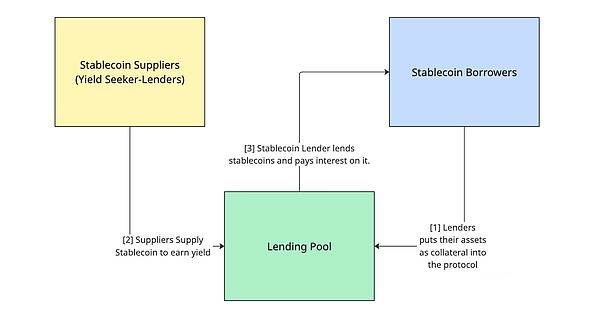
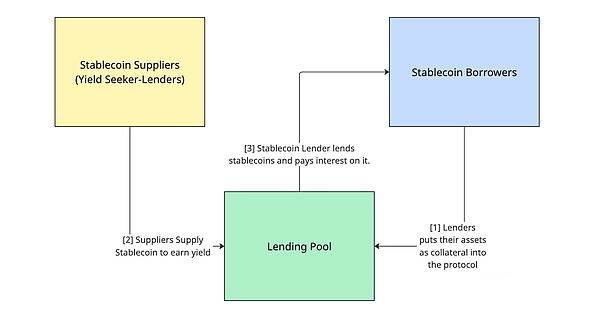
Currently, we have an on-chain lending industry with a total locked value of nearly $50 billion, and active loan amounts reaching $25 billion. These protocols are very simple to operate:
● Lenders deposit stablecoins;
● Borrowers use other liquid assets as collateral to obtain loans.
However, compared to traditional finance, the potential market size of existing lending protocols is relatively small. These protocols rely on certain assumptions:
● The user owns assets on the blockchain. These assets are liquid and accepted by the lending protocol;
● Users can accept floating interest rates;
● Users are willing to use cryptocurrencies, either for leverage trading or for actual payments (though this situation is rare).
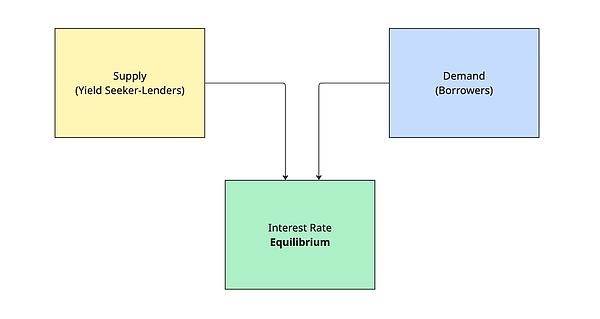
Currently, stable coin lending institutions typically charge higher interest rates than the actual US dollar rate, due to the relatively small supply of stable coins compared to demand. But where does this demand come from?
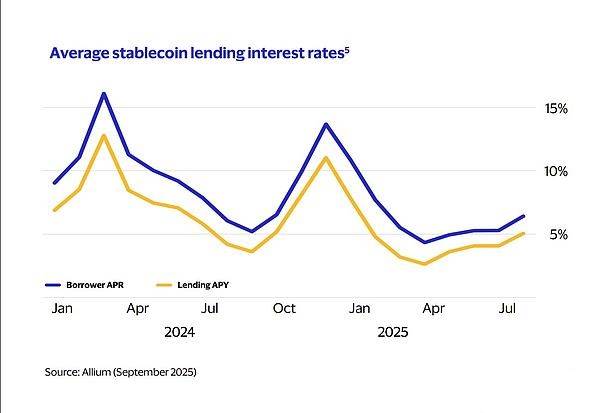
1. Those who prefer leverage: People enjoy leveraging, and this is one of the reasons why “perps” have emerged in the cryptocurrency world. They often use assets as collateral to obtain loans, aiming to increase their income and positions. They also use leverage to boost returns.
2. People who don’t want to sell their assets but need money for expenses: Some people simply want to keep their assets without selling them, but they need funds to cover their expenses. Although this group is relatively small, they are very important.
Right now, both parties benefit: those who prefer leverage pay high interest rates to providers, while providers earn more than the interest rates. But will this situation continue as stable coins continue to develop?
The golden age of stable coins
Citi Group recently published a report predicting the total amount of stablecoins in circulation: the baseline scenario suggests 1.9 trillion dollars in stablecoins (previously estimated at 1.6 trillion dollars), while the optimistic scenario predicts 4 trillion dollars (previously estimated at 3.7 trillion dollars). They believe that there will be trillions of stablecoins circulating on the blockchain at that time. Therefore, it is foreseeable that a large number of stablecoins will remain idle, which will likely lead to a significant reduction in mortgage costs. But under current circumstances, is there enough revenue to cover the high interest rates associated with such a large supply of stablecoins? The answer is no.
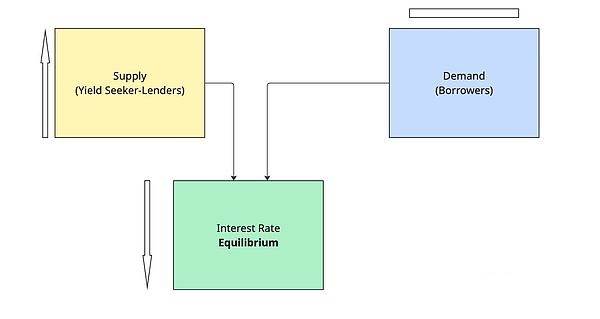
This represents an opportunity for low-risk credit to enter the market. Since mortgage loans are safe and have relatively low risk (with almost zero risk of bad debts if protocols are followed), many stablecoin holders may be willing to provide credit to higher-risk groups. Loans can be granted based on credit scores, future cash flows, asset holdings, and other factors. This is completely different from the current lending market on the blockchain, and the risk is also higher. Even if the loan interest rate is only 20% of the actual rate, it still represents a huge market. So, how can we achieve this goal?
Low-risk credit market
过去,许多协议都尝试过低抵押信贷;它们大多将信贷发放给做市商和投资者,并认为他们会偿还。但不幸的是,正如TrueFi、Goldfinch和Maple Finance的例子所示,这些协议可能会破产,永远无法偿还债务。原因在于:借款人承担了过高的风险,获得了在其他市场无法获得的信贷;主要问题在于他们使用了过多的杠杆和高风险投资。此外,一些协议专注于向散户用户提供低抵押信贷,但它们也未能成功,因为加密货币散户有一个坏习惯:如果他们能钻空子(哪怕只赚1美元),他们就会这么做,并且认为这是他们的权利。我们在奖励计划、联盟营销等方面都看到了这种情况。因此,应该有有效的方法来促使人们偿还债务。那么,什么可以强制人们偿还债务呢?
1、切断与产品的联系:协议可以从少量金额(例如10美元、50美元或100美元)开始,并使用类似zkTLS的方法来确保他们有能力偿还。如果他们不还款,协议可以封禁他们,并且永远不再发放任何债务。这听起来合情合理,但我可以肯定,总会有人利用家人的身份来钻系统的空子,并且永远不会还款。
● 优点:这套系统可以轻松地为世界各地的人提供信贷服务,没有地域限制。因此,它的建设相对容易,而且现行法律也允许其建设。
● 缺点:这套系统很可能最终会破产,产生大量无法追讨的坏账。而且这套系统只能从小额资金开始,所以高净值人士永远不会使用它。
2、链上债务拍卖:我们可以先确保借款人拥有资金、信用评分和/或未来现金流;然后,如果借款人违约,则通过链上拍卖的方式,由债务催收机构从协议中购买债务。为了使这一机制有效运作,债务催收机构必须能够执行必要的法律程序,并迫使借款人偿还债务。该系统可以轻松扩展到大型参与者,包括高净值个人、中等规模的借款人,甚至加密货币赌徒。
● 优点:该系统可以轻松确保人们偿还债务,因为这会影响他们的生活(我并不赞成这种做法,但在资本主义世界里没有其他办法),并且可以轻松找到需要大量资金的信贷申请人。
● 缺点:这意味着它们不太可能扩展到所有市场。它们可能会从小市场起步,然后利用信贷创造方面监管漏洞。而且在某些地区,这套系统可能需要昂贵的许可证费用。
我认为没有一种解决方案能适用于所有情况。但这确实是一个值得考虑的好方案;我觉得这是进入市场并获得市场认可的有效途径。
接下来会怎样?
The supply of stablecoins is increasing, and over the past four years, its growth rate has exceeded that of the entire cryptocurrency market. Therefore, it is inevitable that the yield on stablecoins will decline in the coming years. As a result, cryptocurrencies will become an increasingly important tool for businesses to obtain low-cost credit. However, given the nature of cryptocurrencies, such systems cannot operate completely without any regulatory oversight, as this type of low-risk credit system is not based on cryptocurrencies themselves. We need more verifiable credentials that can be verified on the blockchain. Private credit initiatives must also find ways to issue credit legally and enforce debt repayment when borrowers default.
Implementing this model globally is extremely difficult, and it will inevitably disrupt some of the seamless combinations we currently have in place. Nevertheless, I believe that the emergence of a large amount of free stablecoin liquidity will lead to several practical applications: businesses will use cryptocurrencies as a means to generate additional income, in addition to generating profits from government bonds.