Exchange Ranking
 Top Exchanges
 24h Volume Ranking
 Popularity Ranking
 Exchange BTC Balance
 Proof of Reserves
 Decentralized Exchanges
 Funding Rate
 Funding Heatmap
 Liquidation Data
 Max Pain
 Long/Short Ratio
 Whale L/S Ratio
 Binance/Okex/Huobi L/S
 Bitfinex Margin L/S
 ETF Tracker
 Solana ETF
 XRP ETF
 Hong Kong ETF
 Bitcoin Treasuries
 Crypto Reversal
 Ethereum Reserves
 HyperLiquid Wallet Analysis
 Hyperliquid Whale Watch
 Large Transactions
 On-chain Movement
 Bitcoin ROI
 Stablecoin Market Cap
 Options Analysis
 News
 Articles
 Economic Calendar
 Features
 Wallet
 Contract Calculator


 Security
 Collections
 Watchlist
 Following
 DAO
传统上,数字支付速度慢且乏味。当时有安全的即时通讯网络(SWIFT)、清算系统(ACH、RTGS)和银行卡系统,它们只在工作日批量转移资金,而我们很少会去关注这些基础设施,除非出了问题。用户为无需操心基础设施而支付的代价就是差价和手续费。
区块链将基础设施推到了风口浪尖,从而扭转了这种局面。
每一笔稳定币转账都会在公链上永久记录一条账本条目。任何人都可以实时查看资金流动情况,交易在几秒钟内即可完成,手续费几乎为零。
从理论上讲,这应该标志着Wise、Remitly、Payoneer以及大部分收取不菲手续费的代理银行体系的终结。然而,实际上,它们仍然存在。
稳定币比它们“竞争”的系统速度更快、成本更低,但负责工资发放和向供应商付款的人们仍然对采用区块链路线持怀疑态度。
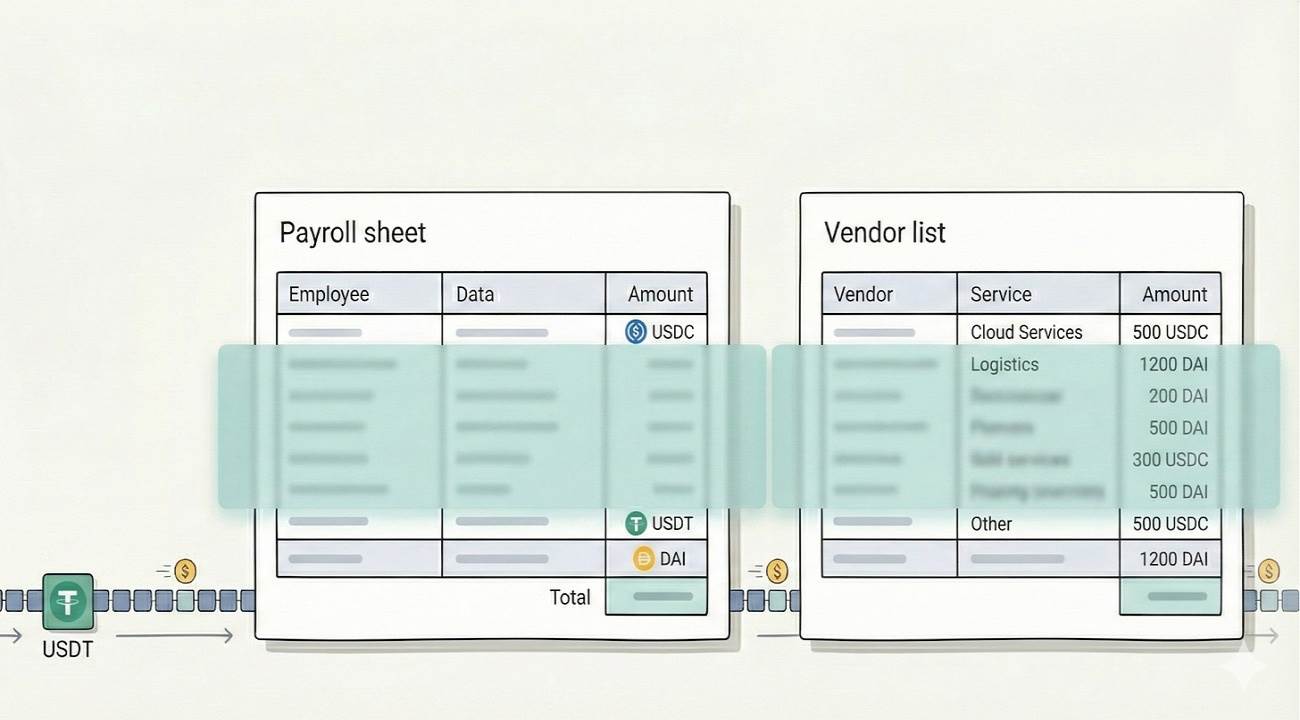
在今天的深度解析中,我将解释是什么阻碍了企业将区块链应用于商业场景,例如支付工资和向供应商付款,以及什么可以弥合这一差距。
稳定币数据表明,支付轨道正在扩展并获得大规模采用。
The Visa's chain analysis dashboard estimates that the volume of stablecoin transactions, after adjusting for robot activities and internal DeFi transactions, will reach $10.1 trillion in 2025. This represents a growth of over 75% compared to $5.7 trillion in 2024.
Every quarter, the gap between stablecoin transactions and transactions processed by Visa continues to narrow.
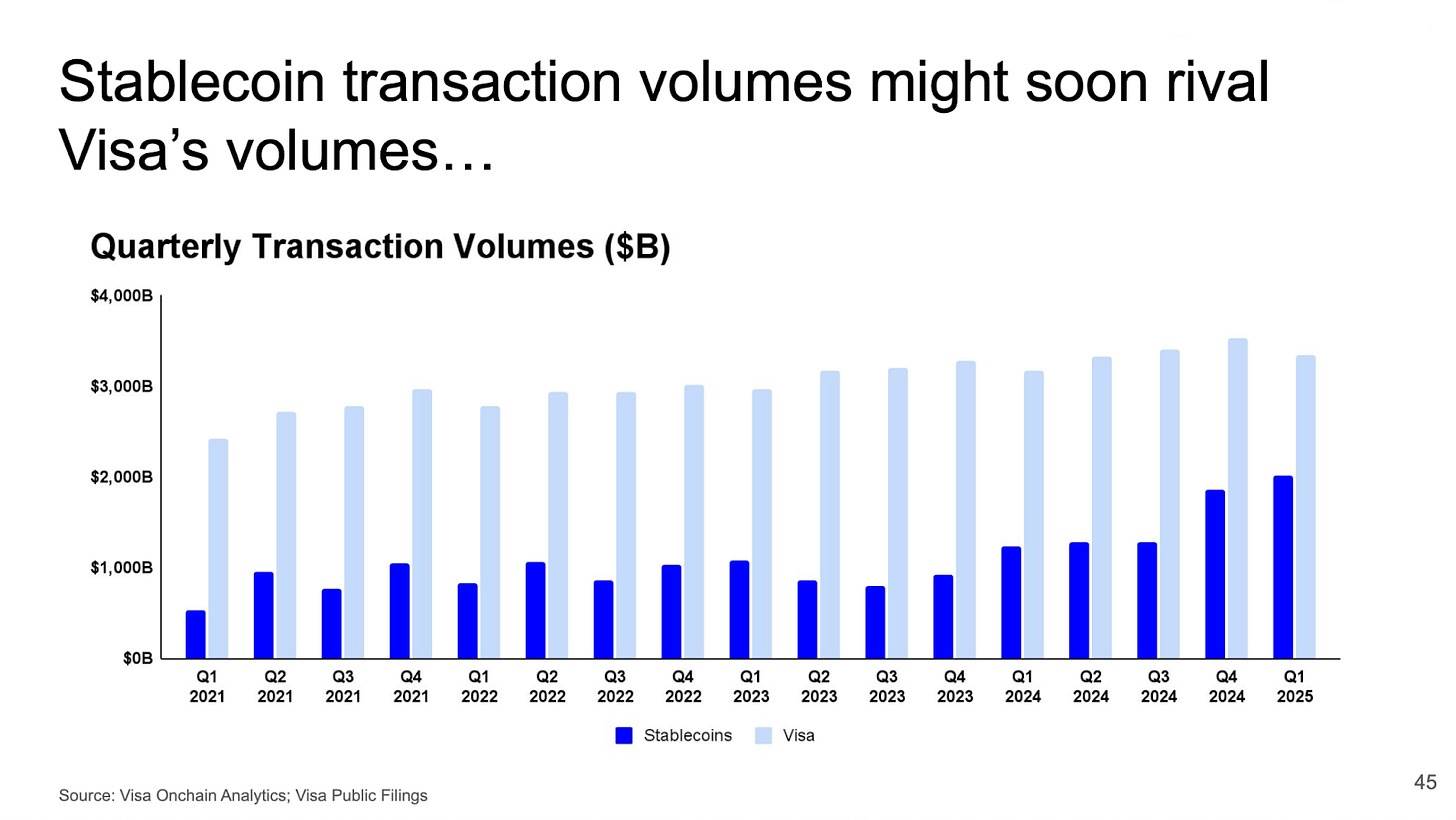
Ethereum currently plays a central role in this context.
As a leading Layer-1 blockchain, Ethereum accounts for more than half of the total stablecoin supply. It is expected that in 2025, more than $7.8 trillion in “adjusted” stablecoin transactions will be settled on Ethereum. This represents approximately one-third of the total value of all stablecoin transactions on all blockchains after adjustment. In 2024, Ethereum facilitated transactions worth over $25 trillion in various emerging areas such as DeFi, stablecoins, DAOs, artificial intelligence agents, and online identities.
Rough estimates suggest that stablecoins account for more than one-third of the total settled value on the Ethereum network.
Blockchains that have introduced ICOs and NFTs have now become engines for clearing digital dollars.
However, many of the fluctuations in stablecoins can be misleading. This may involve traders transferring collateral between exchanges, DeFi users swapping dollars between wallets on different chains, or market makers rebalancing liquidity.
By definition, they remain payment methods. Digital dollars allow people around the world to easily participate in DeFi activities, without having to worry about exchange rate differences or time zone issues. But these are just a portion of the benefits available to users.
Apart from DeFi, countries with high inflation rates and certain remittance channels could also be the main beneficiaries of stablecoin payments. Stablecoins that are pegged to the US dollar are more reliable, offering greater flexibility in transferring funds across the global economy, especially for countries with unstable currencies and weak economies.
Think about how a U.S. company might send money to consultants in South Asian or South American countries. In such cases, using stablecoins for payments could bring significant benefits. For example, suppose a U.S. company wants to send $1,000 to a contractor in India.
Traditional remittance platforms charge fees that are 10 to 70 times higher than those of blockchain-based systems for transferring this amount of money.
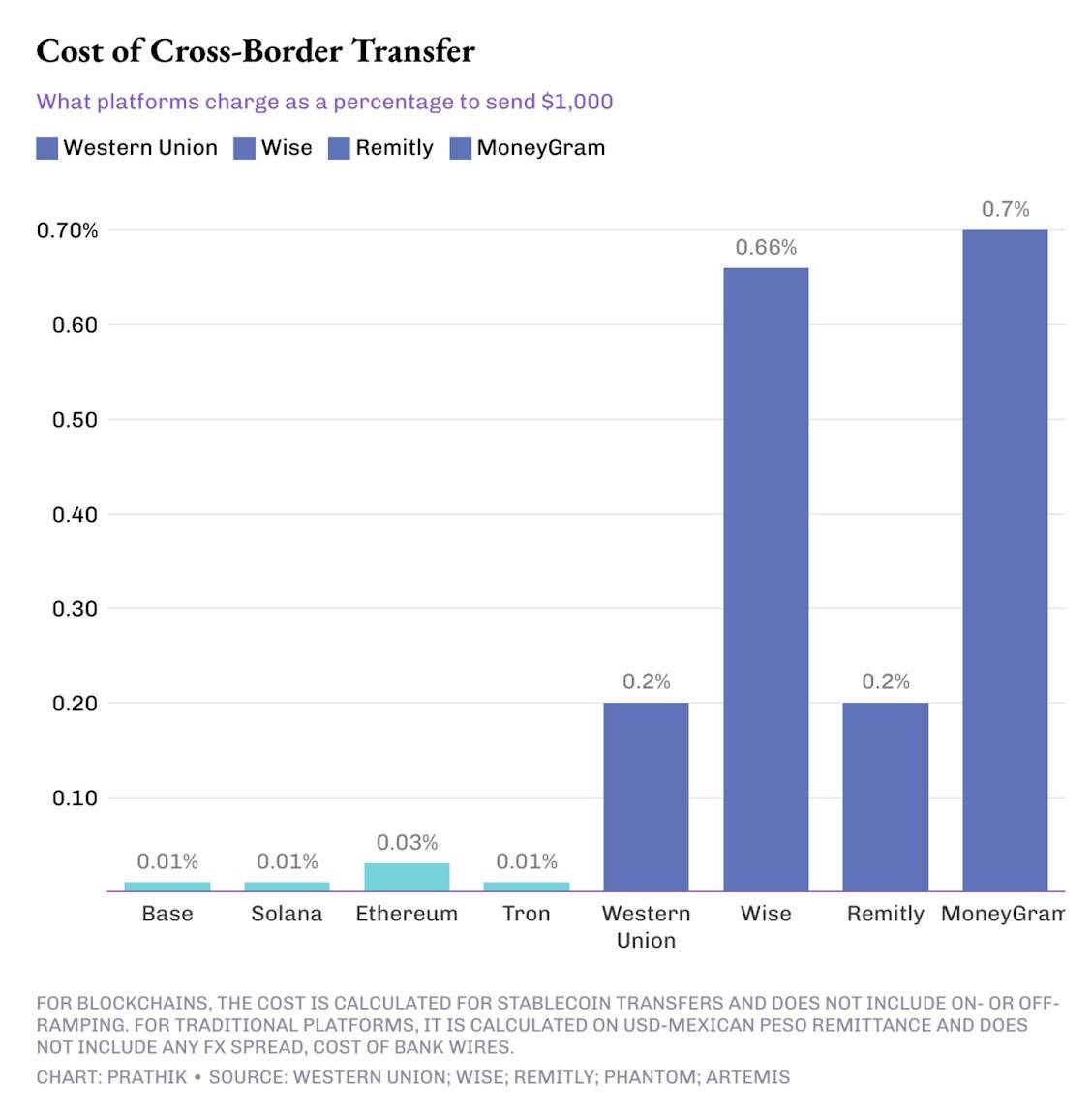
If the transfer is made through traditional banks using SWIFT, there may be charges of $15 to $30 for the remittance transaction itself. Additionally, intermediate banks will charge fees, and the receiving bank may charge a 1.5% to 3% fee for converting the US dollars into Mexican pesos or Indian rupees.
This situation isn’t unique to emerging economies. Even companies that want to receive payments from foreign customers often only get back about $950 or less from their bank accounts for invoices worth $1,000.
In contrast, transferring USDC or USDT via Ethereum, Solana, or Tron can be completed in just seconds or minutes, with fees ranging up to 30 cents. Nevertheless, traditional cross-border platforms still dominate the market. Why?
Because there are things that are more important than payment costs and transfer speeds.
Public ledgers and private spreadsheets
– Traditional payment systems lack transparency. Only departments such as human resources, finance, banks, and possibly auditors have access to payroll data. Others can only see the inflow and outflow of funds.
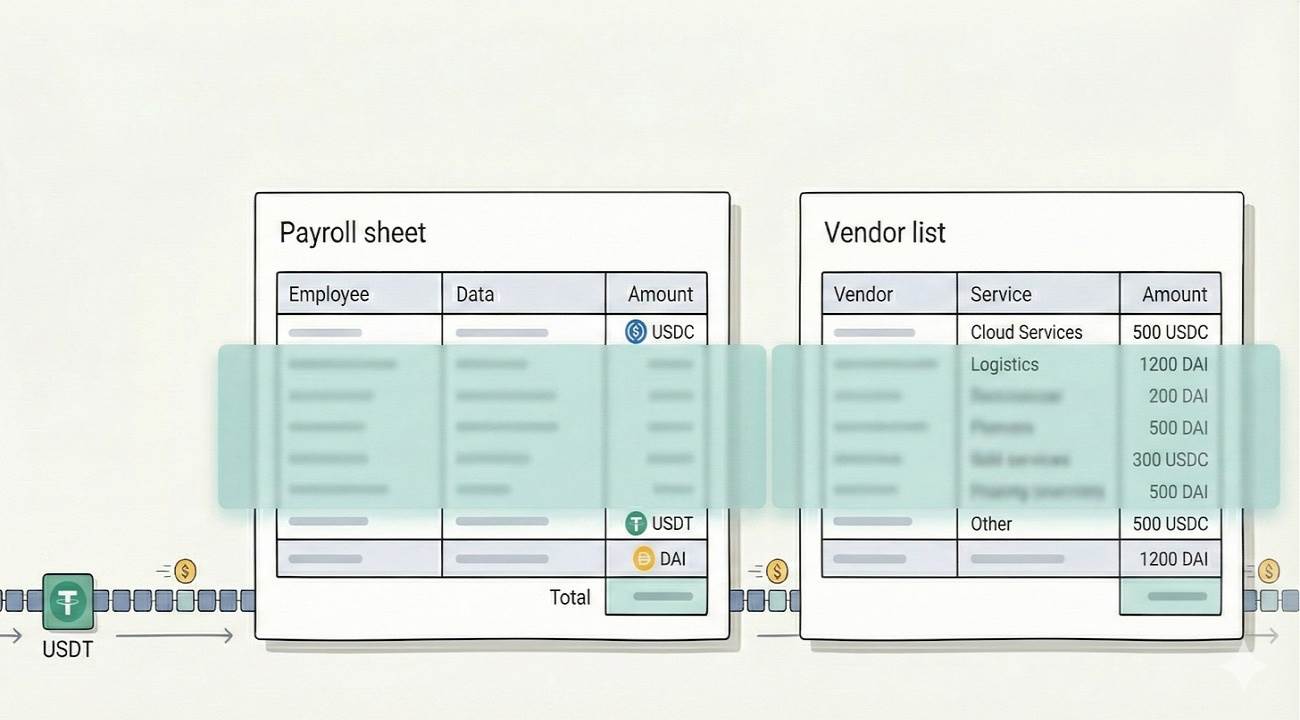
Public blockchains revolutionize this model. When an American company pays its consultants using USDC on Solana, or makes payments to suppliers in Mexico or India, anyone with a blockchain browser can retrieve detailed information such as salary ranges, list of suppliers, and material costs.
Addresses can be anonymous, but as I’ve written before, it’s not difficult to reconstruct patterns by analyzing tools sold by companies like Chain Analysis.
So, when you ask financial managers why they don’t simply include stablecoins in salaries and supplier payments, they will give consistent answers: “We can’t make all our internal financial details public.”
If transparency is too extreme, then being cheap and fast isn’t enough.
That’s why the world needs blockchains and privacy layers to integrate stablecoins more deeply into corporate accounting systems.
Dedicated payment chains
– There are already some protocols working on implementing these features.
Stable.xyz is a Layer-1 layer that’s compatible with EVM and supported by Tether. It allows institutions and individuals to conduct sub-second transactions, while providing dedicated block space to ensure the confidentiality of transactions.
In addition, Circle has launched a new online experimentation project. Through the Circle Payments Network (CPN), this USDC issuer aims to create a closed network that connects banks, payment service providers, and fintech companies via a single API. This allows them to conduct USDC transactions with near-real-time settlement times, while still maintaining standards for access, compliance, and risk management comparable to those of traditional financial institutions.
Celo is an Ethereum Layer-2 layer that supports stablecoin transfers with fees as low as cents and block times of approximately 1 second. It also offers a mobile-first user experience and supports address allocation based on phone numbers. Recently, Celo introduced Nightfall, a zero-knowledge privacy layer that enables private B2B stablecoin payments. Both the amount of payment and counterparty information are protected, but audits can still be conducted when necessary.
These experiments collectively aim to address the same challenge: maintaining the advantages of public chains—such as global reach, open accessibility, and near-real-time settlement—while ensuring the confidentiality of sensitive information.
The adoption of these new payment chains is still in its early stages and remains somewhat chaotic. However, change is underway, and it’s clear that progress is being made.
Major financial institutions have already joined this trend. During the third quarter earnings call, Circle’s senior management mentioned that CPN has already signed early cooperation agreements with several major banks, including Standard Chartered Bank, Deutsche Bank, Societe Generale, and Santander Bank.
In February 2025, Stripe acquired the stablecoin platform Bridge for $1.1 billion. This acquisition will enable this financial infrastructure provider to offer faster and cheaper global stablecoin transactions to businesses, by integrating Bridge’s technology into its offerings.
Just by looking at the Artemis dataset, it’s clear that the volume of transactions involving stablecoins is rapidly increasing compared to Visa, ACH, and other traditional financial systems.
Over the past three years, the volume of stablecoin transactions has grown significantly, reaching approximately 2.5 times that of Visa, and accounting for nearly half of ACH transactions.
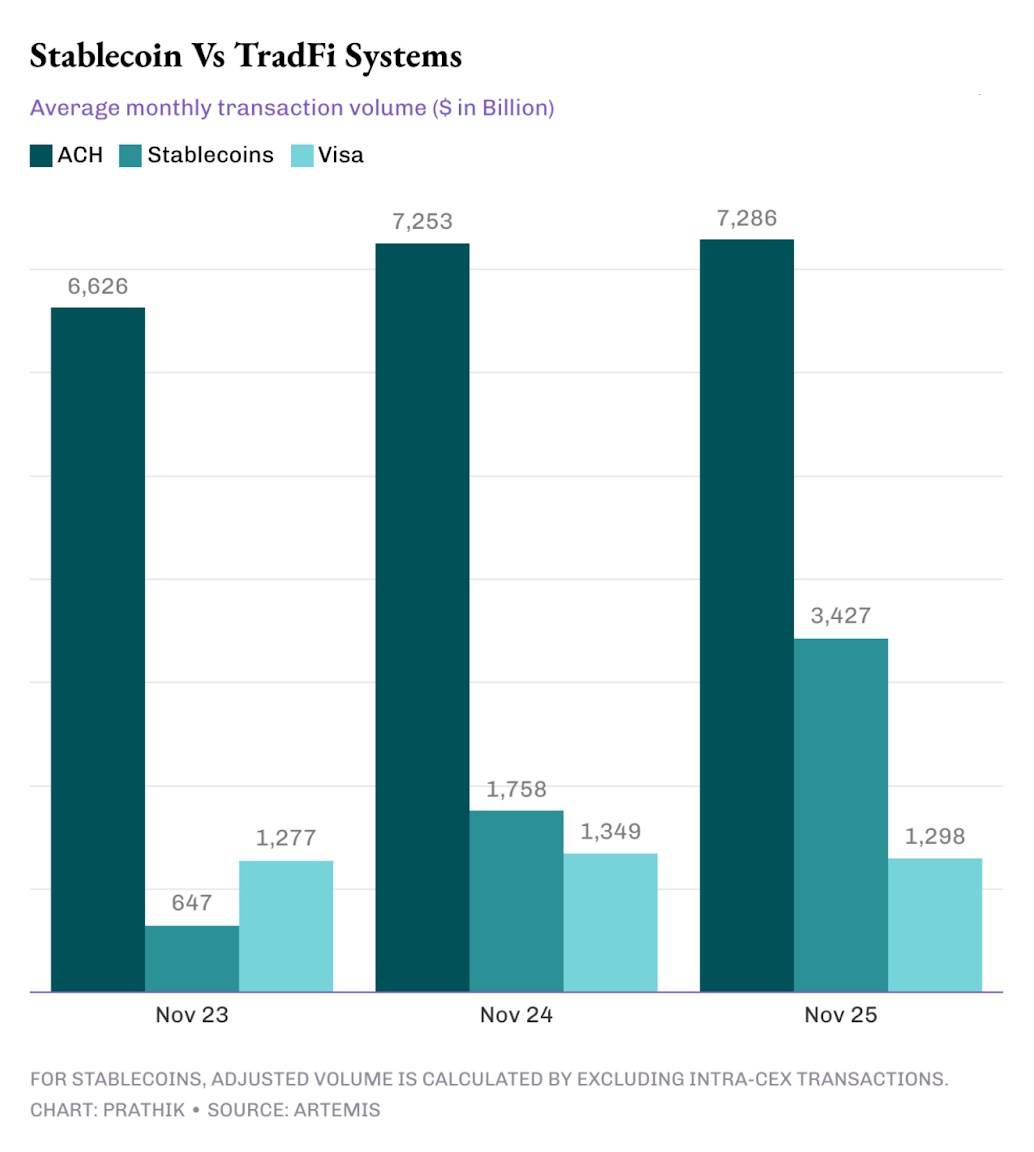
The charts clearly show that it’s only a matter of time before stablecoins disrupt traditional payment systems—it’s not a question of whether this will happen.
In the future, it’s important to see how payment chains that prioritize privacy and focus on payments will evolve.
If they can use stablecoins for settlement and leverage a single API to process payrolls on a bulk basis, then they’re taking the right direction. They also need to ensure privacy, while still allowing auditors to access the information they need.