Exchange Ranking
 Top Exchanges
 24h Volume Ranking
 Popularity Ranking
 Exchange BTC Balance
 Proof of Reserves
 Decentralized Exchanges
 Funding Rate
 Funding Heatmap
 Liquidation Data
 Max Pain
 Long/Short Ratio
 Whale L/S Ratio
 Binance/Okex/Huobi L/S
 Bitfinex Margin L/S
 ETF Tracker
 Solana ETF
 XRP ETF
 Hong Kong ETF
 Bitcoin Treasuries
 Crypto Reversal
 Ethereum Reserves
 HyperLiquid Wallet Analysis
 Hyperliquid Whale Watch
 Large Transactions
 On-chain Movement
 Bitcoin ROI
 Stablecoin Market Cap
 Options Analysis
 News
 Articles
 Economic Calendar
 Features
 Wallet
 Contract Calculator


 Security
 Collections
 Watchlist
 Following
 BTC
 ETH
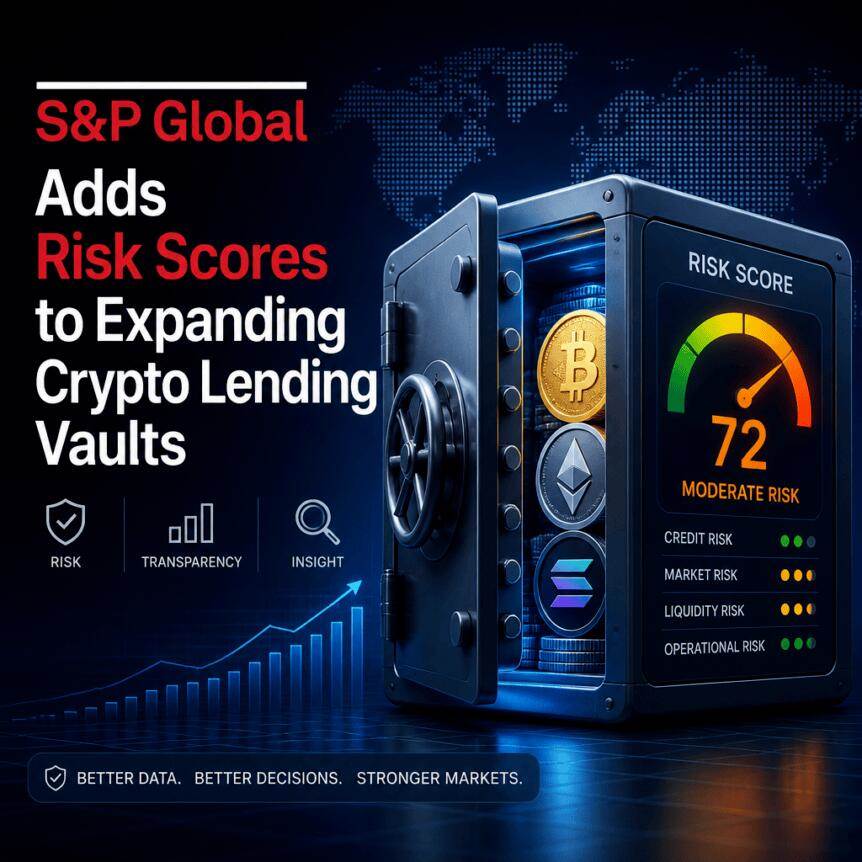
S & P Global Ratings launches new risk assessment framework for digital asset lending vaults
As on-chain revenue products continue to attract more capital from retail and institutional participants, S & P Global Ratings has introduced a new risk assessment framework for digital asset lending vaults. The framework aims to help investors understand how and how the lending vault structure may fail, but makes it clear that it does not provide traditional credit ratings and does not comment on expected returns.
The plan was announced in a press release on Monday and is known as the "Vault Risk Assessment Framework." It breaks down risks into six categories: portfolio credit quality risk, liquidity mismatch risk, curator risk, blockchain risk, agreement risk, and treasury security and governance risk. According to S & P Global Ratings, the assessment focuses on the likelihood of investors suffering losses rather than the size or attractiveness of the gains.
Core Points
- S & P's new framework for global ratings evaluates digital asset lending vaults in six different risk areas associated with potential investor losses.
- These assessments are not credit ratings and do not assess yields, allowing the tool to focus on downside vulnerabilities rather than performance predictions.
- Standard & Poor's pointed out that no single category is pre-defined as the main source of risk; serious weaknesses in any factor may materially affect the overall assessment results.
- Treasury deposits have grown rapidly, with Standard & Poor's estimating deposits reaching about US$10 billion in September, compared with about US$1.5 billion two years ago.
Downward-focused Treasury Investor Framework
Digital asset lending vaults typically pool deposits and allocate capital through smart contracts or predefined strategies run by individuals/third-party curators in some design. Depositors typically receive treasury tokens that represent their share of underlying assets and generate revenue claims on treasury strategies.
The goal of S & P's global rating statement is to provide more practical risk visibility to capital allocators. In an interview, analyst Lisa Schroeer emphasized that the framework focuses on identifying vulnerabilities that could lead to losses.
Schroeer also describes how the scoring logic is expected to operate: "significant weaknesses" in any factor limit the overall treasury risk assessment, and a strong score in one area cannot automatically offset a serious gap in another area. Her comments pointed to an industry with multiple potential points of failure-covering operational decision-making, technical execution and governance.
Importantly, S & P said the framework does not constitute a credit rating and does not assess yields. This distinction is crucial for investors because it separates risk due diligence from return expectations: the framework is designed to inform investors whether the structure of the product exposes it to a specific downward path, rather than predicting the profits that the treasury may generate.
Six major risk categories of concern to S & P
announcement outlines six areas that the framework will assess. Although complete scoring criteria are not provided in excerpts of news materials, these categories map to common failure patterns in crypto lending and treasury operations:
- Portfolio credit quality risk: The possibility of underperforming or default on assets or loans held by the treasury.
- Liquidity mismatch risk: The risk that arises when a treasury's ability to meet withdrawals is inconsistent with the liquidity characteristics of its deployed assets.
- Curator Risk: Risks associated with discretion or operations manager roles when treasury strategies are not fully automated.
- Blockchain risks: Risks related to the underlying network environment and its operational or technical constraints.
- Agreement risk: Risk arising from lending or strategic agreements with which the treasury interacts.
- Treasury security and governance risks: Risks related to smart contract security, key management and governance processes.
Standard & Poor's also stated that the design of the framework does not mean that one of the six categories is inherently more dangerous than the others. Instead, the company appears to view the overall risk profile as the combined effect of multiple interconnected vulnerabilities-consistent with the "non-offsetting" philosophy described by Schroeer.
Treasury adoption is growing rapidly, and regulatory scrutability is intensifying
Treasury products are expanding rapidly as exchanges, wallet providers, and decentralized finance (DeFi) platforms package lending and other revenue strategies into interfaces designed to expand participation. S & P's deposit estimates highlight the rapid growth rate in this market segment: Deposits in the digital asset lending vault reached about $10 billion in September, compared with about $1.5 billion two years ago.
Distribution partnerships and the launch of mainstream adjacent products have also accelerated this shift. Previous reports pointed out that in February, Telegram Wallet launched self-hosted BTC, ETH and USDT vaults using Morpho, TAC and Re7 infrastructure. In May, Kraken launched the Bitcoin Revenue Vault powered by Veda-curated by Sentora, which reportedly raised $30 million from 4,000 wallets in the first 10 hours.
Product expansion is not limited to "pure" cryptocurrency assets. A September report pointed out that Kraken launched tokenized versions of the revenue vault of Nvidia, SPDR S&P 500 and Invesco QQQ ETFs, with Sentora managing the strategy and lending these assets through the DeFi Marketplace. The shift to tokenized security-based exposures has increased the importance of a consistent risk framework, especially when investors may assume that these products behave more like traditional financial instruments.
At the same time, high-profile security failures have always drawn attention to treasury governance and protocol design. In August, it was reported that loan agreement Term Finance lost approximately $8.5 million after attackers used its governance control of Meta Vaults. Cases such as these illustrate why "security and governance risks" as well as agreements and curator responsibilities are at the center of the investor protection debate.
Regulatory uncertainty remains a background factor
In addition to technical risks, crypto vaults remain in a regulatory gray area in the United States. In July, SEC Commissioner Hester Peirce said that according to some reports, certain treasury and on-chain lending products may fall under federal securities laws depending on how they are structured and operated.
Peirce's comments highlight a key factor: Treasury decisions involving discretionary decisions on asset allocation, yield strategies, borrowing terms or liquidation thresholds can trigger requests from securities, investment companies or investment advisers. This distinction is related to the S & P framework because curators and governance design-elements directly included in assessments-can influence how discretionary controls work in practice.
Despite this, S & P's announcement does not position the new framework as a regulatory tool. Instead, it is described as a transparency and due diligence aid used to assess the likelihood of investor losses within the treasury mechanism.
Future Observation Focus
Standard & Poor's Global Ratings said it plans to release the first batch of treasury risk assessments in future announcements, but did not specify which treasury will be evaluated first. Investors and operators should pay close attention to these first assessments, as first-time releases could show how S & P explains the interplay between clearing design, liquidity constraints and governance-areas where real-world incidents have shown that "one weak link" can dominate results.