Exchange Ranking
 Top Exchanges
 24h Volume Ranking
 Popularity Ranking
 Exchange BTC Balance
 Proof of Reserves
 Decentralized Exchanges
 Funding Rate
 Funding Heatmap
 Liquidation Data
 Max Pain
 Long/Short Ratio
 Whale L/S Ratio
 Binance/Okex/Huobi L/S
 Bitfinex Margin L/S
 ETF Tracker
 Solana ETF
 XRP ETF
 Hong Kong ETF
 Bitcoin Treasuries
 Crypto Reversal
 Ethereum Reserves
 HyperLiquid Wallet Analysis
 Hyperliquid Whale Watch
 Large Transactions
 On-chain Movement
 Bitcoin ROI
 Stablecoin Market Cap
 Options Analysis
 News
 Articles
 Economic Calendar
 Features
 Wallet
 Contract Calculator


 Security
 Collections
 Watchlist
 Following
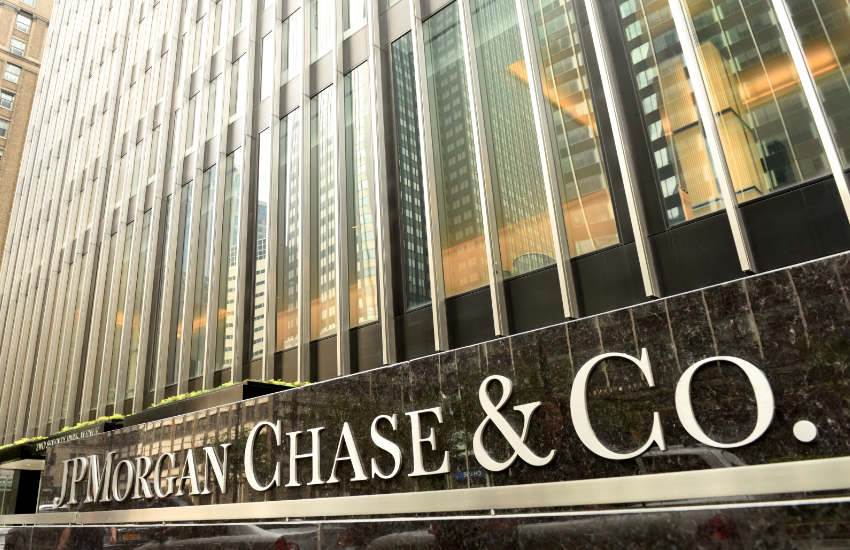
In December 2025, JPMorgan Chase officially launched the token JPMD, which is backed by bank deposits, onto the Base public blockchain. This move quickly sparked discussions in both traditional finance and the crypto market. Unlike conventional stablecoins, JPMD directly corresponds to deposits held in the balance sheets of regulated banks. This means that institutional funds are now able to be settled online in a compliant and auditable manner for the first time. Along with the launch of the tokenized money market fund MONY, it is widely believed that the ceiling on the size of real-world assets (RWA) that can be managed through blockchain technology is being pushed open. Blockchain is evolving from a tool for testing new technologies to an institutional-level financial infrastructure capable of managing trillions of dollars in assets.
Bank deposits will begin to be transferred online in December 2025.
Until recently, applications of real-world assets on public blockchains were limited to tokenized government bonds, money market funds, and structured investment products. Commercial bank deposits—the most system-critical and highly regulated form of currency—remained confined within closed banking systems. This situation changed in December 2025 when JPMorgan Chase announced that its tokenized deposit support, known as JPM Coin (JPMD), was now operational on the Ethereum Layer-2 network developed by Coinbase, called Base.
Unlike previous internal experimentation, JPMD on Base enables actual institutional settlement activities. It allows customers on the whitelist to conduct online payments, settle margin positions, and transfer collateral. This marks the first time that deposits from the balance sheets of major global banks are being managed in a public blockchain environment, rather than within closed or permissioned networks.
为什么存款代币比稳定币更重要
多年来,稳定币一直是链上现金的主要形式,但对于受监管的金融机构而言,它们在结构上仍然与银行系统分离,这引发了关于发行人信用、储备透明度和监管待遇的持续问题;存款代币从根本上来说有所不同,因为它们代表了对商业银行存款的直接索取权,完全嵌入在现有的监管、会计和审计框架中。
就摩根大通而言,这种区别并非理论上的:根据2025年11月12日发布的披露信息,JPMD on Base已投入生产使用,并进行了涉及万事达卡、Coinbase和B2C2的初始试验交易,同时支持全天候链上结算,这表明存款支持的货币可以作为公共区块链上的实时结算资产,而不是概念性的试点。
规模决定一切
从资产负债表数据而非区块链叙事的角度来看,存款代币化的系统性意义就更加清晰了。
根据摩根大通2024年10-K表格,截至2024年12月31日,该银行报告的总存款为2,4060.32亿美元,相当于2.406032万亿美元,这意味着即使将基于存款的结算活动有限地迁移到区块链基础设施,也将超过大多数现有的链上RWA产品的规模。
For reference, although tokenized government bonds and money market funds have developed rapidly, their total value on the blockchain remains in the hundreds of billions of dollars. In contrast, commercial bank deposits in the global financial system reach trillions of dollars in size.
MONY brings benefits directly to users on the blockchain
. While deposit tokens solve the issue of settlement, generating income remains a separate challenge. This gap will be resolved on December 15, 2025, when JPMorgan Asset Management announced the launch of the My OnChain Net Yield Fund (MONY). This is the company’s first tokenized money market fund issued on the public Ethereum network.
According to official announcements, MONY is a private fund category 506(c) designed for qualified investors. Its assets are entirely invested in U.S. government bonds and bond-backed repurchase agreements. JPMorgan provided an initial seed investment of $100 million, allowing investors to hold yield-bearing assets directly on the blockchain within a fully regulated framework.
RWA data shows that the operation mode has transitioned from pilot phases to actual operations
. Quantitative data supports the idea that RWA has already surpassed the proof-of-concept stage.
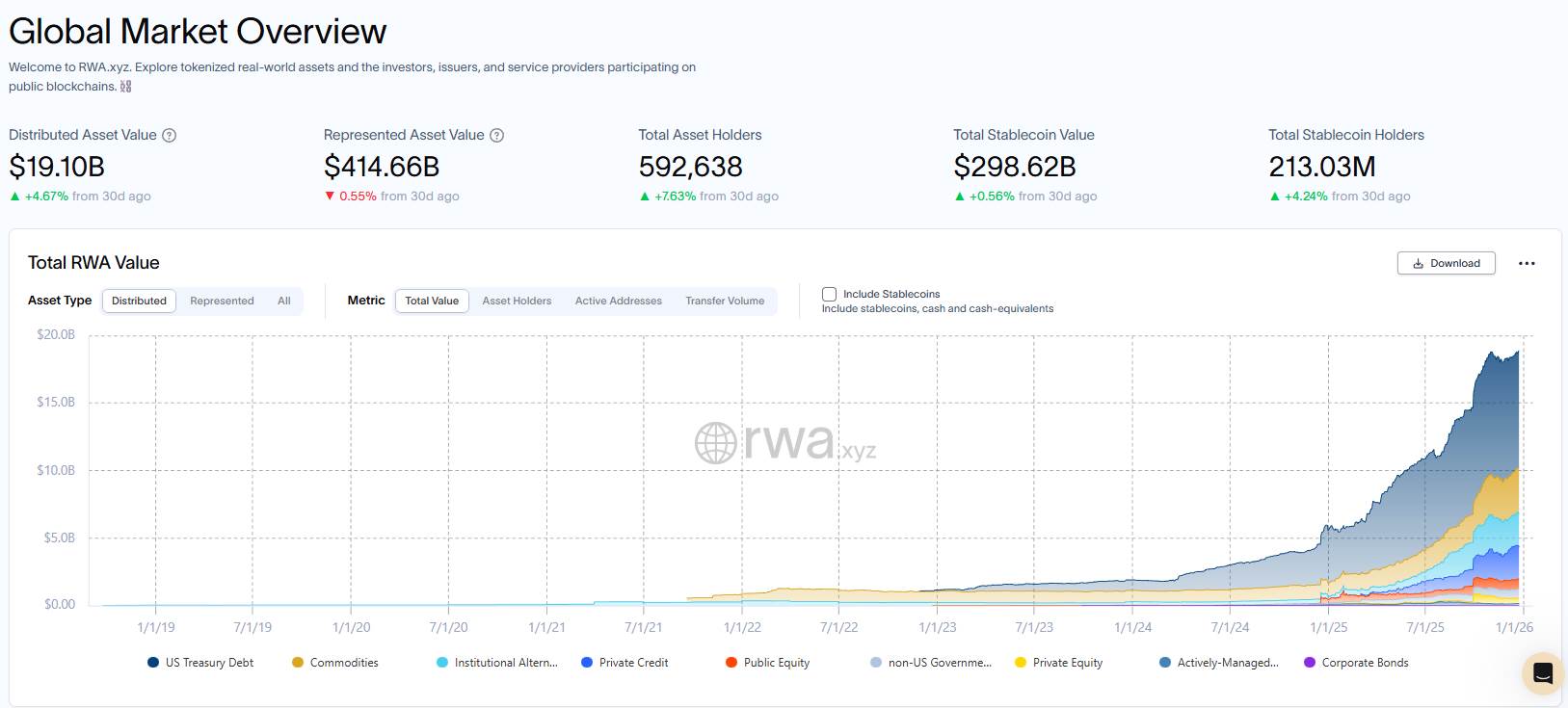
According to RWA.xyz, as of December 25, 2025, the platform reported a distributed asset value of $19.1 billion, representing a total asset value of $414.66 billion. There were a total of 592,638 asset holders, providing a verifiable snapshot of the RWA market at that time.
The same dataset shows that tokenized government bonds have a total value of $9 billion on the blockchain. These bonds represent 62 assets and 59,214 holders. The annualized return over 7 days is 3.82%, making them reliable assets on the blockchain, comparable to traditional cash management tools.
The broader banking environment plays a role in explaining this shift in timing.
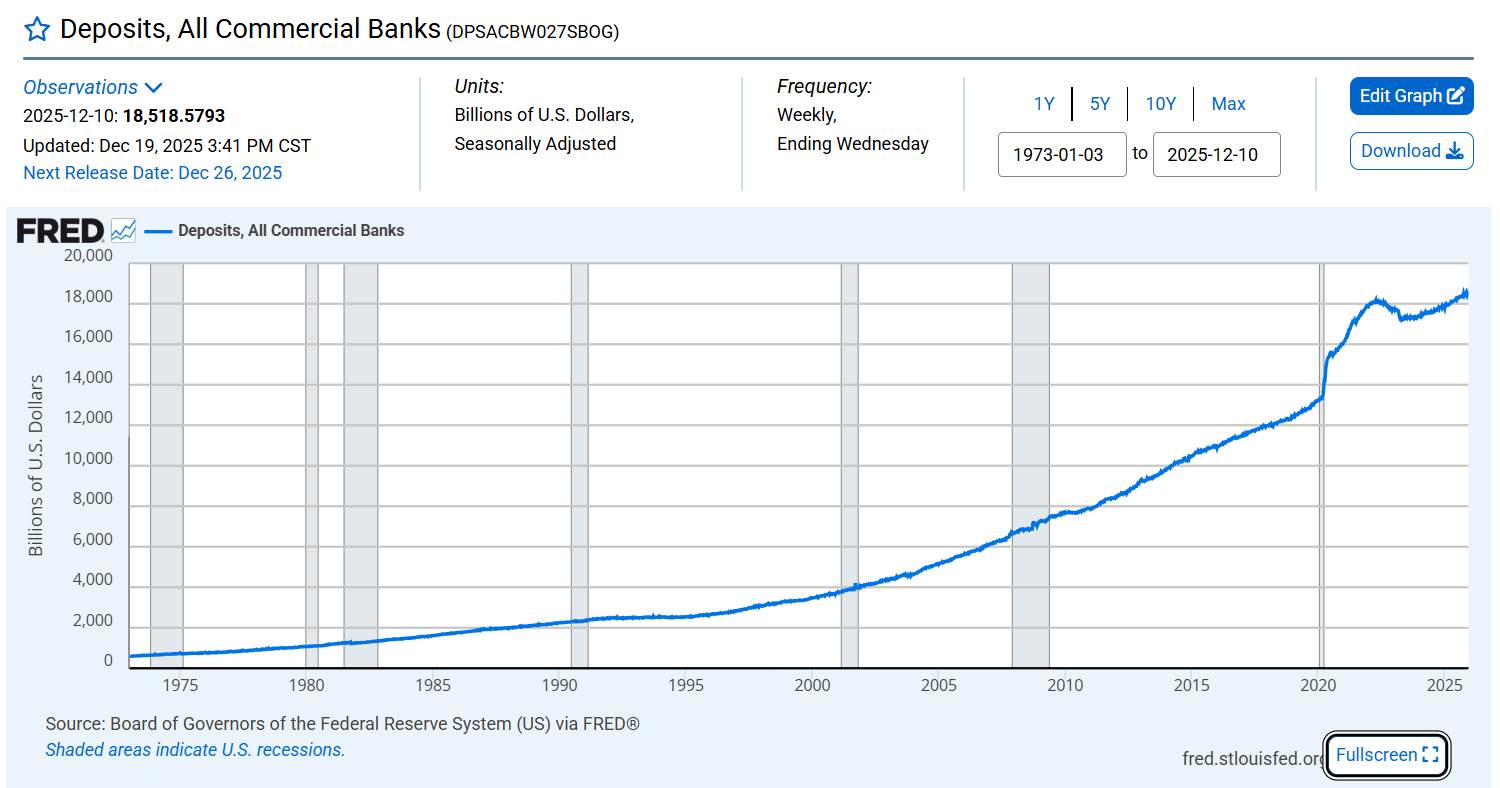
According to Federal Reserve H.8 statistics, as of December 10, 2025, the total deposits of all commercial banks in the United States amounted to $18.5185793 trillion. This highlights the importance of using blockchain-based infrastructure to improve efficiency in settlement and liquidity systems.
In this context, the emergence of deposit tokens and on-chain money market funds can be seen not as a technological experiment, but rather as a structural response to the operational needs of large financial institutions.
From tokenization to financial infrastructure
Overall, JPMD and MONY constitute a coherent institutional framework, rather than isolated products. Deposit tokens convert bank liabilities into 24/7 on-chain settlement tools, while tokenized money market funds provide regulated, low-risk investments within the same blockchain environment. These funds are supported by an expanding pool of tokenized government bonds, which can serve as collateral and liquidity buffers.
From November to December 2025, these developments collectively mark the transformation of RWA – from assets that can be tokenized, to assets that can operate continuously as part of public blockchain financial systems, under institutional control and regulatory oversight.