Exchange Ranking
 Top Exchanges
 24h Volume Ranking
 Popularity Ranking
 Exchange BTC Balance
 Proof of Reserves
 Decentralized Exchanges
 Funding Rate
 Funding Heatmap
 Liquidation Data
 Max Pain
 Long/Short Ratio
 Whale L/S Ratio
 Binance/Okex/Huobi L/S
 Bitfinex Margin L/S
 ETF Tracker
 Solana ETF
 XRP ETF
 Hong Kong ETF
 Bitcoin Treasuries
 Crypto Reversal
 Ethereum Reserves
 HyperLiquid Wallet Analysis
 Hyperliquid Whale Watch
 Large Transactions
 On-chain Movement
 Bitcoin ROI
 Stablecoin Market Cap
 Options Analysis
 News
 Articles
 Economic Calendar
 Features
 Wallet
 Contract Calculator


 Security
 Collections
 Watchlist
 Following
 U
At a time when the stablecoin market is constantly undergoing reshuffling, the rise and fall of BUSD has far exceeded the scope of simply determining the success or failure of a single product. BUSD once grew rapidly thanks to its advantage in liquidity and regulatory support within exchanges. It managed to reshape market order through unified trading pairs and automatic conversions. However, it also exposed structural risks during periods of stricter regulation, leading to its rapid exit from the market. Now, with platforms like FDUSD, BUSD, and United Stables ($U), strategies are clearly shifting towards more subtle forms of aggregation and collaboration. This struggle over liquidity, power, and regulation continues to influence the direction of the stablecoin and crypto markets.

Chapter 1: Passion and Hegemony – The History of BUSD’s “Unified Dominance”
The story of BUSD is not just about the rise and fall of a compliant product, but also about how exchanges attempt to unify market liquidity through administrative means.
1.1 Recognizing the Signs: CZ and Richmond Teo’s Meeting
In 2019, the stablecoin market was a wild west for Tether. At that time, Richmond Teo, as co-founder and CEO of Paxos for Asia, became a key link between New York’s regulatory authorities and Asian crypto giants.
There’s a rumor circulating in the industry that seems false at first glance, but people still tend to believe it: on the eve of the release of BUSD, Paxos posted a tweet to celebrate its status as a compliant platform. Shortly after that, it was reported that Rich Teo and CZ were seen dining together at a high-end restaurant overseas. After that dinner, things changed drastically: Binance’s HUSD gradually lost popularity, while Paxos became the “full-time custodian” of BUSD. CZ handed over Binance’s liquidity to Teo, who then used the “green list” license from the New York State Financial Services Department (NYDFS) to provide Binance with additional security measures.
1.2 A passionate moment: the “exchange rate unification campaign” in 2022
The most “passionate” and controversial moment in BUSD’s history occurred in September 2022. In an attempt to challenge the dominance of USDT and USDC, Binance launched a surprising “liquidity unification” initiative.
Binance announced that existing user balances, along with newly deposited USDC, USDP (Paxos Dollar), and TUSD (TrueUSD), would be automatically converted into BUSD at a ratio of 1:1.
Binance also removed the spot trading pairs for USDC, USDP, and TUSD. This means that while users can deposit USDC in Binance, they will only see and use BUSD in their accounts. However, they can still withdraw USDT and USDC when making withdrawals.
This was a blatant attempt to take control of the liquidity market. By forcing a merger of liquidity sources, BUSD instantly gained the depth of liquidity that was once owned by its competitors. Although Circle, the issuer of USDC, CEO Jeremy Allaire claimed that this would help increase USDC’s liquidity, in reality, USDC’s presence in Binance’s ecosystem was forcibly erased, turning USDC into just “fuel” for BUSD.
This aggressive strategy was highly effective. In November 2022, the market value of BUSD reached a record high of $23 billion, accounting for half of the trading volume on centralized exchanges. That was the most glorious moment for BUSD, and it also marked the peak of Binance’s ambition to establish an independent financial ecosystem.
1.3 Regulatory “Valentine’s Day Massacre”
However, this “unified” situation came to an end on February 13, 2023. The NYDFS stated that Binance’s “Binance-Peg BUSD” token, which was created to be used on the BNB Chain, fell outside Paxos’ regulatory scope, leading to the suspension of its issuance. BUSD’s market value plummeted from its peak of $23 billion, and the empire built through “automatic conversion” collapsed under regulatory pressure.
For Teo, this was undoubtedly a devastating blow. As a architect, he witnessed firsthand how the “child” he raised alongside CZ was forced to cease existence. Paxos was forced to sever its ties with Binance, and Teo went into a period of silence lasting over a year.
But the story didn’t end there. Rich Teo made a dramatic comeback within Trump’s crypto project, World Liberty Financial (WLFI), marking a continuation of his relationship with CZ. Teo is using this new political leverage to create a new compliant stablecoin called USD1. WLFI relies heavily on the liquidity provided by the BNB Chain. It seems like these two old friends are continuing their “liquidity alliance” in a more subtle and indirect way, navigating through the regulatory landscape.
Chapter Two: The Achilles’ Heel – “The Twins” and the Thunder of Regulation
2.1 Deadly Structural Flaws: Binance-Peg BUSD
Behind the glory of BUSD lies a structural flaw that could lead to its collapse. In fact, there are two distinct forms of BUSD in circulation today:
● BUSD issued by Paxos (ERC-20): This is the “compliant BUSD” as defined by Paxos. It is issued on the Ethereum blockchain and is directly regulated by NYDFS. The reserves are stored in secure accounts in the United States.
● Binance-Peg BUSD (BEP-20, etc.): This is a “wrapper token” created by Binance to extend its ecosystem to non-Ethereum chains such as the BNB Chain, Polygon, and Avalanche.
In theory, the mechanism behind Binance-Peg BUSD involves Binance locking up one Paxos BUSD on Ethereum, and then minting one Binance-Peg BUSD on the BNB Chain. However, this “bridge” mechanism relies entirely on Binance’s internal operations, rather than direct management by Paxos. NYDFS’s regulatory authority and “green list” only apply to Paxos BUSD on Ethereum, not Binance-Peg BUSD.
The problem stems from the mismanagement of reserves. Investigations by Bloomberg and other media have revealed that during certain periods between 2020 and 2021, Binance-Peg BUSD holders experienced severe “deposits shortfall” situations, with the deficit reaching up to $1 billion. Although Binance claimed this was merely an “operational delay” rather than a solvency issue, this clearly violated regulatory standards. A stablecoin that claims to be regulated by NYDFS actually has a “shadow version” that operates without any regulation and with chaotic reserve management.
2.2 监管的铁锤:2023年的“情人节屠杀”
BUSD的命运在2023年2月13日戛然而止。在这一天,纽约州金融服务部(NYDFS)发布了一项行政命令,要求Paxos立即停止铸造新的BUSD代币。
监管机构的理由非常明确且致命:Paxos未能对其与币安的关系进行有效监督,特别是关于Binance-Peg BUSD的发行,使得合规的BUSD被用作了未经授权的衍生品的背书工具。NYDFS明确表示:“虽然我们授权了以太坊上的BUSD,但我们从未授权Binance-Peg BUSD。”
与此同时,美国证券交易委员会(SEC)向Paxos发出了Wells Notice,指控BUSD属于“未注册证券”。这一指控的逻辑在于,BUSD不仅仅是一个支付工具,它是币安生态系统盈利机制的一部分(通过Earn理财等产品),因此可能构成投资合同。尽管SEC后来在2024年7月放弃了这一特定调查,但当时的双重打击已足以致命。
2.3 陨落与撤退
“停止铸造”意味着BUSD变成了一个只能赎回、不能增发的“僵尸代币”。对于一个旨在作为流动性媒介的资产来说,这是死刑判决。随着Paxos宣布终止与币安的合作关系,BUSD的市值开始了自由落体。在短短几天内,数亿美元的资金流出;一年内,市值缩水超过90%。
币安被迫进行了一场痛苦的撤退:
● Discontinued trading pairs: Gradually removing the BUSD spot and leveraged trading pairs.
● Stop serving as margin assets: Announced that BUSD will no longer be used as margin assets for contract trading.
● Forced conversion: Users are urged to convert their BUSD holdings into other stablecoins, such as FDUSD.
The once “passionate” stablecoin empire has collapsed under the strict regulations of regulators. Binance has lost one of its key stablecoin assets and is forced to rethink its strategy for stablecoins.
Chapter 3: Transition during the void period and the emergence of FDUSD and BFSUSD
In the early stages after BUSD’s collapse, Binance felt resentful over losing its own stablecoins. Why should it hand over these profits to others? To fill this void, Binance quickly supported First Digital USD (FDUSD). This is a stablecoin issued by Hong Kong-based First Digital Labs.
Binance’s support for FDUSD followed almost the same strategy as when they supported BUSD:
1. Offer “zero commission” trading pairs for FDUSD.
2. Provide a 1:1 lossless conversion from BUSD to FDUSD.
3. Add FDUSD as an option for mining in the Launchpool.
However, FDUSD seems more like a strategic buffer. While it addresses the issue of location relocation from the United States to Hong Kong, it remains a traditional, centralized stablecoin issued by a third party. It doesn’t solve the core problem: if regulatory authorities target the issuer again, Binance remains passive in such situations. Moreover, under an interest rate environment of up to 5% per annum, FDUSD (along with USDT/USDC) allows the issuer to earn all the interest, while users get nothing in return. This approach is outdated in the era of DeFi. The era of new stablecoins has also passed. FDUSD was originally used primarily for participating in Launchpools. However, with the decline in such activities, its value has diminished. Additionally, the scandal involving Justin Sun in April 2025 has posed challenges to FDUSD’s growth. To counter competitors’ “contract position income” features, BFUSD (Binance Futures USD) was created. Binance repeatedly emphasizes that BFUSD is a “reward-based margin asset,” not a true stablecoin. Users who hold BFUSD can earn an APY of 4-5%. This income comes from “delta hedging” strategies. BFUSD cannot be withdrawn; it can only be used as margin in Binance’s contract account. It serves as Binance’s “internal circulation” tool, ensuring that users won’t transfer their funds out of the exchange even during bear markets. It’s essentially an asset appreciation product disguised as a “stablecoin.” Although BFUSD has achieved some success (with a current issuance volume of 1.8 billion), Binance understands that a stablecoin should never be separate from the exchange itself. It must remain a form of “happy beans.”
第四章:United Stables($U)——带来的“惊喜”与新局
如果说BUSD是“排他”的霸权,BFUSD是“对内”的防守,那么最新发布的United Stables($U)则带来了完全不同的惊喜:“兼容”与“未来”。
4.1 不再“造轮子”,而是“吞噬轮子”
与BUSD时期试图消灭USDC不同,$U采取了“元稳定币”(Meta-Stablecoin)的策略。
$U的背后是一个一篮子资产。根据2025年12月18日的发布信息,其储备金包括USDT、USDC和USD1。
延续了BUSD的大一统策略,不管你是USDC,USDT,USD1还是美元,全都成为$U的底层资产,但是对外呈现时是U。通过将流动性割裂的USDT和USDC吸纳进$U的储备池,United Stables试图在BNB Chain上通过算法“统一”这些资产,发行出流动性最好的$U,类比的话可能更接近curveUSD。U是这些稳定币的统一称谓,但是在提现/赎回的时候用户可以选择其他稳定币。
这是一种更高维度的打击——既然我发行的美元你不敢用,那我就把你敢用的美元打包成我的代币。
4.2 惊喜二:草蛇灰线,特朗普概念币USD1入局
United Stables的战略惊喜在还于将USD1纳入了储备资产。(这是特朗普家族加密项目World Liberty Financial(WLFI)发行的稳定币,而该项目的稳定币负责人正是BUSD的老架构师Richmond Teo,不知道有没有这层关系的考量?)
毕竟USD1比起USDC,USDT的体量差了好n个身位,这种支持从外界看来更像是政治投名状。可以预见United Stables为USD1提供了巨大的使用场景(作为$U的底层),毕竟目前USD1的使用场景还是比较局限的。
4.3 惊喜三:为AI而生的货币(The AI Economy)
United Stables明确提出$U是“为AI经济设计的”。
正如United Stables的推文
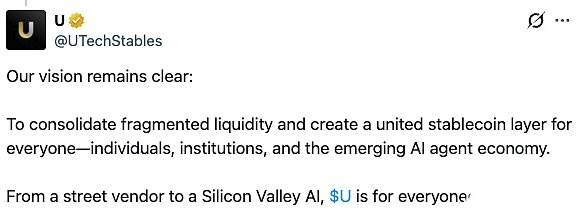
● EIP-3009(无Gas授权):允许“无Gas转账”。这意味着未来的AI代理(Bots)在进行高频微支付时,不需要持有BNB或ETH作为手续费。这解决了机器间经济(M2M)最大的痛点。
● x402委托执行:一种允许智能合约基于特定条件自动执行资金调拨的标准。这为未来的“自主对冲基金”或“供应链自动付款AI”铺平了道路。
截止发稿:U已经有55m的流通量了,是厚积薄发?还是过眼云烟?
尾声:从“霸道”到“大同”走了多少路?
Looking back at the evolution from BUSD to United Stables, we see a remarkable improvement in strategic thinking:
● In the BUSD era, the approach was aggressive and monopolistic. BUSD utilized its position as the exchange leader to eliminate competitors through “automatic conversion,” aiming for absolute market dominance. While this strategy seemed exciting, it also posed significant risks due to potential countermeasures from regulators and competitors.
● In the United Stables era, we learned from our mistakes and adopted a more cooperative approach. We recognized the importance of USDT/USDC as underlying assets, but used $U as our own underlying asset, creating a “superapp” at the top layer.
We also took steps to develop AI-based payments, aiming to enter into markets that would be dominated by machines in the future.
$U isn’t just a new stablecoin; it represents a attempt to redefine the rules of stablecoins after BUSD was brought under regulatory scrutiny. Risks and opportunities coexist here—let’s wait and see!