Exchange Ranking
 Top Exchanges
 24h Volume Ranking
 Popularity Ranking
 Exchange BTC Balance
 Proof of Reserves
 Decentralized Exchanges
 Funding Rate
 Funding Heatmap
 Liquidation Data
 Max Pain
 Long/Short Ratio
 Whale L/S Ratio
 Binance/Okex/Huobi L/S
 Bitfinex Margin L/S
 ETF Tracker
 Solana ETF
 XRP ETF
 Hong Kong ETF
 Bitcoin Treasuries
 Crypto Reversal
 Ethereum Reserves
 HyperLiquid Wallet Analysis
 Hyperliquid Whale Watch
 Large Transactions
 On-chain Movement
 Bitcoin ROI
 Stablecoin Market Cap
 Options Analysis
 News
 Articles
 Economic Calendar
 Features
 Wallet
 Contract Calculator


 Security
 Collections
 Watchlist
 Following
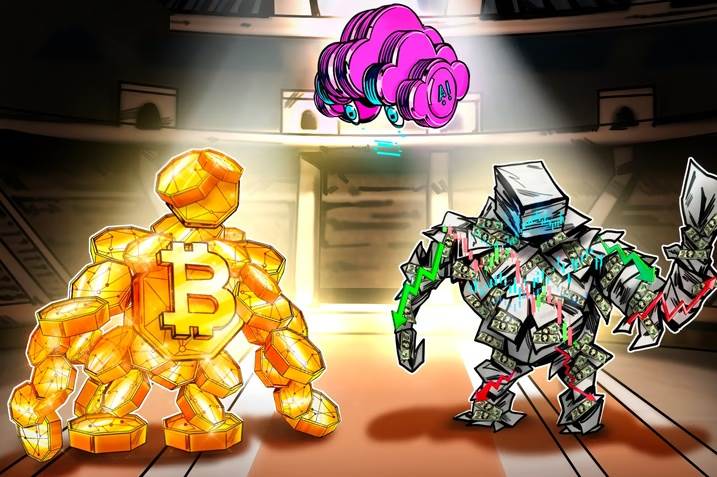
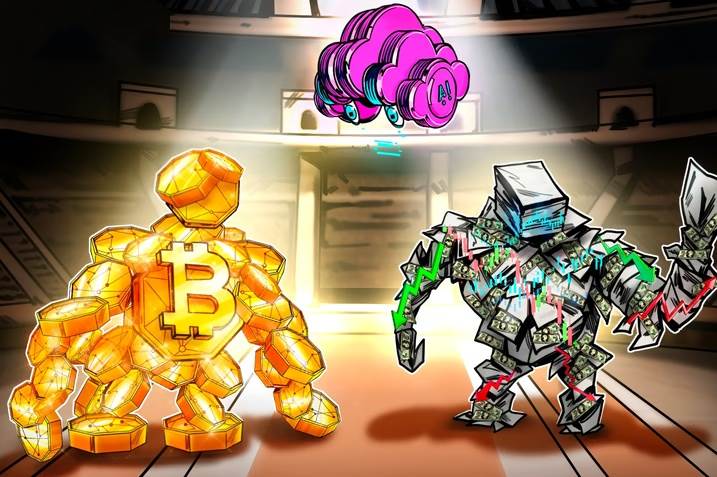
In this era where artificial intelligence is transforming the world, investors often face a controversial decision to make: should they choose a stock market with a long history and well-established systems, or bet on decentralized and imaginative Bitcoin? Both represent different value philosophies and future visions. Stocks rely on corporate growth and economic cycles to survive, while Bitcoin, due to its scarcity and decentralization, is seen by many as “digital gold”. Who will be able to succeed in the next 50 years? Analysts and data are providing intriguing answers, offering investors new perspectives for thought.
Key points
● If stocks can quickly adapt to ever-changing technological and economic demands, they may survive the impact of artificial intelligence.
● It is expected that new industries driven by artificial intelligence, such as robotics, biotechnology, or space exploration, will drive growth. Stocks related to these innovations will have a better chance of surviving amidst the turmoil of innovation.
● As artificial intelligence reshapes labor markets and markets as a whole, there will be a period of chaos. Therefore, the next few years will be spent adapting to new technologies.
● The future of Bitcoin depends on whether it can prove itself as a true value storehouse and eventually become a medium of exchange. Artificial intelligence can facilitate this process, primarily by influencing scalability and transaction processes.
● Bitcoin, as a decentralized system, is not affected by internal political factors. However, human-induced factors can still disrupt its operation. Bitcoin only needs to keep up with new technologies to remain relevant in the future.
No one can predict what will happen in the next 50 years, especially in a financial market that is influenced by so many external factors.
Nevertheless, by analyzing the current state of artificial intelligence and its impact on financial technologies like Bitcoin and stocks, we can determine which investment options are the best for these financial instruments.
The purpose of this article is to help you make more informed decisions and determine whether Bitcoin or stocks are the better choice for your future.
Stocks or Bitcoin: Which Will Survive the Artificial Intelligence Revolution?
Artificial intelligence will accelerate innovation and efficiency in various industries, fields, and aspects of our lives. This will undoubtedly drive improvements in technologies like Bitcoin in terms of efficiency and scale. But what about stocks? Has their investment concept become obsolete? Let’s take a closer look.
What is the situation with stocks?
The world’s first stock market was established in Amsterdam in 1602, when the Dutch East India Company was founded. Initially a marketplace for trading company shares, it quickly became a model for financing and investing. By the end of the 17th century, London had developed its own trading center, while the New York Stock Exchange emerged in 1792, spreading this model across the Atlantic.
Stocks represent ownership in a company, while the stock market is the place where investors buy and sell stocks. The value of stocks can vary depending on the performance of the company and market conditions, including their ability to adapt to technological changes such as artificial intelligence. Over the centuries, companies that embraced technological advancements have been able to withstand economic cycles, wars, and other turbulent times. Looking back, companies that invested in artificial intelligence seem to be destined to face similar challenges. Specifically, companies that utilize artificial intelligence through automation, data analysis, and new business models have the potential to succeed. Historically, market indices like the S&P 500 have achieved annual returns of around 7%-10% over the past few decades, adjusted for inflation. This index tracks the performance of the 500 largest listed companies in the United States and is widely used as a benchmark for the overall stock market. As shown in the table below, its performance has been exceptionally high. What about Bitcoin? Bitcoin is a relatively new invention, created in 2009 by a person under the pseudonym Satoshi Nakamoto. This project was described in a white paper, which detailed the use of blockchain technology for peer-to-peer electronic cash systems. Bitcoin goes far beyond being just an investment tool or a means of value storage. It represents a real revolution in currency management, challenging gold and other financial instruments.The decentralized design of Bitcoin allows it to withstand the centralized control and inflation that is common in traditional monetary systems. With a fixed supply of 21 million coins, its scarcity attracts those who seek protection from currency devaluation. Additionally, the transparency and security provided by blockchain technology align well with the need for verifiable data by artificial intelligence. Over the years, Bitcoin has become a means of value storage and an alternative currency. It continues to strive to become a widely used medium of exchange. As analyst and investor Jordi Visser predicted, “Artificial intelligence accelerates innovation, making listed companies inefficient investment targets.” In the next 50 years, the survival of the stock market as an institution may be challenged. The stock market has a long history, but the disruptive changes brought about by artificial intelligence require immediate adaptation. Companies that fail to adjust risk facing falling behind. This is especially true for tech giants like FAANG stocks (Facebook, Amazon, Apple, Netflix, and Google). Although they are one of the largest investors in the field of artificial intelligence, these companies still need to keep up with rapid developments and effectively apply this technology. Artificial intelligence will also have a significant impact on the stock market, from analyzing vast amounts of data to predicting market trends and automating decision-making processes, thereby achieving faster and more efficient operations. Artificial intelligence will greatly influence investors’ trading and investment strategies.
Overall, artificial intelligence can foster innovation in businesses. However, it also increases the gap between companies that are able to adapt quickly and those that remain stagnant.
How does artificial intelligence affect Bitcoin?
Visser believes that Bitcoin is a better investment for the future, and he compares it to gold, which has existed for thousands of years.
In addition to serving as a means of value storage, Bitcoin also holds significant potential in the future financial landscape. The combination of artificial intelligence and blockchain could revolutionize traditional financial systems, bringing more capital and participants to the digital economy.
Artificial intelligence has the potential to improve the security and trading strategies related to Bitcoin. By using automated tools, enhanced data analysis, and market pattern predictions, cryptocurrency transactions can be streamlined. All these changes could lead to higher system efficiency.
Artificial intelligence can also predict the optimal times for mining activities, thereby reducing costs and maximizing output. This would improve the efficiency of Bitcoin mining and resource allocation. Since artificial intelligence can detect existing or impending failures, system maintenance will be improved, leading to increased overall reliability.
However, Bitcoin faces regulatory risks, scalability issues, and volatility, which may deter investors who prefer more predictable and stable investment instruments like stocks.
The integration of artificial intelligence and blockchain could usher in a new era for Bitcoin. By creating a more intuitive and secure ecosystem, Bitcoin could become more attractive than stocks, which remain stagnant over time.
Which of these technologies will survive in the next 50 years?
It’s almost impossible to predict what will happen in the next 50 years. Both Bitcoin and stocks have their own unique advantages and disadvantages, and their future depends on economic, technological, and social changes.
If the stock market can adapt to an economy driven by artificial intelligence, then it is likely to continue to exist. Investors can reduce the risk of individual company failures by investing in diversified portfolios (such as index funds), as these portfolios seem more secure. Stocks in industries like robotics, biotechnology, space exploration, and artificial intelligence may perform better than assets with less emphasis on technology.
The emergence of quantum computing is often discussed in connection with Bitcoin’s security model. Although most experts believe that its risks remain theoretical and not yet realized, its impact could be either positive or negative, depending on the direction of technological development and how Bitcoin’s network adapts to it. If only a few entities can use advanced quantum AI systems early on, then centralized mining could become a concern.
On the other hand, this combination can improve Bitcoin’s security and network optimization by improving transaction processing, wallet security, or blockchain analysis, thereby enhancing Bitcoin’s efficiency and user experience. As long as the Bitcoin community remains ahead in terms of resistance to quantum upgrades, its overall impact could be positive.
As decentralized finance becomes increasingly popular in the investment sector, Bitcoin has also gained a competitive edge over gold. As a result, it is becoming a more superior means of value storage, and it is encouraging traditional markets to shift their funds into digital finance.