Exchange Ranking
 Top Exchanges
 24h Volume Ranking
 Popularity Ranking
 Exchange BTC Balance
 Proof of Reserves
 Decentralized Exchanges
 Funding Rate
 Funding Heatmap
 Liquidation Data
 Max Pain
 Long/Short Ratio
 Whale L/S Ratio
 Binance/Okex/Huobi L/S
 Bitfinex Margin L/S
 ETF Tracker
 Solana ETF
 XRP ETF
 Hong Kong ETF
 Bitcoin Treasuries
 Crypto Reversal
 Ethereum Reserves
 HyperLiquid Wallet Analysis
 Hyperliquid Whale Watch
 Large Transactions
 On-chain Movement
 Bitcoin ROI
 Stablecoin Market Cap
 Options Analysis
 News
 Articles
 Economic Calendar
 Features
 Wallet
 Contract Calculator


 Security
 Collections
 Watchlist
 Following
 ETH
In late December 2025, BitMine invested approximately $219 million in ETH into Ethereum staking contracts. At the same time, they chose to maintain a larger amount of unstaked assets. This practice of “locking only a portion” of their assets quickly sparked discussions in the market. Chain-level data shows that the ETH staking rate reached near historical highs at the end of the year. The participation of enterprise-level investors is quietly changing the supply-demand structure: Staking involves sacrificing short-term liquidity in exchange for long-term returns and influence within the network. When such decisions appear on a company’s balance sheet, they convey signals that are no longer purely bullish or bearish—rather, they indicate that institutions are revaluating Ethereum as a long-term settlement layer and income asset.

Chain-level transaction records and funding flows
According to chain-level transaction information shared by the community account TedPillows, BitMine’s associated wallet transferred a large amount of ETH into staking addresses within a few hours. Multiple transfers occurred during this period, including around 16,992, 20,768, and 24,544 ETH. Together, these transfers represent an investment of approximately $219 million.
This approach of making gradual investments is common among institutions when executing large-scale chain-level operations. It helps reduce the risk of failure or delays in individual transactions, while also facilitating internal accounting and tracking of funds.
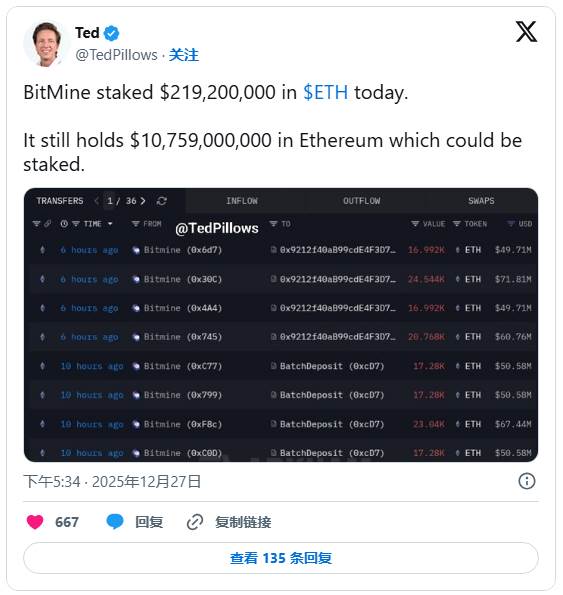
What is more notable is that BitMine is also mentioned as having a much larger stake in ETH. According to the announcement, the value of the ETH it holds is approximately $10.759 billion, and it is possible that this stake could increase in the future. If such companies begin to treat staking as a regular method of managing capital, the impact on the market will not only be limited to short-term changes in supply, but investors will also start to re-evaluate their motivations for holding ETH based on “sustainable returns” and “long-term lock-ups”.
The contraction of supply and the trend of long-term holding have significant implications for the market.
Staking behavior directly alters the liquidity structure. When ETH is locked into the protocol, short-term tradable supply decreases, and market depth may become less dense during certain periods. Additionally, prices become more sensitive to fluctuations in demand. Over a longer period, if stakers include enterprises in their balance sheets, it means that ETH begins to meet the needs for “fixed-income assets”.
This demand isn’t based on daily fluctuations, but rather on a comprehensive assessment of factors such as network security, protocol revenue, staking returns, and usage growth.
As news about BitMine’s staking activities spreads, TomLee also expresses optimism regarding Ethereum. According to videos circulating on X, he suggests that Ethereum’s price could rise from around $3,000 at the beginning of 2026 to $7,000 or even $9,000. He also believes that if the Ethereum network becomes competitive in the global payment ecosystem, it could potentially reach $20,000.
The core of such arguments isn’t simply chasing market trends, but rather linking the reasons for价格上涨与支付结算机制、规模化应用以及金融基础设施的发展联系起来。 The goal is to remove Ethereum from the category of speculative assets and turn it into a settlement layer that can be utilized by businesses and institutions.
The valuation logic centered on payment and settlement mechanisms
. TomLee’s arguments focus on scale, settlement capabilities, and practical applications. He argues that if Ethereum can handle large transactions reliably, while meeting expected enterprise-level standards in terms of cost and speed, then the market will be more likely to see it as a financial infrastructure, rather than just a speculative asset.
This perspective emphasizes adoption rates and network effects, especially the expansion of basic needs such as exchanges, stablecoin issuers, and tokenization platforms. These factors will drive up the demand for block space and settlement services, thereby further enhancing the value of the network and the demand for assets.
Currently, the market is examining whether Ethereum’s ecosystem can extend beyond transactions and DeFi to include payment and settlement scenarios within enterprises. Ultimately, this will boil down to factors like cost structure, throughput, user experience, and predictability. Global payments require systems that are fast, cost-effective, scalable, and reliable at an engineering level.
If Ethereum continues to improve in these areas, then the narrative of enterprise-level staking and long-term investment will become more viable. Otherwise, optimistic expectations may have to be adjusted due to temporary market fluctuations.
Additionally, prominent investors are optimistic about Bitcoin’s Layer 2 projects, believing that they could potentially achieve a hundredfold increase in value during the next bull market.