Exchange Ranking
 Top Exchanges
 24h Volume Ranking
 Popularity Ranking
 Exchange BTC Balance
 Proof of Reserves
 Decentralized Exchanges
 Funding Rate
 Funding Heatmap
 Liquidation Data
 Max Pain
 Long/Short Ratio
 Whale L/S Ratio
 Binance/Okex/Huobi L/S
 Bitfinex Margin L/S
 ETF Tracker
 Solana ETF
 XRP ETF
 Hong Kong ETF
 Bitcoin Treasuries
 Crypto Reversal
 Ethereum Reserves
 HyperLiquid Wallet Analysis
 Hyperliquid Whale Watch
 Large Transactions
 On-chain Movement
 Bitcoin ROI
 Stablecoin Market Cap
 Options Analysis
 News
 Articles
 Economic Calendar
 Features
 Wallet
 Contract Calculator


 Security
 Collections
 Watchlist
 Following
In an era where encrypted assets and traditional markets fluctuate simultaneously, more and more funds are beginning to reconsider the “quality of returns” rather than just the absolute increase in value. Comparing hedge funds simply to index funds is like trying to measure ocean-going ships using standards for sprinting competitions—it’s not appropriate. While low-cost indexes offer only exposure to a single market, high-fee hedge funds provide risk-adjusted returns that are stable and less correlated with market movements. This is precisely why institutional investors are still willing to pay for “manageable returns” during periods of high volatility in the crypto market.

Where does this demand come from?
A common criticism is: “This year, the S&P index increased by 17%, while Castle Funds only made a 9.3% profit.” For most hedge funds, this criticism might hold true, as many funds merely capture market fluctuations without adding any real value to their products.
But this completely misunderstands the product strategy of top funds like Citadel, Millennium, and Point72. Their goal isn’t to outperform the broader market; that’s not even their mission. Comparing a fund designed to be completely uncorrelated with a 100% stock benchmark is like arguing that an insurance policy can’t make money.
When managing hundreds of billions in pension funds, 60 billion of those funds are already invested in stocks. You don’t lack exposure to stocks—in fact, you have too many stocks. What you really need is something that can increase in value when the stock market falls (or at least not fall along with it). What you need is risk diversification. More precisely, what you want is something that can continue to grow in value regardless of market conditions, and that outperforms cash investments.
Sounds great, doesn’t it? But it seems expensive, right? That’s true! True risk diversification is extremely expensive because it’s extremely rare.
Who are the competitors?
The long-term Sharpe ratio of the S&P 500 is approximately 0.35-0.5, which means that for every 1% of market volatility, investors can obtain an additional 0.35%-0.5% of returns. Top global hedge funds have Sharpe ratios of 1.5-2.5 or even higher.
We’re talking about maintaining a Sharpe ratio of around 2 over several decades. This not only leads to returns that aren’t affected by market volatility, but the volatility itself is also much lower. These companies experience minimal drawdowns and can recover quickly.
Hedge funds aren’t just more expensive versions of the same products; they represent a completely different category. Top hedge funds offer two advantages that other ETFs/index funds don’t have:
● Factor-neutral
● High Sharpe ratio
Why is factor-neutral so valuable?
To understand the value of factor-neutral strategies, let’s look at this formula:
Return = Alpha + Beta × Factor return + Random error
● Alpha = Returns brought by individual skills
● Beta = Exposure to systematic factors
● Factor return = Return on market factors
● Random error = Individual differences
The Beta component can be replicated using publicly available factor portfolios. What can be replicated should be priced accordingly. Replication is relatively inexpensive: 0.03%-0.09% for market factors, and 0.15%-0.3% for style factors.
Alpha represents the amount remaining after all replicable components are taken out. By definition, Alpha cannot be synthesized through exposure to factors. This non-replicability is the basis for premium pricing.
Key insights: Beta is inexpensive because factor returns are public goods, with unlimited capacity. When the market rises by 10%, all holders benefit equally, with no exclusivity. S&P’s returns do not decrease due to increased buying volume.
Alpha is expensive because it operates as a zero-sum game, with limited capacity. For every dollar earned by Alpha, someone else loses one dollar. The number of situations where Alpha is generated is limited, and this will diminish as more capital flows into the market. A strategy with a Sharpe ratio of 2 at a scale of 100 million dollars may only yield an average of 0.8 after scaling up to 1 billion dollars, as large-scale transactions can affect prices.
Factor-neutral returns (all systematic exposures to Beta are approximately zero) are the only truly non-replicable source of return. This is why premiums are reasonable—not because of the returns themselves, but because these returns cannot be obtained through other means.
The magic of high Sharpe ratios
The compound effect of high Sharpe ratios becomes apparent over time. A portfolio with both expected returns of 7% but different volatilities (16% vs. 10%) will yield vastly different results after 20 years. A low-volatility portfolio has half the probability of loss, providing better protection against downturns.
For institutions with stable expenses, this level of reliability justifies paying a premium.
Volatility not only affects the investment experience but also erodes long-term returns mathematically:
Geometric mean return ≈ Arithmetic mean return – (Volatility²/2)
This phenomenon is known as “volatility drag”. A portfolio with high volatility will inevitably underperform a low-volatility portfolio, even when the expected returns are the same.
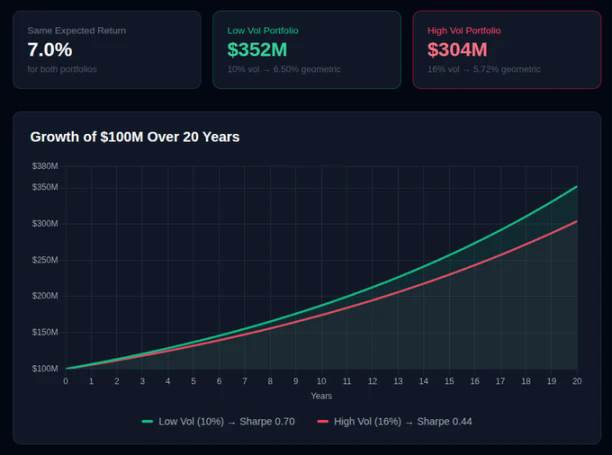
The low-volatility portfolio ended up earning an additional $48 million, with a 16% increase in net worth. This is not a matter of risk preference, but rather a mathematical fact: volatility erodes wealth over time.
Think like professional investors.
Why are institutions willing to pay a 100-time premium for factor-neutral funds? Understand this by studying portfolio mathematics.
Suppose we have a standard portfolio: 60% stocks + 40% bonds. Expected return: 5%, volatility: 10%, Sharpe ratio: 0.5. Not bad, but the risk associated with stocks is quite high.
Now, let’s add a 20% factor-neutral hedge fund: expected return: 10%, volatility: 5%, Sharpe ratio: 2.0. This fund has no correlation with stocks or bonds at all. The new portfolio consists of 48% stocks, 32% bonds, and 20% hedge funds.
As a result, the expected return increased to 6%, volatility dropped to 8%, and the Sharpe ratio rose to 0.75 (an increase of 50%).
This is just one fund. What if we could find two or three unrelated top-tier funds? Now you understand why such assets are so valuable.
Institutions are eager to invest in top-tier funds not because they don’t know that index funds are cheap, but because they understand the mathematics behind portfolio management. What matters isn’t the cost, but the efficiency of the portfolio as a whole.
How to select funds like institutions do
Suppose you want to find products that are similar to top-tier hedge funds, but you can’t access Citadel/Millennium/Point72. You have plenty of time to research. How should you filter through these options?
Pay attention to these points:
● Consider long-term exposure to factors:It’s not just about the current situation; we need to look at rolling data over several years. A truly neutral fund should have a low exposure to market, industry, and style factors. If the market beta fluctuates around 0.3, then it’s simply a form of factor-based timing strategy—it might be useful, but it certainly isn’t the product you want to buy.
● Stress tests: In a bull market, no one seems to be related to the market. We need to consider crisis periods like 2008, early 2020, and 2022. If the drawdown coincides with market movements, then it isn’t truly neutral; there’s an underlying exposure to market factors.
● Look at long-term Sharpe ratio: A high short-term Sharpe ratio may be due to luck, but maintaining a high Sharpe ratio over the long term requires more than just luck. Sharpe ratio is essentially a measure of the statistical significance of returns.
● Give up the idea of replicating other funds: Factor ETFs can provide exposure to factors like value and momentum, with annual costs ranging from 0.15% to 0.5%. But these are not the same products. Factor ETFs are related to specific factors, while neutral funds aren’t related at all. This correlation structure is what matters most. You need to look for actively managed products or alpha strategies.
Recognizing scarcity
After conducting this research, you might find that there are zero products that fully meet all the criteria!
Seriously, maybe you can find similar products, but it’s very unlikely that they can accommodate the scale of institutional investments. For sovereign funds worth trillions, investing just a few hundred million isn’t meaningful.
You will eventually understand that only a very few companies can maintain a Sharpe ratio of over 2, even when operating on a scale of over 50 billion units, and across multiple cycles. It’s extremely difficult to achieve such a feat. Being able to combine factor neutralization with large-scale operations and long-term stability is a rare combination. This scarcity makes the premium paid for these investments seem reasonable to those who invest in them.
Finally, paying a 50-100 times higher premium for top-tier factor-neutral hedge funds is supported by solid portfolio management techniques—something that critics often overlook. Institutional investors aren’t stupid. The real problem might be that too many funds charge high fees, but offer beta values that are only worth 0.15% per year.
(Note: The funds report net returns after deducting all fees; no additional deductions are required.)