Exchange Ranking
 Top Exchanges
 24h Volume Ranking
 Popularity Ranking
 Exchange BTC Balance
 Proof of Reserves
 Decentralized Exchanges
 Funding Rate
 Funding Heatmap
 Liquidation Data
 Max Pain
 Long/Short Ratio
 Whale L/S Ratio
 Binance/Okex/Huobi L/S
 Bitfinex Margin L/S
 ETF Tracker
 Solana ETF
 XRP ETF
 Hong Kong ETF
 Bitcoin Treasuries
 Crypto Reversal
 Ethereum Reserves
 HyperLiquid Wallet Analysis
 Hyperliquid Whale Watch
 Large Transactions
 On-chain Movement
 Bitcoin ROI
 Stablecoin Market Cap
 Options Analysis
 News
 Articles
 Economic Calendar
 Features
 Wallet
 Contract Calculator


 Security
 Collections
 Watchlist
 Following
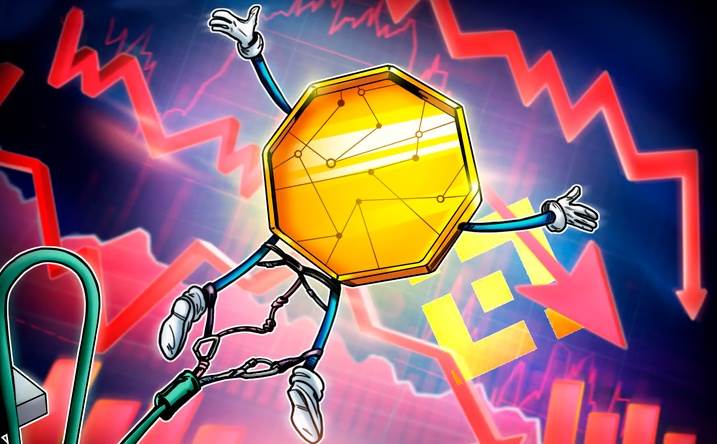
In today's highly volatile加密市场, some altcoins have experienced temporary drops to zero on Binance, causing surprise and concern among investors. Coins like ATOM and IOTX saw their prices instantly drop to zero during Friday’s market fluctuations due to limited liquidity and insufficient order book depth. However, these coins still retain some value on other trading platforms. This reminds us that exchange liquidity and matching mechanisms can amplify market volatility. An instant price drop does not mean that the asset is worthless. Investors should consider both platform risks and market depth, rather than making decisions based solely on price movements of a single exchange.
Key points:
Some altcoins, including Cosmos’ ATOM token, experienced temporary drops to near-zero levels on Binance during Friday’s crypto market crash.
These altcoins still have real market value on other centralized exchanges.
On October 10th, the crypto market experienced its worst decline since the FTX collapse. The total market value decreased by approximately 850 billion within a few hours.
Bitcoin (BTC) fell by about 10%-15%, from a high of nearly $124,000 to a low of $105,000. Altcoins suffered even worse losses, especially those traded on Binance. Many altcoins plummeted by 99.99%-100% in just a few minutes.
This includes tokens such as Cosmos’ ATOM, IoTeX’ IOTX, and Enjin’ ENJ. The prices of these coins on Binance briefly dropped to zero.
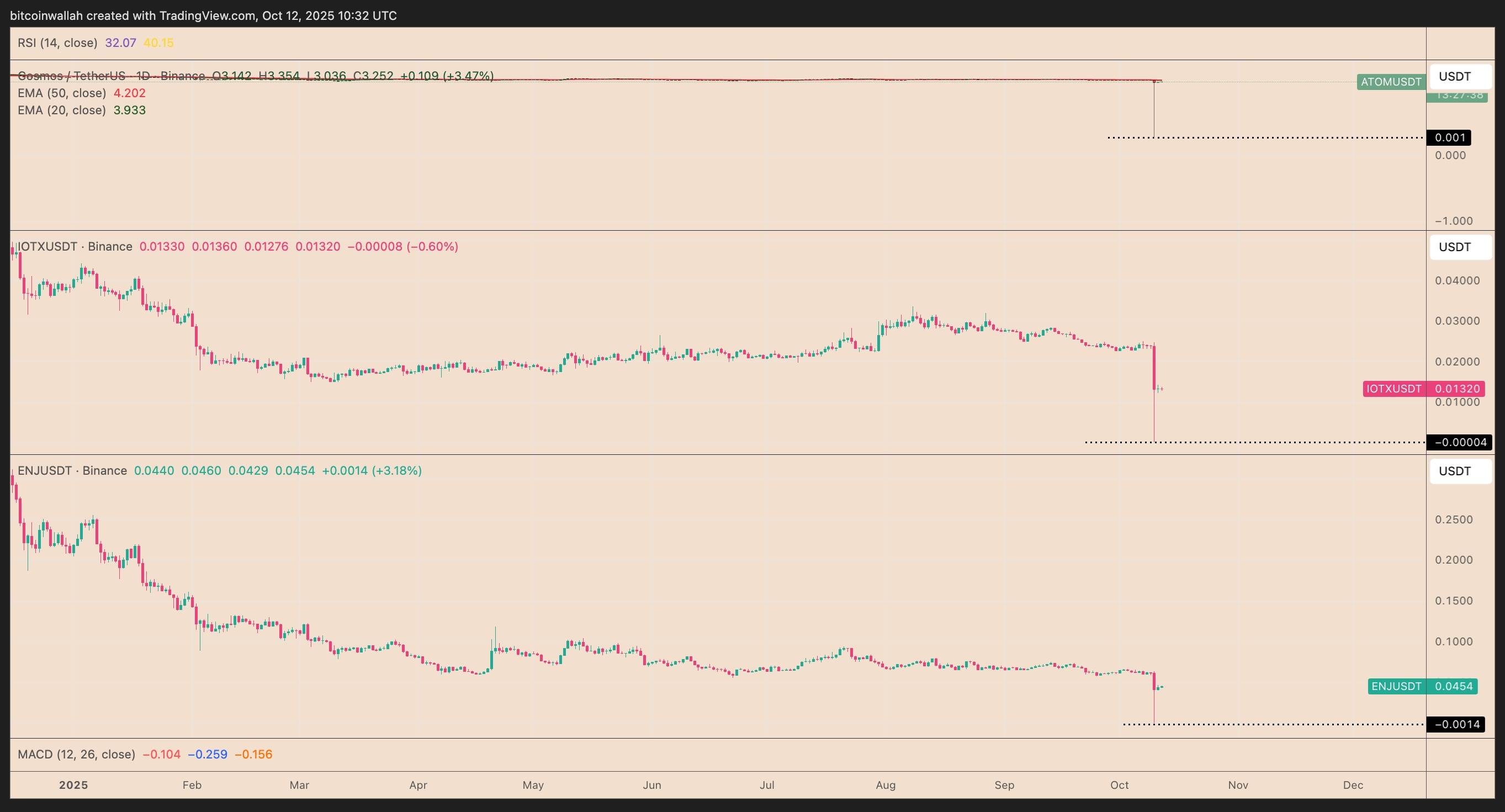
ATOM/USDT, IOTX/USDT, ENJ/USDT's daily charts on Binance. Source: TradingView
In comparison, ATOM fell by 53% on competing exchanges, while IOTX and ENJ dropped by 46% and 64.5%, respectively. However, these tokens did not lose all of their value elsewhere—this phenomenon only occurs on Binance.
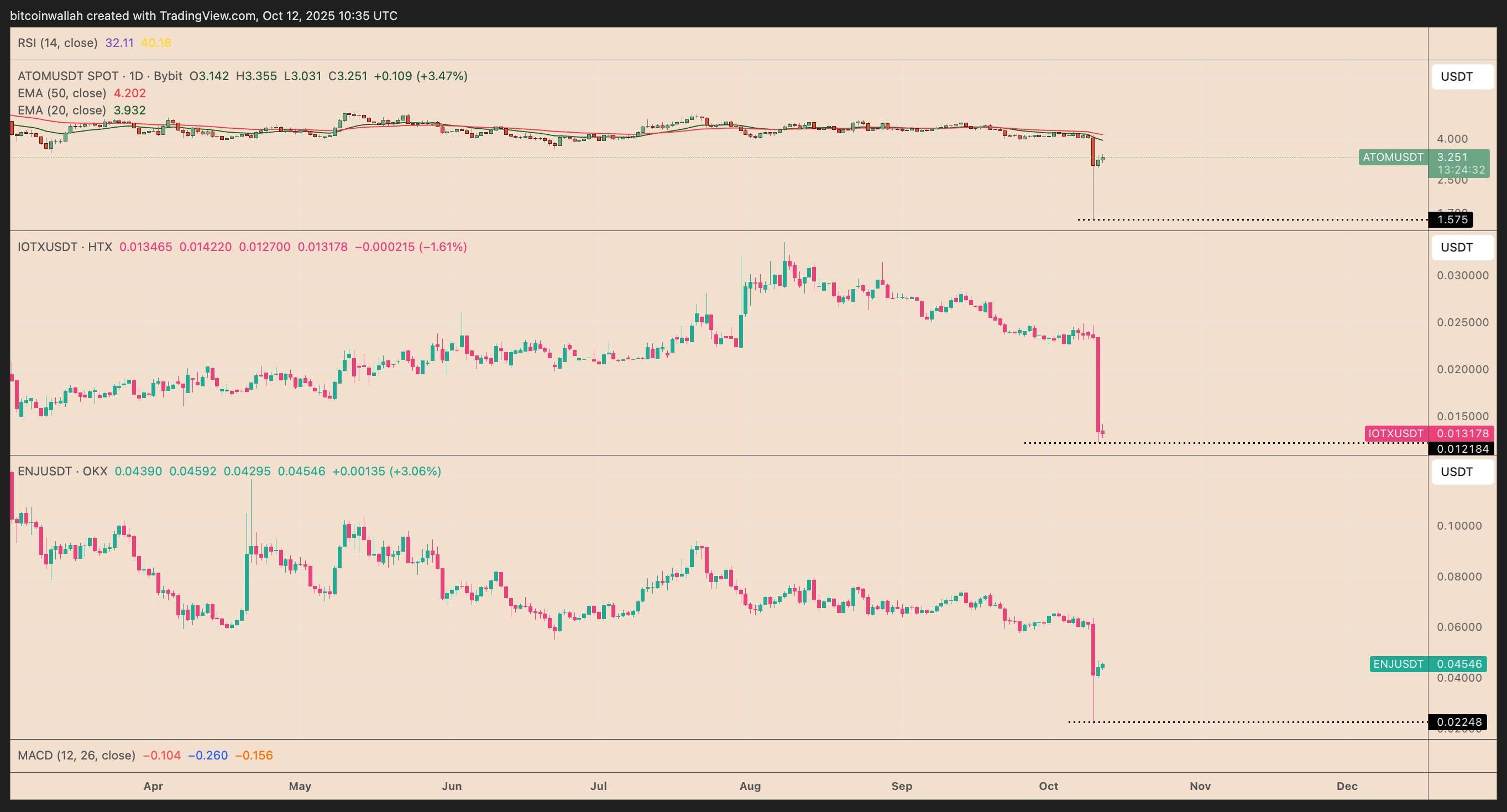
A comparison of ATOM/USDT, IOTX/USDT, and ENJ/USDT's daily charts across various exchanges. Source: TradingView
Why have these altcoins lost all of their value?
During the sharp decline from October 9th to 10th, approximately 20 billion cryptocurrencies were liquidated, which is 20 times higher than during the market crash due to the COVID-19 pandemic in 2020. Over 1.6 million traders had their positions liquidated due to margin calls.
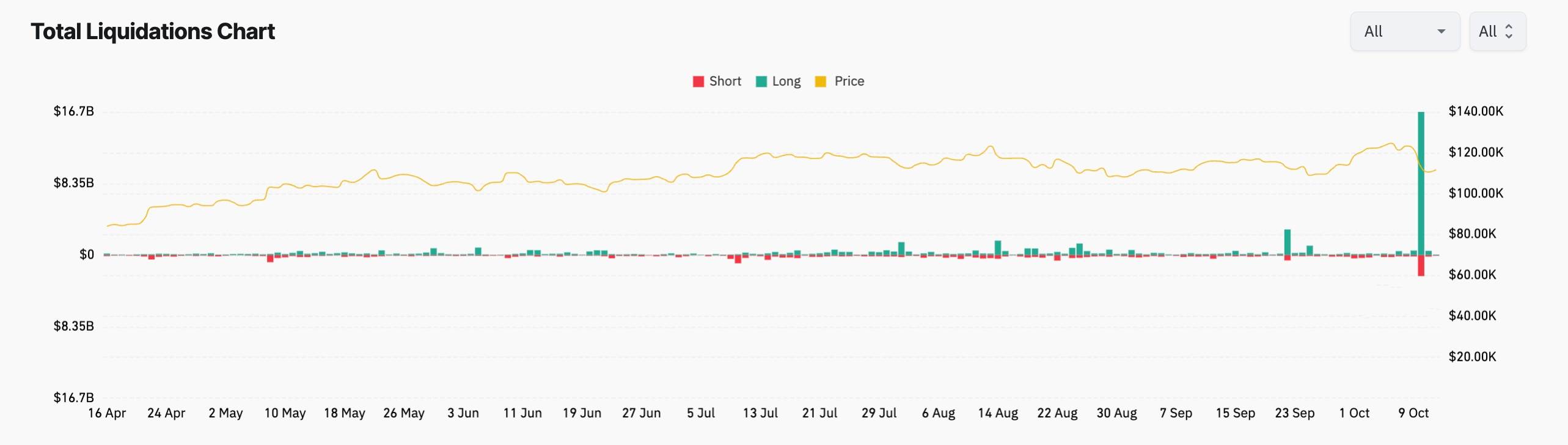
Chart showing total crypto market liquidations. Source: CoinGlass
Many traders used leverage (borrowing money) on Binance to increase their profits.
Arthur Hayes, co-founder of BitMEX, said that major exchanges like Binance are “liquidating collateral related to margin positions,” which has exacerbated the sell-off.
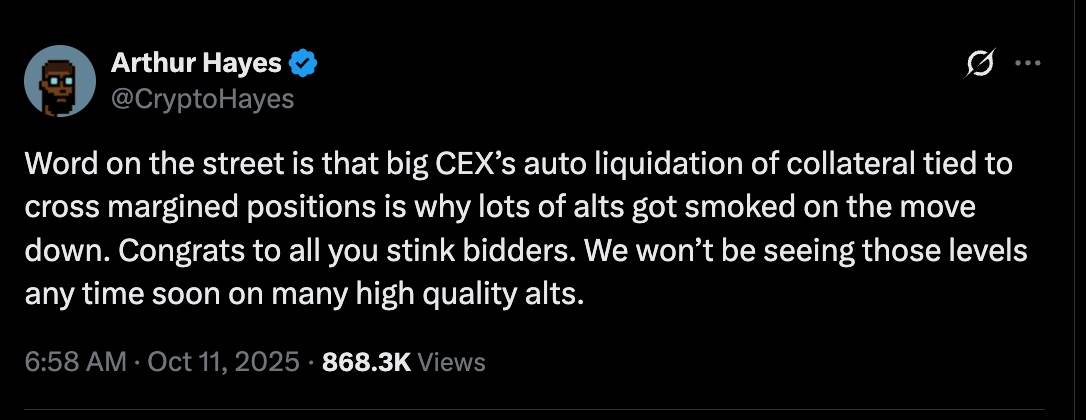
Source: X
Simply put, when prices start to fall, Binance automatically sells off the altcoins used as collateral to cover losses. This leads to further selling pressure, causing prices to fall even faster.
As prices plummeted, Binance’s trading system became overloaded. Some users reported that their accounts were frozen, stop-loss orders weren’t executed, and transactions were delayed.
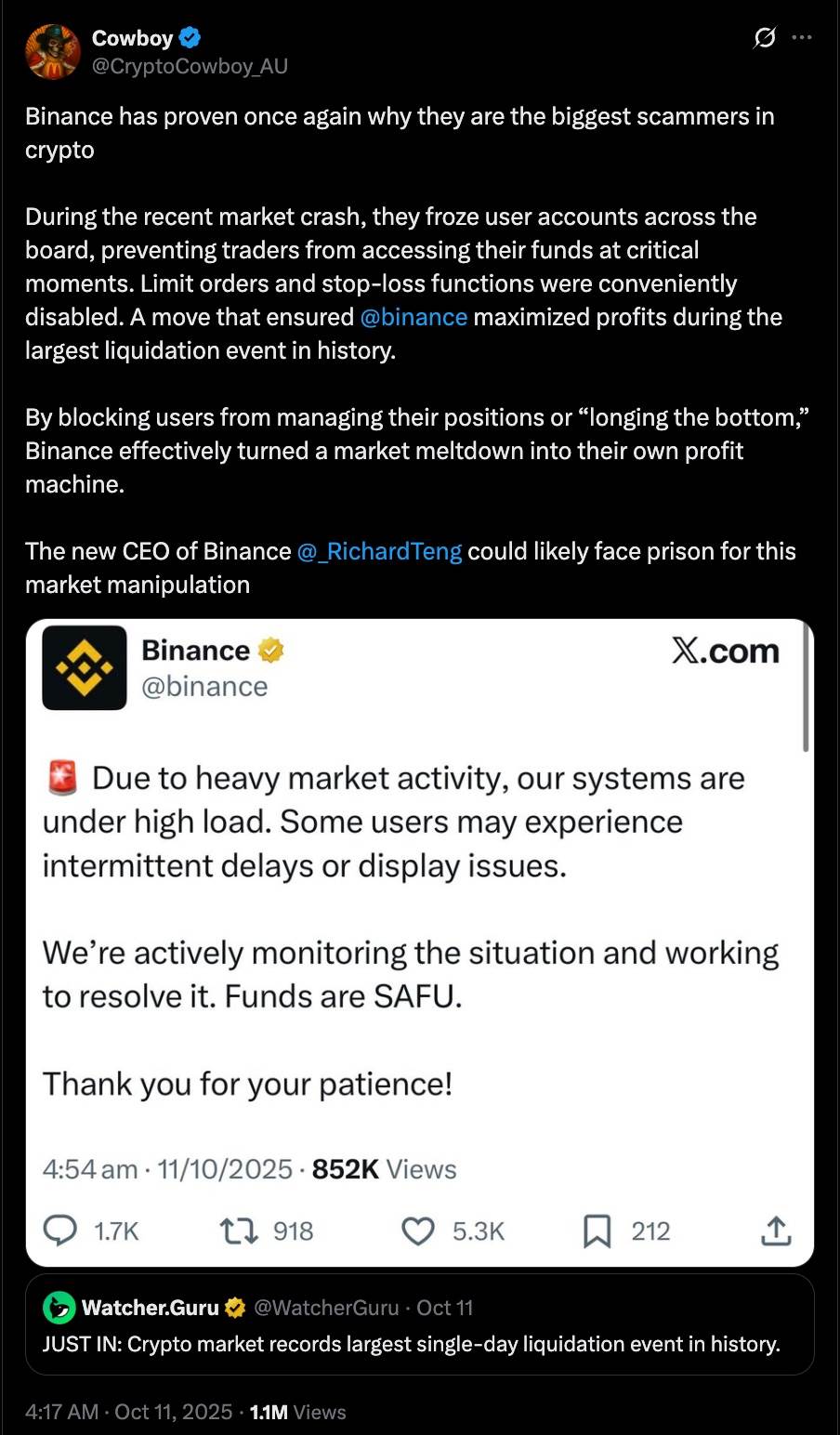
Source: X
At the same time, some analysts suggest that due to these delays, market makers like Wintermute have withdrawn their funds from Binance.
This means that there was no bidding activity for certain tokens during that period, resulting in the system displaying prices of those tokens as “zero”. However, these tokens still had value elsewhere.
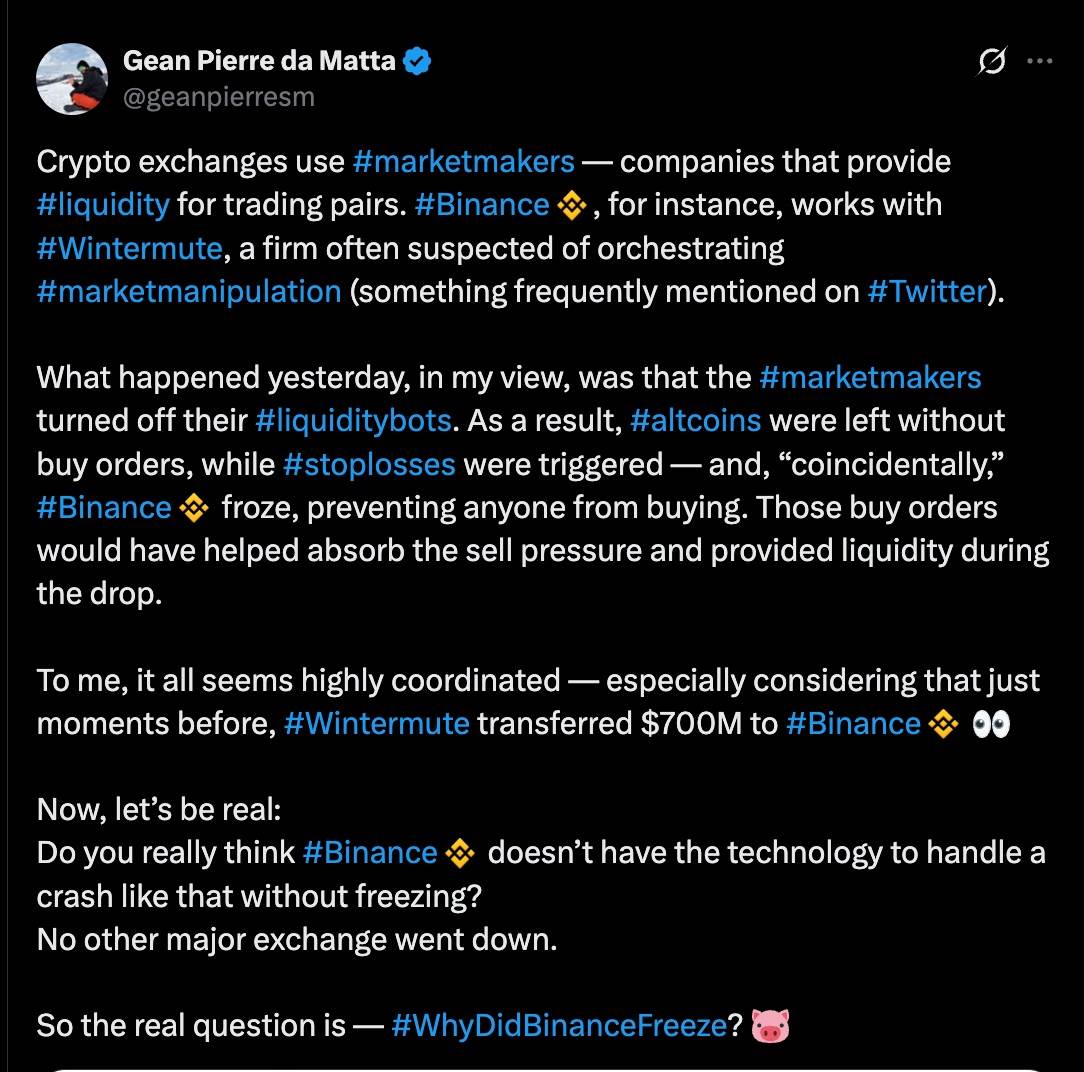
Source: X
A similar “flash crash” occurred in 2017, when Ethereum’s price dropped briefly to $0.10 on GDAX due to a surge in automated sell orders.
Binance issued an apology statement.
Binance’s co-founder, He Yi (Chief Customer Service Officer), also issued an apology, stating that “some users encountered problems during transactions due to extreme volatility and increased platform traffic.”
CEO Richard Teng also apologized, saying:
“I am deeply sorry for anyone who was affected by this situation. We are not seeking excuses—we will listen carefully, learn from this experience, and commit to doing better in the future.”
Binance stated that they will compensate for any verifiable losses related to platform or system failures. They also clarified that losses caused by price fluctuations or unrealized gains are not covered by their compensation policies.