Exchange Ranking
 Top Exchanges
 24h Volume Ranking
 Popularity Ranking
 Exchange BTC Balance
 Proof of Reserves
 Decentralized Exchanges
 Funding Rate
 Funding Heatmap
 Liquidation Data
 Max Pain
 Long/Short Ratio
 Whale L/S Ratio
 Binance/Okex/Huobi L/S
 Bitfinex Margin L/S
 ETF Tracker
 Solana ETF
 XRP ETF
 Hong Kong ETF
 Bitcoin Treasuries
 Crypto Reversal
 Ethereum Reserves
 HyperLiquid Wallet Analysis
 Hyperliquid Whale Watch
 Large Transactions
 On-chain Movement
 Bitcoin ROI
 Stablecoin Market Cap
 Options Analysis
 News
 Articles
 Economic Calendar
 Features
 Wallet
 Contract Calculator


 Security
 Collections
 Watchlist
 Following
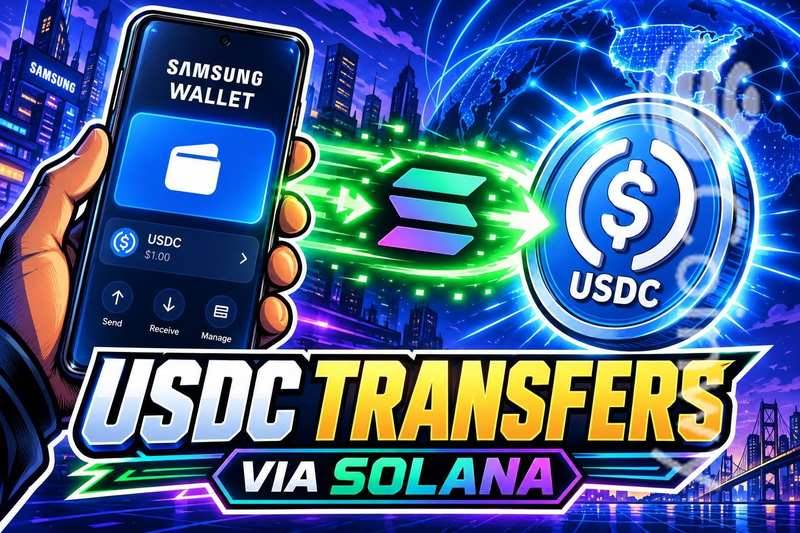
Samsung Wallet may support cross-border USDC transfers based on the Solana network
It is reported that Samsung Wallet is increasing support for cross-border USDC (USD Coin) transfers routed through the Solana blockchain. The move will allow one of the world's most widely used mobile wallet platforms to directly connect to high-speed cryptocurrency payment networks. If the message is confirmed, Samsung's consumer wallet interface will establish a connection with the USDC, a dollar-linked stablecoin issued by Circle, and use Solana as the settlement network.
Samsung Wallet and Solana: What is the announcement?
It is rumored that this integration will allow Samsung Wallet users to use Solana as the underlying blockchain to send USD Coin (USDC) across borders. Currently, Samsung Wallet already supports multiple payment and identification functions on Android devices. Previously, Samsung had disclosed its intention to support stablecoins, so this was seen as a continuation of its established strategic direction rather than a complete innovative breakthrough.
USDC is a fully reserve, dollar-pegged stablecoin issued by Circle and regulated by the U.S. currency transmission framework. In this arrangement, Solana acts as a blockchain channel, responsible for handling the actual flow and settlement of tokens between wallets. This combination positions the integration as a consumer-facing payment product rather than a speculative cryptocurrency feature.
As of now, information on implementation details has not been confirmed, including the market scope supported, applicable fees, transaction limits and public release date.
How do users make cross-border USDC transfers?
In a typical cross-border stablecoin process, the sender initiates a transfer through the wallet interface, the stablecoin flows on the blockchain network, and the recipient receives the equivalent USDC at the other end. During this process, Samsung Wallet will serve as the consumer interface layer, while Solana will be responsible for the underlying transaction settlement.
Solana's architecture is designed to achieve high transaction throughput and low fees, which make it a common choice for payment-oriented applications. In addition, Circle has also expanded cross-chain availability of USDC in recent months, such as deploying its cross-chain transport protocol V2 on Sui, demonstrating its continued investment in multi-chain stablecoin infrastructure.
The current announcement details do not clearly state whether Samsung wallet users need a separate encrypted wallet or hosting arrangement, or whether the feature is fully included within Samsung apps.
What does this mean for digital payments?
Embedding stablecoin transfers into mainstream mobile wallets eliminates a major friction point in cryptocurrency payments: the need to use a dedicated encryption application. If Samsung wallet users can make international USDC transfers without leaving the Samsung ecosystem, the practical obstacles to attempting blockchain-based remittances will be significantly reduced.
At the same time, cross-border payments involve regulatory requirements in different jurisdictions, including money transfer licenses, Know Your Customer (KYC) inspections, and sanctions screening. Any large-scale consumer-level deployment will need to meet these requirements in each market, and the timetable for compliance has not yet been made public.
The integration also reflects a broader trend among mobile platform operators to add stablecoin functionality to traditional payment options. Recently, USDC's availability across multiple protocols and networks has expanded, indicating that infrastructure support for stablecoin transfers is growing, allowing consumer wallet products like Samsung Wallet to access it.
Observers focusing on this area will need to track the specific rollover market, whether Samsung holds it on its own or co-holds it, and how the product handles conversions between local fiat currencies and USDC on both ends of the transfer. These details will determine whether this becomes a meaningful payment tool or a limited pilot feature.