Exchange Ranking
 Top Exchanges
 24h Volume Ranking
 Popularity Ranking
 Exchange BTC Balance
 Proof of Reserves
 Decentralized Exchanges
 Funding Rate
 Funding Heatmap
 Liquidation Data
 Max Pain
 Long/Short Ratio
 Whale L/S Ratio
 Binance/Okex/Huobi L/S
 Bitfinex Margin L/S
 ETF Tracker
 Solana ETF
 XRP ETF
 Hong Kong ETF
 Bitcoin Treasuries
 Crypto Reversal
 Ethereum Reserves
 HyperLiquid Wallet Analysis
 Hyperliquid Whale Watch
 Large Transactions
 On-chain Movement
 Bitcoin ROI
 Stablecoin Market Cap
 Options Analysis
 News
 Articles
 Economic Calendar
 Features
 Wallet
 Contract Calculator


 Security
 Collections
 Watchlist
 Following
Core Points
The EU Crypto Regulatory Review is assessing whether central counterparties (CCPs) can safely use tokenized collateral. The European Securities and Markets Authority (ESMA) is seeking evidence on liquidity, legal rights and settlements; the deadline for response is January 15, 2027. An independent stablecoin opinion set a three-month rectification period under state supervision.
EU crypto regulation is penetrating into the core mechanisms of European financial markets
On October 9, the European Securities and Markets Authority (ESMA) issued a "Call for Evidence". The initiative aims to review whether central counterparties can safely use tokenized collateral. Stakeholders have until January 15, 2027 to submit responses.
This consultation did not authorize new collateral arrangements. Instead, it aims to gather practical evidence to confirm whether digital systems can retain the required protections in central clearing. The scope of the review covers the transfer, management, protection and use of collateral throughout the life cycle.
ESMA wants to know how tokenized collateral 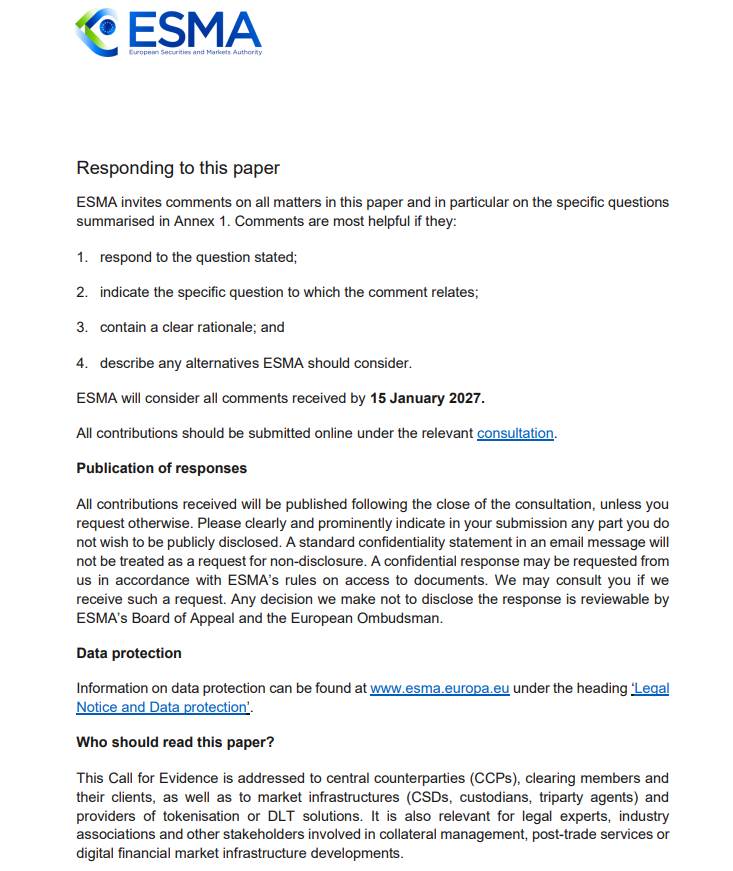 performs during periods of market stress. It is also reviewing whether existing requirements can accommodate these arrangements. Legal certainty, liquidity and operational controls must remain intact.
EU crypto regulatory review focuses on clearing house collateral risk
ESMA's formal consultation reviewed how tokenization affects assets in the liquidation process. Regulators focus on collateral transfers, custody arrangements, ownership protection and liquidation procedures. EU crypto regulation: deadline for consultation on tokenized collateral| Source: ESMA
Under the European Market Infrastructure Regulation (EMIR), clearing houses must maintain reliable access to eligible collateral. These institutions collect margin deposits and default fund contributions to manage exposure if a counterparty defaults.
However, when blockchain infrastructure supports collateral transfers, EU crypto regulation faces additional questions. ESMA asked whether tokenized securities could maintain their liquidity during periods of market stress or settlement disruption.
The consultation did not propose to expand the categories of collateral for qualified clearing houses. Instead, ESMA sought evidence of applying existing safeguards to assets represented through distributed ledger technology (DLT).
How should tokenized collateral work during default?
Clearing member default is the most stringent test for any collateral arrangement. ESMA asked whether central counterparties could access, transfer and convert tokenized collateral into liquidity when needed. It also wants to provide feedback on operational and legal dependencies that may affect these actions.
Central counterparty collateral must remain of high quality, legally enforceable, highly liquid and operationally available. These requirements apply not only to normal conditions, but also to stressful markets. ESMA is reviewing whether tokenization will change the risk profile of qualified collateral under existing rules.
EU crypto regulatory advice also covers customer protection and isolation issues. It asks customer assets how to remain identifiable, controlled and protected in different models. ESMA wanted to know whether technical separation on the ledger would provide the same protection as legal separation.
Settlement finality is another key issue. The agency is reviewing whether collateral transfers can be finalized and irrevocable when distributed ledger technology is connected to established market infrastructure. It also asked whether customers could quickly move positions and collateral after a member defaults.
EU crypto regulation becomes focus as ESMA sets a January deadline
ESMA invites clearing houses, custodians, clearing members, infrastructure operators and technology providers to submit evidence. The consultation required information on liquidity, settlement finality, operational resilience and legal protection.
Regulators also reviewed how the automated margin process affects liquidity requirements during periods of market stress. Faster collateral transfers can improve efficiency but will not eliminate potential credit, operational or settlement risks.
这些问题可能会塑造未来用于中央清算的代币化抵押品的欧盟加密监管。然而,ESMA尚未提出新的约束性要求,也未宣布修改现有的抵押品资格规则。
监管机构将接受截至2027年1月15日的咨询回复。ESMA计划于2027年第一季度评估行业反馈,然后决定下一步行动。