Exchange Ranking
 Top Exchanges
 24h Volume Ranking
 Popularity Ranking
 Exchange BTC Balance
 Proof of Reserves
 Decentralized Exchanges
 Funding Rate
 Funding Heatmap
 Liquidation Data
 Max Pain
 Long/Short Ratio
 Whale L/S Ratio
 Binance/Okex/Huobi L/S
 Bitfinex Margin L/S
 ETF Tracker
 Solana ETF
 XRP ETF
 Hong Kong ETF
 Bitcoin Treasuries
 Crypto Reversal
 Ethereum Reserves
 HyperLiquid Wallet Analysis
 Hyperliquid Whale Watch
 Large Transactions
 On-chain Movement
 Bitcoin ROI
 Stablecoin Market Cap
 Options Analysis
 News
 Articles
 Economic Calendar
 Features
 Wallet
 Contract Calculator


 Security
 Collections
 Watchlist
 Following
At a time when stable coin payments, on-chain settlements, and account abstractions are being rapidly implemented, the idea of “encrypted credit cards” is being reexamined. Many experts believe that encrypted cards are merely transitional measures: they have indeed helped encrypted assets enter everyday consumption scenarios, but ultimately, they still rely on traditional banking institutions and existing payment systems. As on-chain payments, borderless transfers, and compliant stable coins become more widespread, perhaps we won’t need a card to facilitate transactions in the future.

All encrypted card companies will eventually disappear.
In the long run, encrypted card companies are likely to decline, but traditional bank cards won’t do the same. Encrypting cards actually adds an additional layer of abstraction—they aren’t truly effective as means of cryptocurrency transactions. The issuers of these cards remain banks. Although these cards may have different designs, logos, or user experiences, they are essentially just an abstraction of the original system. Abstraction certainly makes the user experience smoother, but the underlying processes remain unchanged.
Currently, various Level 1 blockchains and Rollup solutions are eager to compare their transaction processing capabilities with Visa and Mastercard. For years, their goal has been to “replace” or even “overpower” Visa, Mastercard, American Express, and other payment processing institutions.
But this goal cannot be achieved through encrypted cards. Encrypting cards cannot replace existing payment networks; instead, they add more value to companies like Visa and Mastercard.
● Traditional payment networks like Visa and Mastercard remain crucial “gatekeepers,” as they have the power to set rules and define compliance standards.
● More importantly, they still retain the right to ban your card, block your company, or even restrict banks that work with you.
Therefore, encrypted cards are not the ultimate solution for the future of payments. They serve more as a transitional tool, eventually being replaced by more pure and decentralized technologies.
The crypto industry has always pursued “permissionless” and “decentralized” approaches. So why are they now willing to hand over these aspects to payment processors?
1. Your card is a Visa card, not an Ethereum card;
2. Your card comes from a traditional bank, not MetaMask;
3. You still use fiat currency, not cryptocurrencies.
In fact, most of the “encrypted card” companies you’re familiar with do nothing beyond printing their logos on the cards. They rely on hype and publicity, and may disappear within a few years. Even the digital cards issued today might become unusable by 2030.
Creating encrypted cards has become increasingly simple.
Nowadays, it’s very easy to create one’s own encrypted cards. In fact, in the future, you can even make such cards yourself!
The same problems exist, along with additional costs.
The best analogy I can think of is “app-specific sequencing” (ASS). Yes, the idea of apps being able to process transactions and earn money from them sounds great, but this is only a temporary phenomenon. Infrastructure costs are decreasing, communication technologies are becoming more advanced, but economic issues still lie at a higher level, not lower ones.
The same applies to encrypted cards: yes, you can deposit cryptocurrency and then convert it into fiat currency for payment purposes. But centralization and the need for authorized access remain issues.
It’s undeniable that encrypted cards are useful in the short term: retailers don’t need to adopt new payment methods, and cryptocurrency transactions become more “invisible”. However, this is just a transitional stage toward the real goal of those who believe in cryptocurrency.
● Required: Direct payment using stablecoins, Solana, Ethereum, Zcash, etc.
● Not required: Indirect payment methods involving USDT → encrypted cards → banks → fiat currency.
Every additional layer of abstraction means more costs: exchange rate fees, withdrawal fees, transfer fees, and even share profits from custody services. These costs may seem insignificant, but they accumulate over time – “Every penny saved is a penny earned.”
Encryption cards may be a short-term solution, but in the long run, they are not the ultimate answer to decentralized payment systems.
Using encryption cards does not mean that users are “unbanked” or “bankless”.
There is a common belief that people who use encryption cards are “unbanked” or “bankless”. But this is not true. Banks still exist behind encryption cards, and banks need to report certain information about their customers to the governments of the countries they operate in. Of course, not all data is reported, but at least some information is shared.
If you are a citizen or resident of the EU, the government will have access to information such as interest income from your bank accounts, suspicious transactions, certain investment earnings, and account balances. If the underlying bank is American, they will have even more information.
From the perspective of cryptocurrencies, this situation has both advantages and disadvantages.
● Advantages: Transparency and verifiability are improved, but these rules also apply to standard debit cards or credit cards issued by local banks.
● Disadvantages: It neither provides anonymity nor pseudo-anonymity. Banks still know your real name, not an EVM (Ethereum Virtual Machine) or SVM (Solana Virtual Machine) address.
Additionally, KYC (Know Your Customer) procedures are still required.
Restrictions still exist.
Some people might say that the advantage of encrypted cards lies in their convenience: you can download the app, complete the KYC process, wait for 1-2 minutes for verification, then top up with cryptocurrency, and be ready to use them right away. Indeed, this convenience is a significant advantage, but it isn’t available to everyone. In countries like Russia, Ukraine, Syria, Iraq, Iran, Myanmar, Lebanon, Afghanistan, and most of Africa, citizens without residency status in other countries cannot use cryptocurrency for everyday transactions. But you might argue that this applies only to 10-20 countries. What about the remaining 150+ countries? The issue isn’t whether “most people” can use these cards, but rather the core values of cryptocurrency: a decentralized network, equal access for all nodes, equal financial opportunities, and equal rights for everyone. Encrypted cards don’t align with these values, as they aren’t truly cryptocurrency products at all. Max Karpis has explained perfectly why “neobanks” are doomed to fail in their early stages. In fact, the only time I actually used cryptocurrency payment was when booking flights on Trip.com. They recently added a stablecoin payment option, allowing payments directly from wallets, and this method is available to anyone around the world.I highly recommend using Trip.com instead of Booking to experience true cryptocurrency payments. Here, you can find a real application scenario for cryptocurrencies and a seamless payment experience. I believe that in the future, wallets will have an optimized user experience for payments and transactions. Alternatively, they might evolve into “crypto cards” if cryptocurrency payments become more widespread.
Crypto cards function similarly to cross-chain bridges
. Another interesting observation is that self-custodial crypto cards function very much like cross-chain bridges.
● This applies only to self-custodial cards: cards issued by centralized exchanges are not considered self-custodial cards. Therefore, exchanges like Coinbase have no obligation to mislead users into thinking that their funds are completely under their control.
● One useful use case for CEX cards is providing funding for government projects, visa applications, or similar activities. When using a crypto card tied to your CEX balance, technically, you remain part of the same ecosystem.
But with self-custodial crypto cards, things are different: their functionality is similar to that of cross-chain bridges. In this case, you lock your funds (cryptocurrencies) in Chain A, while unlocking them as fiat currency in Chain B.
This bridging mechanism serves as a valuable link between native cryptocurrency users and businesses that want to issue their own cards. It’s like shovels during the Gold Rush in California—they served as a means of connecting people who wanted to use cryptocurrencies with those who wanted to issue their own digital currencies.
stablewatchHQ对这种桥接机制进行了深入分析,将其本质上定义为一种“卡片即服务”(Card-as-a-Service,CaaS)模式。这是许多人讨论加密卡片时最容易忽视的一个关键点。这些CaaS平台提供了发行自有品牌卡片的基础设施。
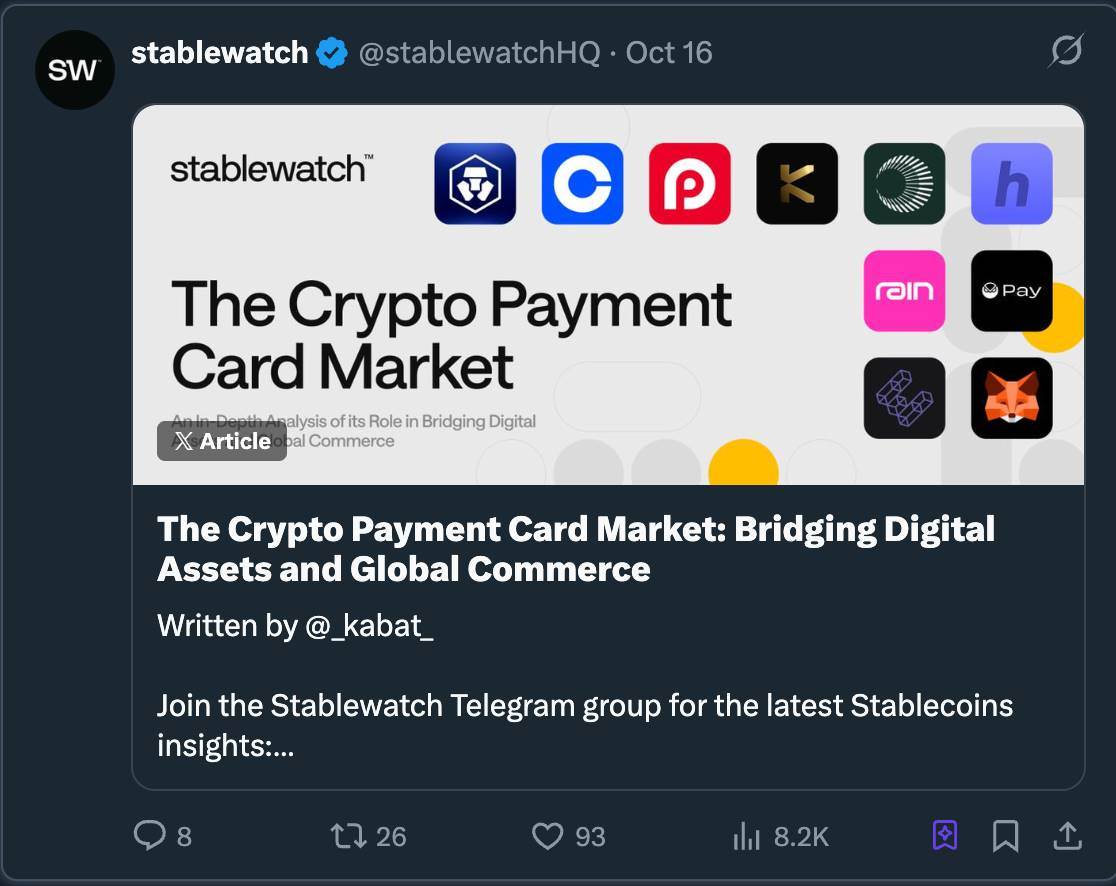
Rain:加密卡片背后的核心协议
你可能不知道,你最喜欢的加密卡片中有一半可能是由 raincards支持的。Rain是新兴银行(neobank)系统中最基础的协议之一,因为它几乎承担了加密卡片背后的所有技术支持。那些加密卡片公司所做的,只不过是在卡片上加上自己的品牌标志而已(虽然听起来有些苛刻,但这就是事实的真相)。
为了帮助你理解Rain的运作原理以及设置加密卡片有多简单,我特意制作了这张图表。
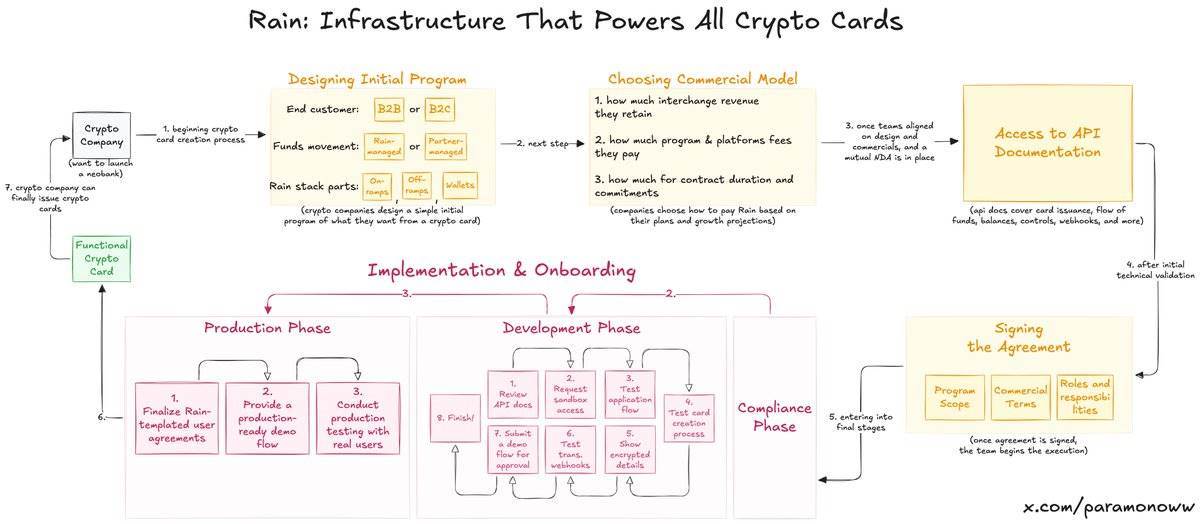
(放大后能看得更清楚。)
Rain赋能企业发行自己的加密卡片,坦白说,Rain的执行模式甚至可以超越加密货币领域,成为更广泛的基础设施。因此,不要误以为团队需要筹集数千万美元才能推出一款加密卡片。他们并不需要这些,他们只需要Rain。
The reason I mention Rain multiple times is that people generally underestimate the effort required to implement encrypted cards. Maybe in the future, I will write an article specifically about Rain, because this technology has been seriously underestimated.
Encrypted cards offer no privacy or anonymity at all.
The lack of privacy or anonymity in encrypted cards isn’t a problem with the cards themselves, but rather a result of those who promote encrypted cards while hiding behind the so-called “encryption value” and ignoring this issue.
In the world of cryptocurrencies, privacy isn’t a widely used feature. Pseudo-privacy exists because we can’t see names, only addresses.
But if you’re ZachXBT, Igor Igamberdiev from Wintermute, Storm from Paradigm, or anyone else with powerful on-chain skills, then you can greatly reduce the difficulty of determining who owns a particular address.
Of course, compared to traditional cryptocurrencies, encrypted cards don’t provide any real protection against pseudo-privacy. This is because when you activate an encrypted card, KYC verification is required (since you’re not actually using the encrypted card itself, but rather a bank account).
● If you’re located within the European Union, your cryptocurrency card provider may still send some of your data to the government for tax purposes or other reasons.
● Now, you give the authorities another opportunity to track you: by linking your cryptocurrency address to your real identity.
Future currencies: personal data?
Cash still exists as the only anonymous payment method available, with sellers being the only ones who can see your transactions. This will continue for a long time to come. But eventually, everything will transition towards digital payments. Current digital payment systems don’t protect consumers’ privacy at all: the more you spend, the higher the fees, and in return, they gain more insight into you. This arrangement is truly “cost-effective”!
Privacy has become a luxury nowadays, and this situation will continue in the ecosystem of encrypted cards. There’s an interesting idea: if we can achieve true privacy protection, even to the point where businesses and organizations are willing to pay for it (not by using users’ data like Facebook, but based on their consent), then privacy could become a form of currency in the future. Even in a world without jobs, driven by AI, privacy could still be the only form of currency.
If the prospects for encrypted cards are uncertain, why develop Tempo, Arc Plasma, and Stable?
The answer is simple: to keep users locked within the ecosystem.
Most non-custodial cards choose to use L2 networks (such as MetaMask on LineaBuild) or independent L1 networks (like Plasma Card uses Plasma). Due to high costs and long transaction confirmation times, Ethereum and Bitcoin aren’t suitable for such operations. While some cards use Solana, it remains a minority at present (and this isn’t meant to spark another debate here).
Of course, companies choose different blockchain platforms not only due to infrastructural reasons, but also considering economic benefits. For example, MetaMask chose Linea instead of other faster or more secure alternatives, because both Linea and MetaMask are part of ConsenSys’ larger ecosystem.
I specifically mentioned MetaMask as an example, because it decided to use Linea. As most people know, hardly anyone actually uses Linea at all. Its competitive edge compared to other L2 platforms like Base or Arbitrum is very limited.
But ConsenSys made a smart decision by using Linea as the underlying support for its tokens, as this helps to keep users locked within the ecosystem. By providing a good user experience, users gradually become accustomed to using Linea, without having to use it every day. In this way, Linea naturally attracts liquidity, trading volume, and other metrics, rather than relying on liquidity mining or forcing users to use cross-chain bridges.
This strategy is similar to what Apple did when it introduced the iPhone in 2007: by keeping users on the iOS system, they gradually became accustomed to it so that it became difficult to switch to other ecosystems. Never underestimate the power of habit.
EtherFi: The only cryptocurrency token that truly embodies the spirit of cryptography
After some thought, I conclude that EtherFi might be the only truly viable cryptocurrency token that fully reflects the core principles of cryptocurrencies. (This research was not sponsored by EtherFi, but even if it were, I wouldn’t mind.)
在大多数加密卡片中,你存入的加密货币会被卖掉,然后将余额以现金形式充值(类似于我之前提到的流动性桥模型)。
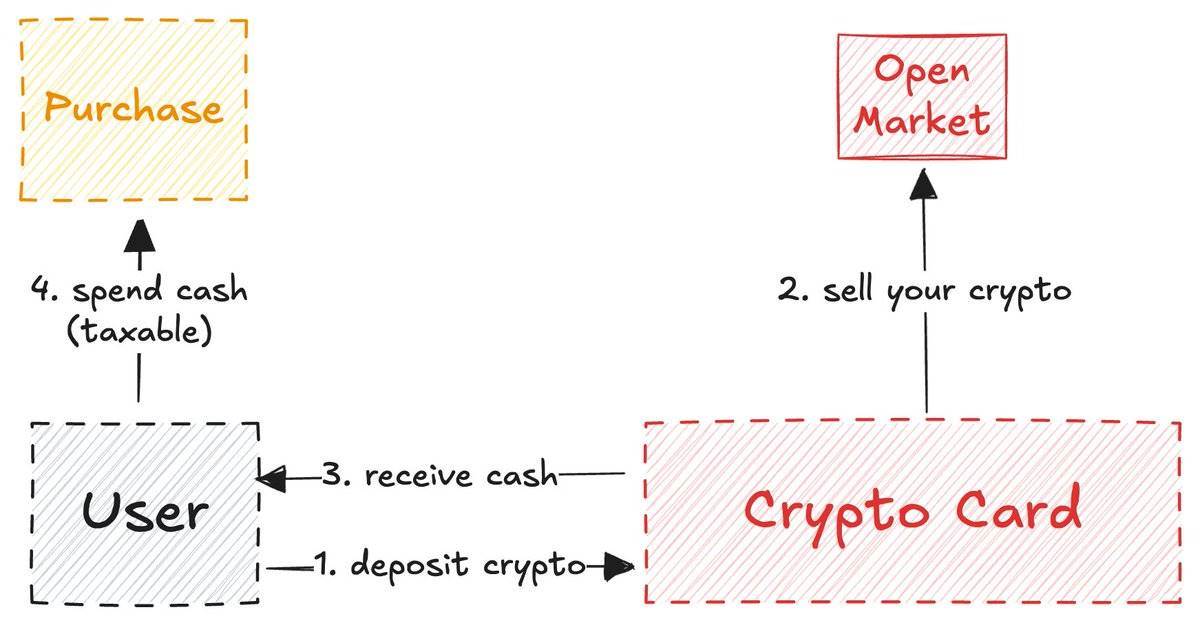
而EtherFi不同:它从不出售你的加密货币,而是以你的加密货币作为抵押,给你提供现金贷款,同时利用你的加密资产赚取收益。
EtherFi的模式与Aave类似。大多数DeFi用户都希望能无缝地通过加密资产获得现金贷款,而EtherFi已经实现了这一点。你可能会问:“这和普通加密卡片有什么不同?我也可以充值加密货币,然后像普通借记卡一样使用加密卡片,这一步额外的操作似乎没必要。”
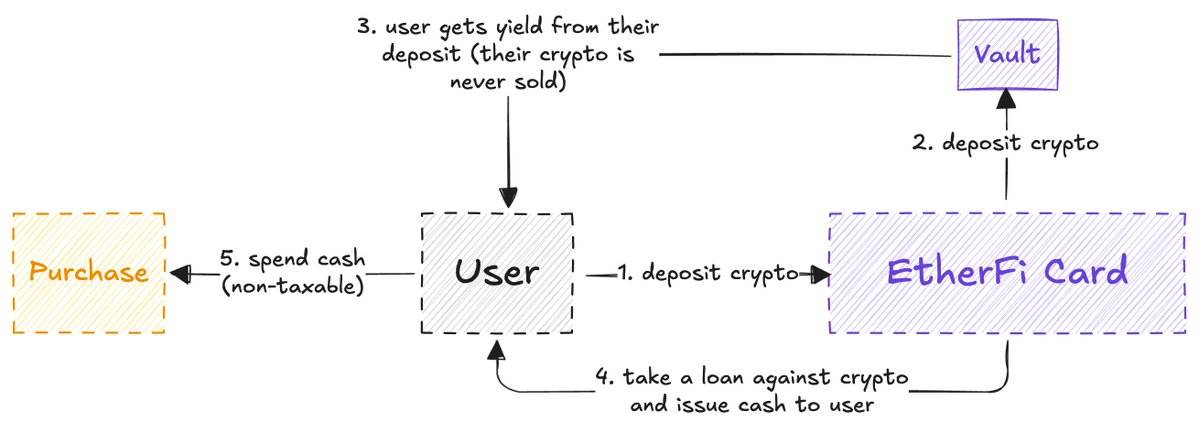
简单来说,区别在于税收问题:出售你的加密货币是一种应税行为,有时甚至比日常消费的税负更高。而对于大多数加密卡片来说,每次操作都会被征税,最终你需要向政府支付更多税款。(再次强调,使用加密卡片并不意味着“去银行化”。)
● EtherFi在这一点上有所改进,因为你并未真正出售你的加密货币,而是通过它获得贷款。
● 仅凭这一点(再加上无美元外汇费用、返现和其他福利),EtherFi就成为了DeFi和TradFi(传统金融)交汇的最佳范例。
Most encrypted cards attempt to appear as “fully encrypted solutions,” but in reality, they’re merely platforms for facilitating transactions. EtherFi, on the other hand, aims to serve encrypted users rather than simply promoting cryptocurrencies to the general public. Their strategy is to bring cryptocurrencies to local users, allowing them to use them in everyday transactions, until the public realizes how cool this approach really is.
Among all encrypted cards, EtherFi might be the only product that can stand the test of time.
I prefer to view encrypted cards as a testing ground for new technologies. Unfortunately, most teams simply use these tools for marketing purposes, without giving enough recognition to the underlying systems and developers involved.
Let’s wait and see where technological progress and innovation will lead us. Currently, the encrypted card industry is indeed expanding through horizontal growth, but there’s little progress in vertical growth. For early-stage technologies like encrypted cards, which focus on payment processing, vertical growth is crucial.