Exchange Ranking
 Top Exchanges
 24h Volume Ranking
 Popularity Ranking
 Exchange BTC Balance
 Proof of Reserves
 Decentralized Exchanges
 Funding Rate
 Funding Heatmap
 Liquidation Data
 Max Pain
 Long/Short Ratio
 Whale L/S Ratio
 Binance/Okex/Huobi L/S
 Bitfinex Margin L/S
 ETF Tracker
 Solana ETF
 XRP ETF
 Hong Kong ETF
 Bitcoin Treasuries
 Crypto Reversal
 Ethereum Reserves
 HyperLiquid Wallet Analysis
 Hyperliquid Whale Watch
 Large Transactions
 On-chain Movement
 Bitcoin ROI
 Stablecoin Market Cap
 Options Analysis
 News
 Articles
 Economic Calendar
 Features
 Wallet
 Contract Calculator


 Security
 Collections
 Watchlist
 Following
 BTC
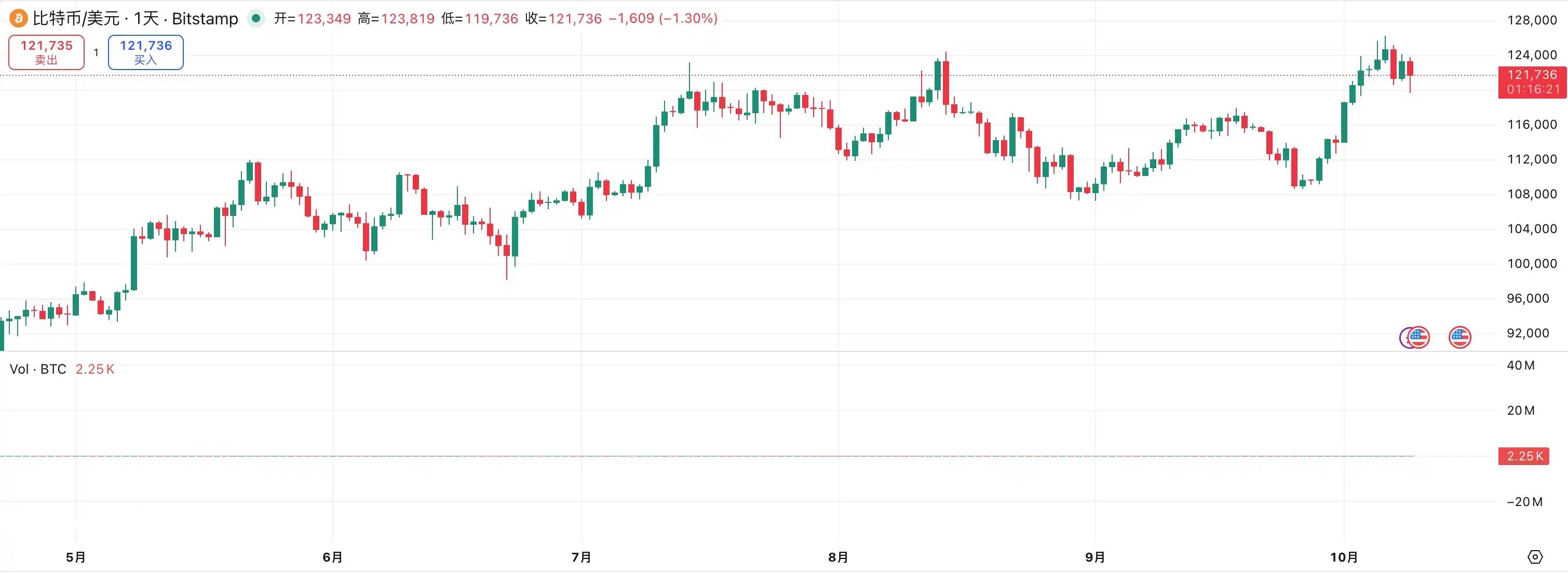
比特币在10月6日再次爆发,直接冲破125,000美元大关,刷新历史新高,整个市场瞬间进入一波狂热期。随着BTC的飙升,Aster、BNB等主流山寨币也跟着大涨,BSC链上的流动性迅速回流,市场氛围热度飙升到年内顶峰。之前因为美国政府停摆带来的短暂下跌,现在已经被这一波「FOMO式行情」彻底吞没,投资者的情绪也被彻底点燃。
从宏观面来看,宽松预期正在为风险资产提供坚实支撑。根据 CME FedWatch 数据,截至目前,10 月与 12 月降息概率分别高达 94.1% 与 84%。市场普遍认为,美联储已进入政策拐点前的「预沟通阶段」,财政与流动性双宽松成为主旋律。伴随美国劳动力市场疲软、债务上限压力缓解、财政部持续放水,美元实际利率出现回落迹象,资金正加速撤离货币市场,重新流入股票与加密资产。本轮上涨既是对降息预期与流动性重启的提前反应,也是一次典型的「资金驱动型牛市」。
接下来,律动 BlockBeats 整理了交易员们对接下的市场情况的看法,为大家本周的交易做出一些方向参考。
@CryptoHayes
Arthur Hayes discussed in his latest article “Long Live the King” the logical patterns behind Bitcoin’s price cycles. He proposed that the “four-year halving cycle is no longer effective,” and instead, liquidity cycles should be considered more important. He pointed out that the three major turning points in Bitcoin’s price history were actually caused by changes in the liquidity of the US dollar and the RMB, rather than changes in block rewards. From 2009 to 2013, the Federal Reserve implemented quantitative easing measures, along with China’s credit stimulus, which contributed to the emergence of Bitcoin and its first bull market. From 2013 to 2017, China’s rapid increase in credit led to a surge in ICOs, until the monetary bubble burst. From 2017 to 2021, the “quantitative easing” policies during the Trump and Biden administrations resulted in the largest liquidity expansion in history, pushing Bitcoin to record highs.
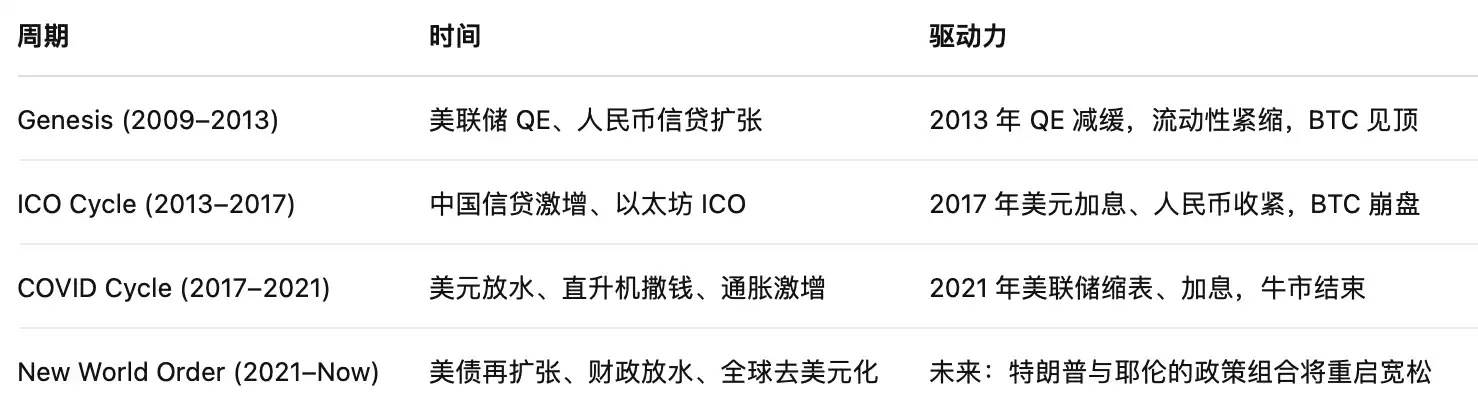
By 2025, Hayes believes that the world is returning to a period of “easy monetary policy.” The U.S. Treasury Department has released trillions of dollars in liquidity through the issuance of short-term government bonds, while the Federal Reserve is forced to lower interest rates due to high inflation. In China, under the pressure of the real estate crisis and deflation, credit policies have been relaxed again, stimulating domestic demand. With such loose monetary conditions in both economies, funds will inevitably flow back into risk assets.
@Jackyi_ld
Liquid Capital founder Yi Lihua wrote that a major buying opportunity is approaching. It’s important to wait out the noise and seize good opportunities. Sell when everyone is buying, and buy when no one is interested. Focus on valuable assets and increase your holdings. In the cryptocurrency market, there are three key assets that can outperform traditional cycles: public chains (BTC, ETH, etc.), exchanges (BNB, Aster, etc.), and stablecoins (WLFI, TDA Equity, etc.).
@Phyrex_Ni
The rise in the risk markets this round is essentially a result of market participants “overstretching” their expectations regarding a possible Fed easing policy. The government shutdown and Trump’s job cuts have led investors to expect interest rate cuts in October. As a result, stocks, cryptocurrencies, and gold all witnessed increases. However, this kind of market movement is more driven by emotions rather than real economic factors. In reality, the Fed remains in a high-interest-rate environment. Inflation is sticky, wage growth has slowed, and purchasing power has declined. Weak labor market data further highlights the structural risks facing the economy. At the macro level, the U.S. fiscal deficit continues to widen, leading to an increase in bond yields and the dollar index. Gold prices also strengthen, indicating that global funds are seeking safe havens like the dollar, while at the same time, there is growing skepticism about the U.S.’s long-term solvency. In the short term, the data vacuum caused by the shutdown will continue to foster optimism, and funds may continue to flow into risky assets. But this is merely a “false prosperity” without any real data behind it. Once inflation data returns to high levels, the Fed will be forced to tighten policies, and the market could experience a sudden turn. @Corsica267
The current economic problems in the U.S. stem from the structural contradiction between weak demand and high debt. Long-term low interest rates and improved productivity have reduced investment returns, widening the gap between rich and poor. Additionally, aging demographics and slowing consumption have further dampened growth momentum. Facing this dilemma of “high debt + low growth,” Secretary of the Treasury Betsy Deresso is using “financial repression” strategies to address the debt issue: setting rigid interest rate ceilings, tolerating inflation, and attracting passive buyers, thereby ensuring that nominal economic growth exceeds financing costs, thereby “shedding” the debt burden.
This has led to a situation where “nominal interest rate cuts do not necessarily mean real easing”. Even when the Federal Reserve cuts interest rates, if inflation expectations decline faster than expected, real interest rates may actually increase, leading to a passive tightening of monetary policy. Currently, the roles of the Federal Reserve and the Treasury Department are as follows: the former focuses on stabilizing the economy, while the latter focuses on stabilizing government bonds. The Treasury uses fiscal stimulus to support asset prices, while the Federal Reserve must make difficult choices between employment and inflation. At the asset level, tech stocks and gold can both experience increases. Tech stocks benefit from lower discount rates and long-term growth prospects, creating a “productive bubble”; gold, on the other hand, benefits from both lower real interest rates and increased institutional uncertainty, resulting in a “dual premium”. This joint rise in prices reflects a consensus among investors during times of financial repression—capital expects real returns to decline, while safe-haven assets and growth opportunities become the only certainties. Future trends will depend on whether inflation is controlled and fiscal repression continues, allowing risk assets and gold to remain supportive. If inflation rises again and real interest rates increase, bubbles will be forced to burst. In short, this is an era where financial repression is used to drive growth, and institutional premiums support assets. Prosperity and risks coexist; high valuations often coincide with low levels of institutional trust. @JPMorgan
JPMorgan analysts stated in their report dated October 1st that Bitcoin is expected to continue rising. The reason for this is the resurgence of what’s known as “currency devaluation trading” – i.e., retail investors and institutional investors, facing concerns over geopolitical uncertainties, high global debt levels, and a weakening dominance of the US dollar, have turned to investing in gold and Bitcoin as a way to hedge their risks.
On a broader scale, recent developments in the crypto industry indicate that it is gradually integrating into the mainstream financial system. This includes the launch of several new crypto ETFs, as well as the rise of “crypto treasury stocks”, indicating a growing acceptance and participation by capital markets in this sector.